Grammar A2 Compound Nouns

Compound noun plurals — which word takes -s?

Compound noun plurals — which word takes -s?

What is a compound noun?

A compound noun is a noun made from two or more words joined together. These words can be written as one word, two words, or with a hyphen. Examples include toothbrush, mother-in-law, and living room. When you make a compound noun plural, you need to know which word gets the -s ending. This depends on the type of compound noun.

The main rule: pluralize the most important word

In most compound nouns, you add -s to the main word — the word that is most important for the meaning. Usually, this is the first word. For example, in toothbrush, the main word is tooth, so we write toothbrushes. In living room, the main word is room, so we write living rooms. However, in compound nouns with hyphens like mother-in-law, the first word is the main word, so we write mothers-in-law.

Special cases to remember

Some compound nouns are written as one word and only get one -s at the end: notebook → notebooks, playground → playgrounds, and bedroom → bedrooms. Other compound nouns like man and woman change their first word completely: policeman → policemen, and woman driver → women drivers. When you are unsure, remember to add -s to the most important word in the compound noun.

Which word takes -s? A step-by-step guide

Follow these four simple steps to determine which word in a compound noun takes the plural -s ending.
Step 1: Identify the head noun
The head noun is the main noun that determines what the compound refers to. It is usually the most important word in meaning. For example, in "mother-in-law," the head noun is "mother" (you are pluralizing the person), not "law."
Step 2: Check if the compound is written as one word, hyphenated, or two words
Most compounds written as one word (bookcase, textbook) pluralize the last word: bookcases, textbooks. Hyphenated compounds and compounds with spaces typically pluralize the head noun instead.
Step 3: Apply the head noun rule for hyphenated and spaced compounds
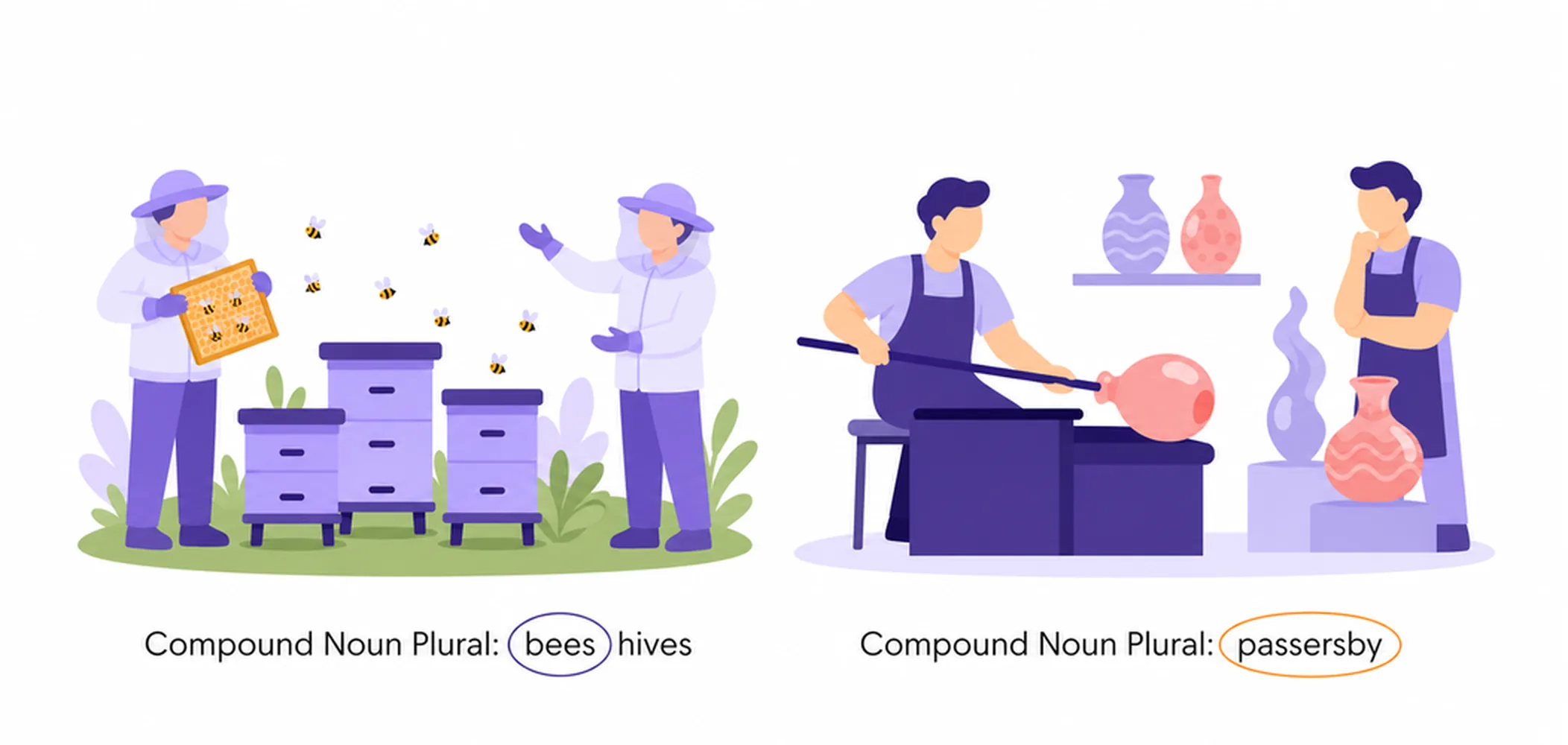
In hyphenated or two-word compounds, add -s or -es to the head noun (the most meaningful word), not necessarily the last word. Examples: mothers-in-law, court-martials, runners-up, passersby.
Step 4: Check for irregular plurals
Some compound nouns have irregular plural forms that do not follow standard rules. For instance, "is" does not become "ises"—instead, "is" itself changes (though this is rare in modern English). Always verify with a dictionary if unsure.
Compound Type Rule Examples
One word Pluralize the last word textbooks, bedrooms, notebooks
Hyphenated Pluralize the head noun (usually first word) mothers-in-law, editors-in-chief, courts-martial
Two words (spaced) Pluralize the head noun (usually first word) attorneys general, runners-up, passersby
Noun + preposition + noun Pluralize the first noun (the head) commanders in chief, daughters-in-law, notaries public
Formula
Formula
One-word compound + + -s
notebook → notebooks

Examples

I need to buy three new toothbrushes for my family.
One word compound · Plural -s at end
My two sisters-in-law live in Australia.
Hyphenated compound · Main word pluralized
The living rooms in this hotel are very large.
Two-word compound · Second word pluralized
There are five policemen working at the station.
Man/woman compound · First word changes
The children are playing in the playgrounds near school.
One word compound · Regular plural
We saw three mother-in-law characters in the film.
Hyphenated compound · First word pluralized
When to use it
Describing homes
Use compound nouns like bedrooms, living rooms, and kitchens when talking about parts of a house. Knowing the correct plural helps you describe your home accurately.
"My apartment has two bedrooms and two bathrooms."
Family relationships
Compound nouns with hyphens like mother-in-law, father-in-law, and sister-in-law are common in family discussions. Remember to pluralize the first word only.
"I have three sisters-in-law and two brothers-in-law."
Occupations
Many job titles use man or woman. These change differently in the plural. Learn these special forms for talking about jobs.
"The policemen helped the firemen at the accident."
School and objects
Items found at school or in daily life often have compound noun names. Use correct plurals when shopping or organizing.
"I bought three notebooks and two pencil cases at the shop."
Signal words
compound noun main word first word pluralize hyphenated one-word compound two-word compound
Common Mistakes
Wrong
I need to buy new tooth brushes for my family.
Correct
I need to buy new toothbrushes for my family.
Toothbrush is a compound noun written as one word, so the plural adds -s only to the end, not to the first word.
Wrong
My brothers-in-laws are coming to visit.
Correct
My brothers-in-law are coming to visit.
In hyphenated compounds, pluralize only the first word, not the last.
Wrong
The livings rooms are clean.
Correct
The living rooms are clean.
The main word (room) gets -s, not the adjective (living).
Wrong
There are many woman doctors at the hospital.
Correct
There are many women doctors at the hospital.
When woman is part of a compound, it changes to women in the plural.
KEY TAKEAWAYS

What to Remember

  • A compound noun is made from two or more words written as one word, hyphenated, or separate.
  • When making compound nouns plural, add -s to the main word, usually the first word.
  • In noun + noun compounds like toothbrush, add -s to the first word: toothbrushes.
  • In compounds with adjectives or prepositions like mother-in-law, add -s to the main noun: mothers-in-law.
  • Check which word carries the main meaning to know which word takes the -s ending.
← Previous
Compound nouns — stress and pronunciation
Next →
Compound nouns — 100 most common