What are compound nouns?
A compound noun is made from two or more words joined together to create one new word with a single meaning. For example, 'sunflower' is a compound noun—it combines 'sun' and 'flower.' Compound nouns are very common in English and appear in three forms: written as one word (sunflower), as two separate words (ice cream), or with a hyphen (mother-in-law).
How do you stress compound nouns?
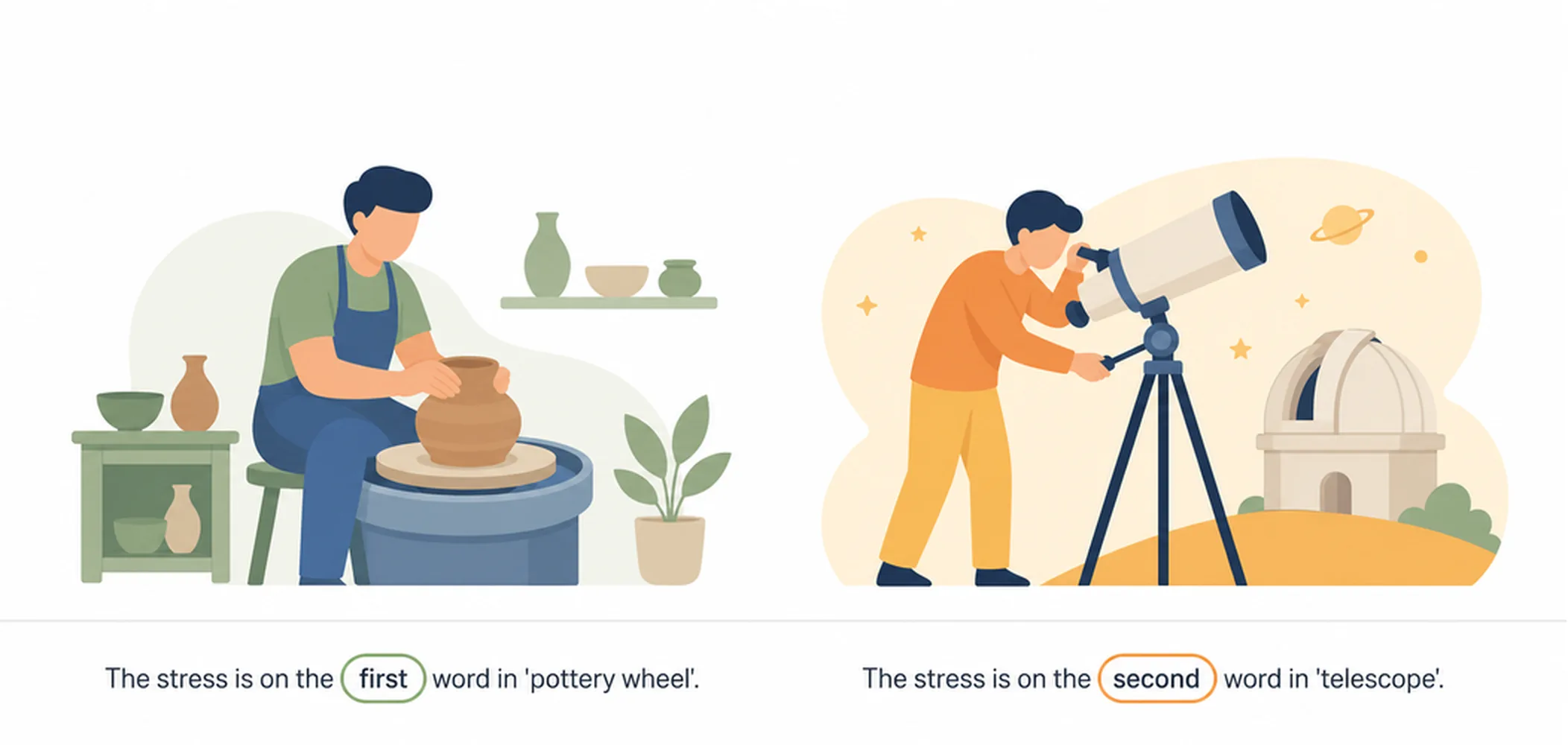
In English, compound nouns have word stress (emphasis on one part). Most compound nouns have PRIMARY STRESS on the first word. For example, in 'SUNflower,' the stress falls on 'SUN.' This pattern is important because it changes the meaning and pronunciation of the word. When you stress the wrong syllable, the word can sound wrong or confusing to native speakers.
Different stress patterns
Most one-word compound nouns (like 'basketball' and 'toothbrush') have stress on the first word: 'BASketball,' 'TOOTHbrush.' However, two-word compounds vary. 'Ice cream' and 'coffee cup' have equal stress on both words, or slight stress on the first. With hyphenated words like 'mother-in-law,' the stress usually falls on the first word: 'MOther-in-law.' Learning these patterns helps you speak English more naturally.
Compound Noun Stress Patterns at a Glance
| Form | Stress Pattern | Stress Marker | Example | Note |
|---|---|---|---|---|
| One word | Stress on first element | ˈ__ __ | FOOTball /ˈfʊt.bɔːl/ | Written and spoken as a single unit; most common compound form |
| Two words | Stress on first word | ˈ__ __ | POST office /ˈpəʊst ˌɒf.ɪs/ | Looks like a noun phrase but functions as one noun; stress distinguishes it from a modifier + noun |
| Hyphenated | Stress on first element | ˈ__-__ | CHECK-in /ˈtʃek.ɪn/ | Often transitional — may evolve into one word over time; hyphen clarifies reading |
Examples






What to Remember
- A compound noun combines two or more words to create one new word with a single meaning.
- Compound nouns appear in three forms: one word, two separate words, or hyphenated words.
- Most compound nouns have primary stress on the first word of the compound.
- Stress placement affects pronunciation and helps distinguish compound nouns from regular word combinations.
- Learning stress patterns helps you sound more natural and be better understood by speakers.