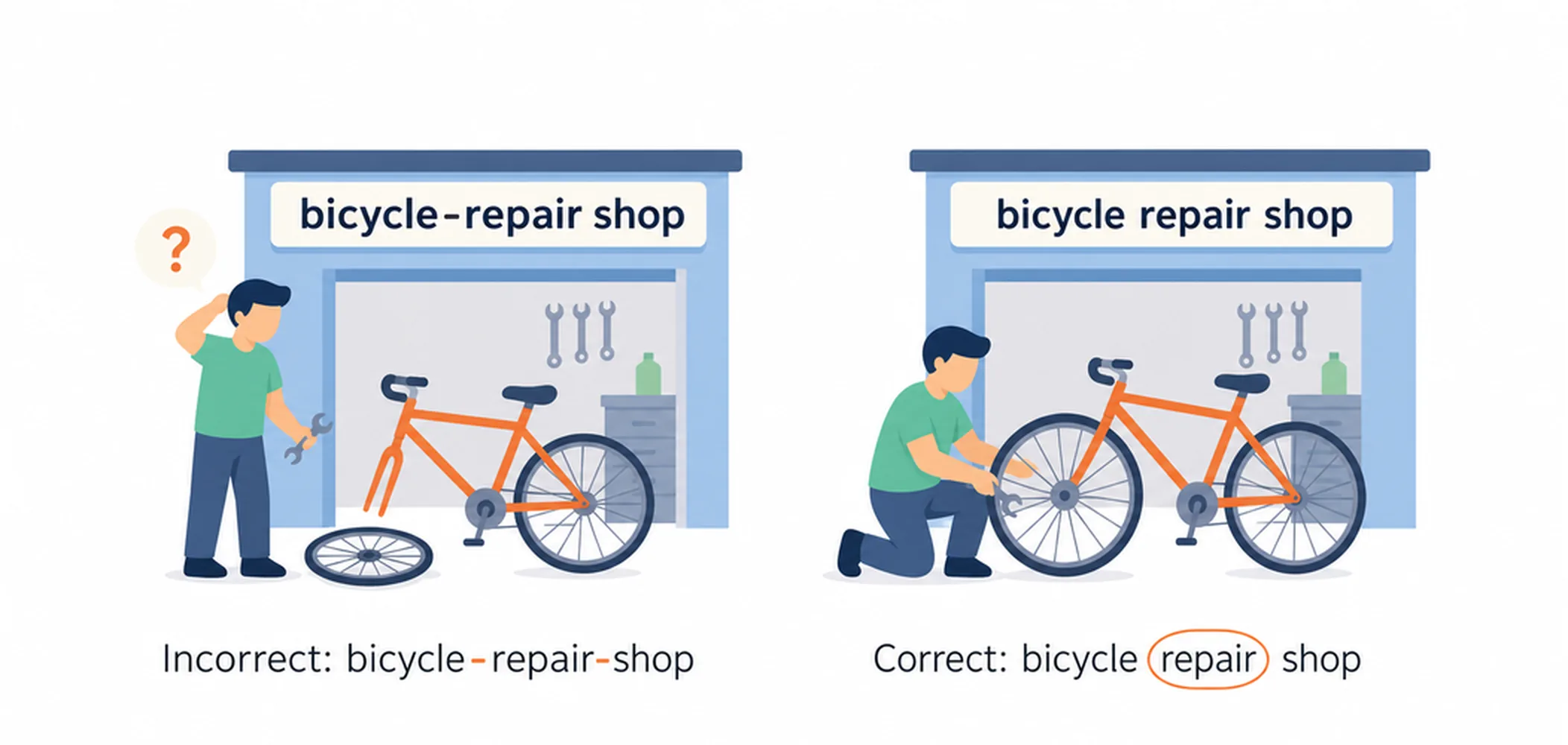
Why Compound Nouns Are Tricky
Compound nouns are words made from two or more words together. The problem is that English doesn't follow one rule — some compound nouns are written as one word, some as two words, and some with a hyphen. Learners often mix these up because their first language may work differently. This lesson shows you the most common mistakes and how to avoid them.
5 Common Compound Noun Mistakes
Here are the mistakes we see most often. Study each one carefully and check your own writing.
One Word, Two Words, or Hyphen?
| Category | Closed Form (One Word) | Open Form (Two Words) | Hyphenated Form |
|---|---|---|---|
| Form | Two or more words merged into a single word with no space or hyphen. | Two or more separate words written with a space between them. | Two or more words joined by a hyphen (–) to form a single unit. |
| When to Use | When the compound has been used so long it has fused into one word; common in everyday vocabulary. | When the compound is newer or less established, or when the meaning is still clearly compositional. | When the compound is used as a modifier before a noun, or when clarity requires linking the words together. |
| Positive Example |
notebook sunflower toothpaste basketball bedroom |
ice cream post office real estate living room full moon |
well-known self-esteem mother-in-law up-to-date long-term |
| Negative Example (Common Mistake) |
❌ note book (incorrectly split) ❌ sun flower (incorrectly split) ❌ tooth paste (incorrectly split) |
❌ icecream (incorrectly closed) ❌ postoffice (incorrectly closed) ❌ livingroom (incorrectly closed) |
❌ well known actor (missing hyphen before noun) ❌ motherinlaw (no hyphens) ❌ up to date report (missing hyphens as modifier) |
| Question Example | Is it one word or two? → Check a dictionary: football ✔ | Should these words be joined? → Not always: bus stop ✔ | Does it come before a noun it modifies? → Use a hyphen: a well-known fact ✔ |
| Key Signal Words / Clues | High frequency words; listed as one entry in the dictionary; meaning has shifted from the sum of its parts. | Noun + noun combinations; meaning still transparent; common in American and British English everyday speech. | Modifier + noun constructions; compounds with self-, ex-, -in-law; number + unit before a noun (e.g., five-year-old). |
| Key Difference: The written form of a compound noun — closed, open, or hyphenated — is not determined by a single fixed rule but by a combination of factors: how long the compound has existed in the language (older compounds tend to close up), how frequently it is used, whether it appears as a pre-noun modifier (favouring hyphenation), and regional or stylistic conventions. Because there is no universal rule, learners should consult a reliable dictionary and be consistent. When in doubt, the hyphenated form is often the safest choice for a compound used as an adjective before a noun. | |||
Examples
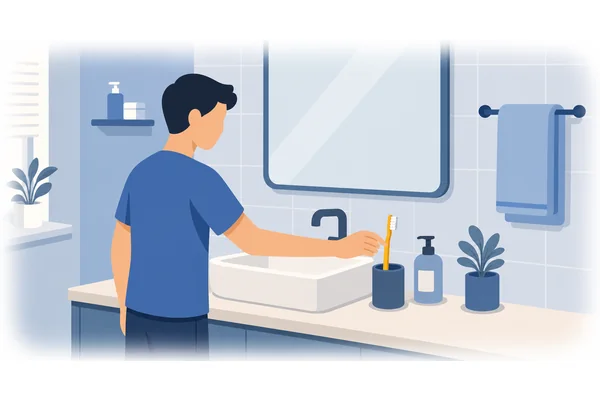
I have a toothbrush in my bathroom.
Common compound noun · One word · Noun

My brother-in-law is getting married next year.
Family compound noun · Hyphenated · Noun

The football team won the championship.
Two-word compound · Sports · Noun
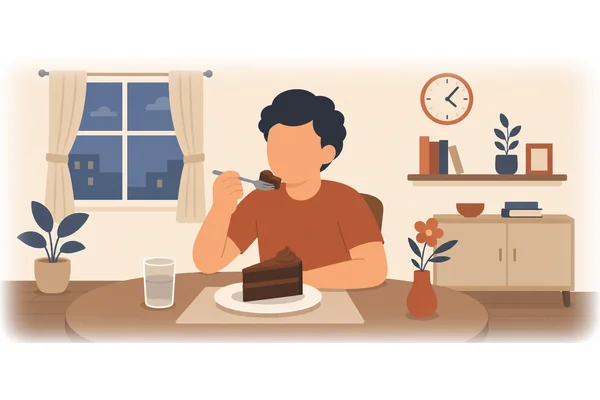
I like to eat a piece of chocolate cake after dinner.
Adjective + noun (not a true compound) · Food · Noun
When to use it
Family Relationships
Always use hyphens for family compound nouns like mother-in-law, sister-in-law, and father-in-law.
"My sister-in-law is a doctor."
Common Objects
Many everyday objects are written as one word: toothbrush, notebook, keyboard, backpack.
"Where is my backpack?"
School & Work
Some school and work compounds are one word (homework, classroom) and some are two words (living room, football field).
"The homework is easy today."
Signal words
Written as one word
Written as two words
Use a hyphen
Keep them separate
Join them together
Common Mistakes
✕
Wrong
I live in a book case.
✓
Correct
I live in a bookcase.
Compound nouns with 'book' are written as one word, not two. Bookcase, bookmark, bookstore.
✕
Wrong
My mother in law is very kind.
✓
Correct
My mother-in-law is very kind.
Family relationships with 'in-law' always need hyphens to show they are one compound noun.
✕
Wrong
I drink a coffee cup every morning.
✓
Correct
I drink a cup of coffee every morning.
Don't use 'coffee cup' as a compound noun here. Use 'cup of coffee' for the drink itself.
✕
Wrong
She works at the supermarket in the city center.
✓
Correct
She works at the supermarket in the city centre.
In compounds like 'city centre' (British English), keep the structure clear. Some compounds stay as two words.
✕
Wrong
I need a new door-key for my house.
✓
Correct
I need a new door key for my house.
Modern English prefers 'door key' as two words, not hyphenated. Hyphens are less common now in simple compounds.
✕
Wrong
The homework's are difficult.
✓
Correct
The homework is difficult.
Compound nouns like 'homework' are usually singular. Don't add apostrophes or extra letters.
✕
Wrong
I saw three white-houses on the street.
✓
Correct
I saw three white houses on the street.
Only use hyphens when two adjectives describe the noun together (well-known house). 'White house' is adjective + noun.
KEY TAKEAWAYS
What to Remember
- Compound nouns are made from two or more words combined together.
- English has no single rule: some compound nouns are one word, others are two.
- Some compound nouns use hyphens to connect the words together.
- Check a dictionary when unsure about spelling because English compound nouns are inconsistent.
- Your first language's rules may not apply to English compound noun spelling.