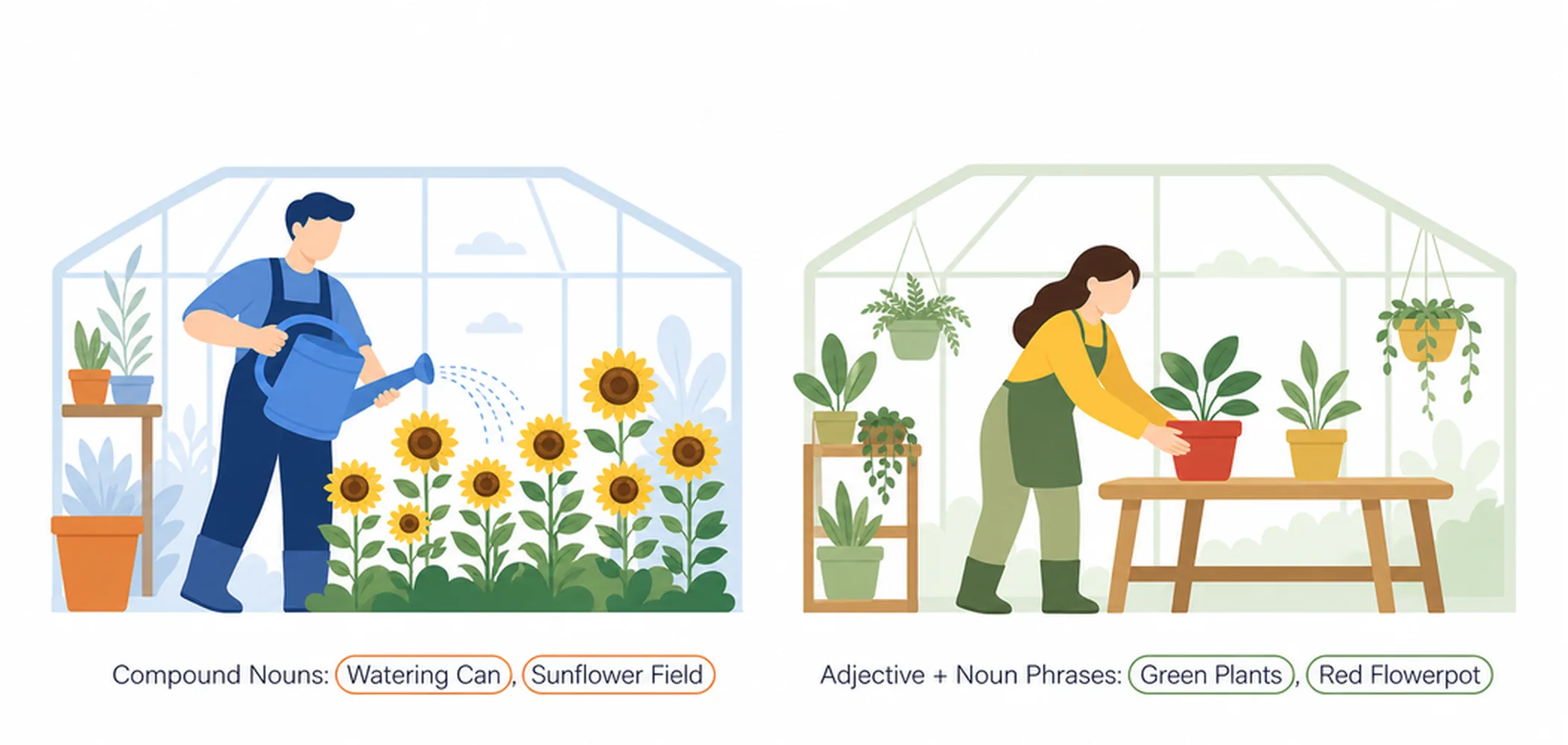
Compound Nouns vs Adjective + Noun Phrases
In English, we can describe things in two different ways. A compound noun is two or more words written together as one unit—like 'basketball' or 'bedroom'. An adjective + noun phrase uses separate words—like 'tall building' or 'cold water'. Understanding the difference helps you write correctly and speak naturally.
The Key Difference
Compound nouns are fixed combinations that create a single meaning. They are often written as one word or hyphenated. Adjective + noun phrases are flexible—you can use different adjectives before the same noun to describe different qualities. For example, 'football' is always one word, but you can say 'small football', 'red football', or 'expensive football'.
Compound Nouns vs Adjective + Noun Phrases: Side-by-Side Comparison
| Feature | Compound Noun | Adjective + Noun Phrase |
|---|---|---|
| Form | Two or more nouns (or other parts of speech) combined to form a single unit; written as one word, hyphenated, or two words. e.g., bookstore, ice cream, mother-in-law |
A descriptive adjective modifying a noun; always written as separate words; functions as a noun phrase rather than a fixed unit. e.g., big store, cold cream, elderly mother |
| When to Use | Use when two concepts have merged into a new, fixed meaning that refers to a specific type of thing, person, or place. The combination is conventional and must be memorised. | Use when a quality or characteristic is being described about a noun. The adjective can usually be replaced with another adjective without changing the basic category of the noun. |
| Meaning | The meaning is often specialised or idiomatic — it refers to a specific concept, not simply a noun described by another noun. e.g., greenhouse = a glass structure for growing plants (not just a green house) |
The meaning is compositional — the adjective straightforwardly describes a quality of the noun, and both words retain their individual meanings. e.g., green house = a house that is green in colour |
| Stress Pattern | Primary stress typically falls on the first element. e.g., GREENhouse, BLACKbird, ICEcream |
Stress is more balanced, with the main stress usually on the noun (the head). e.g., green HOUSE, black BIRD, cold CREAM |
| Spelling | Variable and must be checked in a dictionary — may appear as: • One word: toothpaste • Hyphenated: well-being • Two words: coffee table |
Always written as separate words with no hyphen or joining. e.g., comfortable chair, blue car, heavy rain |
| Flexibility & Modification | The first element cannot easily be replaced by a synonym without losing the specific meaning. The compound acts as a fixed, lexicalised unit. e.g., you cannot say *rainstorm → *precipitationstorm |
The adjective can be freely swapped for another without changing the noun's core category. Degree modifiers (very, quite) can be added to the adjective. e.g., a very heavy bag, an extremely cold day |
| Positive Example | She works at a bookshop. (a specific type of shop — fixed meaning) | She works at a busy shop. (describing a quality of the shop) |
| Negative Example | ❌ *She works at a very bookshop. (degree adverbs cannot modify the first element of a compound noun) |
❌ *She works at a busyshop. (adjective + noun phrases are never written as a single fused word) |
| Question / Test Example | Is sunflower a compound noun? ✅ Yes — SUNflower (stress on first element; specialised meaning: a specific plant) |
Is sunny day a compound noun? ❌ No — sunny DAY (stress on noun; sunny simply describes the day) |
| Key Signal Words / Clues | • Fixed, lexicalised meaning • Stress on first word • Listed in the dictionary as a unit • Cannot insert very before first element • First element is often a noun |
• Describes a quality (colour, size, opinion, etc.) • Stress on the noun • Accepts degree modifiers: very, quite, rather • Adjective can be graded: bigger, biggest • Always two separate words |
| Key Difference: A compound noun is a fixed lexical unit in which two or more elements combine to express a single, often specialised concept — identifiable by stress on the first element and a meaning that cannot be derived simply by adding the meanings of its parts (e.g., greenhouse ≠ a green house). An adjective + noun phrase, by contrast, is a free, compositional combination in which an adjective openly describes a property of the noun, stress falls on the noun, and the adjective can be freely replaced or modified with degree adverbs (e.g., a very green house). The same words may form either structure depending on stress, spacing, and intended meaning. | ||
Examples

I play basketball every Saturday.
Compound noun · A2 · Sport

My bedroom is very small.
Compound noun · A2 · Home

She wore a blue dress to the party.
Compound noun · A2 · Fashion

I bought a red apple at the market.
Adjective + noun · A2 · Food

The old woman walked slowly down the street.
Adjective + noun · A2 · People

He lives in a large house near the park.
Adjective + noun · A2 · Homes
When to use it
Fixed Objects & Things
Compound nouns are used for objects that always have the same name. These are established things with fixed meanings.
"I need a new toothbrush and a coffee cup for the kitchen."
Describing Qualities
Use adjective + noun when you want to describe how something looks, feels, or is. You can change the adjective.
"I want a hot coffee, not a cold coffee." or "She has a beautiful garden and a big house."
Flexibility
Adjective + noun combinations are flexible. You can add different adjectives to make different meanings.
"heavy box, light box, big box, small box, plastic box"
Signal words
written as one word
written separately
fixed meaning
flexible description
always the same
can change
Common Mistakes
✕
Wrong
I like to play the foot ball with my friends.
✓
Correct
I like to play football with my friends.
Football is a compound noun written as one word, not two separate words.
✕
Wrong
My tooth-brush is new.
✓
Correct
My toothbrush is new.
Toothbrush is a compound noun written as one word without a hyphen in modern English.
✕
Wrong
The black coffee hot is very nice.
✓
Correct
The hot black coffee is very nice.
When using adjectives + noun, put adjectives before the noun. Use adjective + adjective + noun order.
KEY TAKEAWAYS
What to Remember
- Compound nouns are written as one word or hyphenated, like 'basketball' or 'mother-in-law'.
- Adjective + noun phrases use separate words, like 'tall building' or 'cold water'.
- Compound nouns have a special meaning different from the individual words combined.
- Some compound nouns are written as two separate words, like 'ice cream'.
- Use adjective + noun when you want to describe a quality of something.