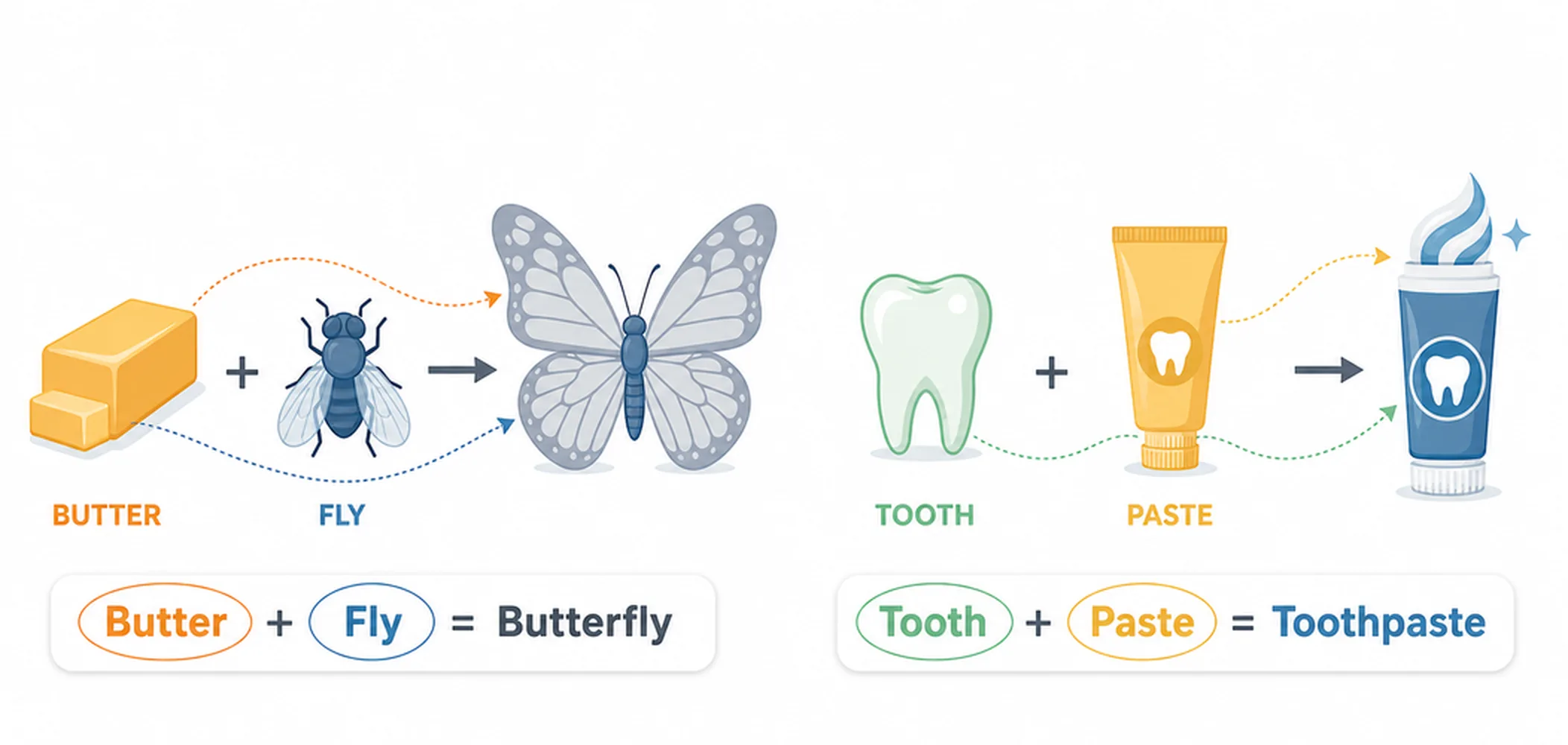
What are Compound Nouns?
A compound noun is made from two or more words that together create one meaning. When we combine two nouns, we create a new word with a new definition. For example, 'sun' and 'flower' together make 'sunflower' — a yellow flower that grows towards the sun. Compound nouns are very common in English and help us name things more clearly and specifically.
How to Form Noun + Noun Compounds
When we write a noun + noun compound, the first noun describes or modifies the second noun. The second noun is the main word. We usually write these compounds as one word, but sometimes we use a space or a hyphen between them. The first noun tells us what type or purpose the second noun has. For example: 'toothbrush' — a brush for teeth. 'Coffee table' — a table for coffee. The first noun always comes before the second noun.
Writing Compound Nouns: One Word, Two Words, or Hyphenated?
Compound nouns can be written three different ways: as one word (toothbrush, notebook), as two separate words (coffee table, bus stop), or with a hyphen (mother-in-law, merry-go-round). For A2 level, it is important to learn the most common ones as single words or two-word phrases. When you learn a new compound noun, check a dictionary to see the correct spelling. Most modern compound nouns are written as one word or two words.
Common Noun + Noun Compound Nouns
| Writing Style | Compound Noun | Noun 1 | Noun 2 | Meaning | Note |
|---|---|---|---|---|---|
| One Word | bedroom | bed | room | a room for sleeping | very common; fully merged |
| football | foot | ball | a ball game played with the feet | sport name; fully merged | |
| sunlight | sun | light | light from the sun | natural phenomenon | |
| bathroom | bath | room | a room with a bath/toilet | household term | |
| doorstep | door | step | step at the entrance of a door | architecture/household | |
| notebook | note | book | a book for writing notes | stationery/technology | |
| toothbrush | tooth | brush | a brush for cleaning teeth | personal hygiene item | |
| fireplace | fire | place | a structure for burning fuel indoors | household/architecture | |
| Two Words | car park | car | park | an area where cars are parked | British English common; "parking lot" in AmE |
| bus stop | bus | stop | a designated place where buses stop | transport term | |
| credit card | credit | card | a card used to borrow money for purchases | finance/banking | |
| rock music | rock | music | a genre of popular music | genre/arts | |
| tennis court | tennis | court | the area where tennis is played | sport/venue | |
| water bottle | water | bottle | a bottle used to carry water | everyday object | |
| police officer | police | officer | a member of the police force | job title/profession |
Examples






What to Remember
- A compound noun combines two or more words to create a new meaning and is counted as one word.
- When combining two nouns, the first noun describes or modifies the second noun, which is the main word.
- Compound nouns help us name things more clearly and specifically in English communication.
- The first noun acts as an adjective describing what type of thing the second noun is.
- Compound nouns are written as one word, two separate words, or hyphenated depending on common usage.