What Are Compound Nouns?
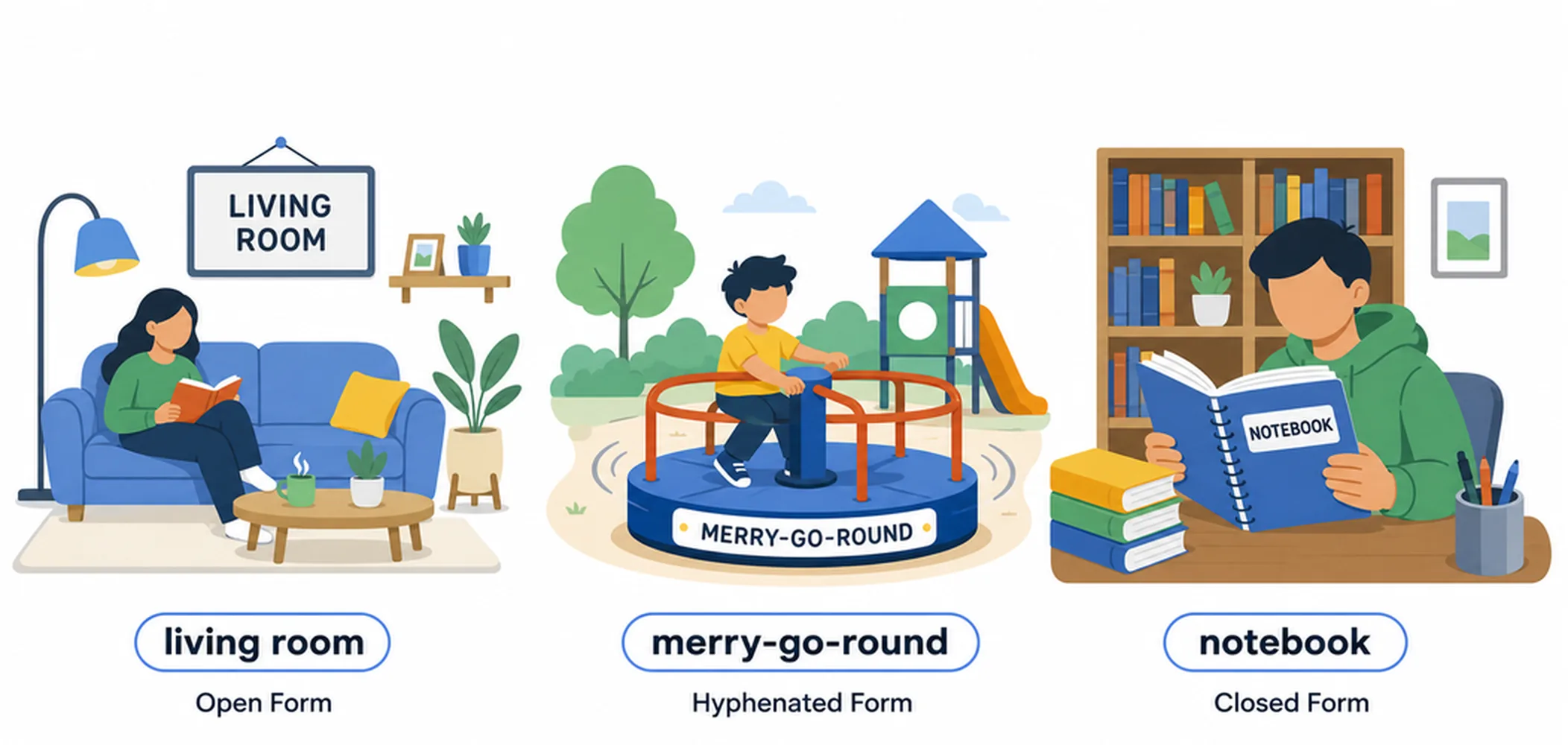
A compound noun is a noun made from two or more words. These words combine to create a single meaning that is different from the individual words. For example, 'sun' and 'flower' are separate words, but 'sunflower' is a compound noun meaning a specific type of flower. Compound nouns are very common in English and are written in three different ways: open form (two words), hyphenated form (with a hyphen), and closed form (one word).
The Three Forms of Compound Nouns
Open compound nouns are written as two separate words, like 'ice cream' and 'high school'. Hyphenated compound nouns use a hyphen to connect the words, such as 'mother-in-law' and 'well-being'. Closed compound nouns are written as one word, like 'basketball' and 'bedroom'. Unfortunately, there are no strict rules for which form to use—it depends on common usage and the specific compound. However, compound nouns often start as open forms, then become hyphenated, and eventually become closed as they become more common.
How to Use Compound Nouns Correctly
When using compound nouns, treat them as single units. For example, we say 'the living room is large' not 'the livings room is large'. If you are unsure about the correct form, check a dictionary. Modern dictionaries show the standard way to write each compound noun. When you learn a new compound noun, learn it with its correct form so you use it accurately in writing and speaking.
Open, Hyphenated, and Closed Forms: Side-by-Side Comparison
| Criterion | Open Form | Hyphenated Form | Closed Form |
|---|---|---|---|
| Form / Structure | Two or more separate words written with a space between them, yet functioning as a single noun unit. | Two or more words joined by a hyphen (–) to signal they operate as one compound noun. | Two words merged into a single, unspaced word with no punctuation between them. |
| When to Use | Common in everyday language for compounds that are widely understood but have not yet fully merged. Often used when the compound is relatively new or less frequent. | Used to avoid ambiguity, especially when a modifier precedes the noun, or when the compound is in a transitional stage between open and closed forms. Also standard before a noun it modifies. | Used for well-established, high-frequency compounds that have fully fused over time through repeated use. Typically recognised as a single dictionary entry. |
| Positive Example | full moon, ice cream, real estate, post office, coffee table | mother-in-law, well-being, editor-in-chief, six-pack, check-in | notebook, sunflower, toothpaste, bedroom, basketball |
| Negative Example | Writing icecream or ice-cream when the standard, widely accepted form in a given dialect is ice cream (two words). | Writing mother in law (open) or motherinlaw (closed) instead of the standard hyphenated mother-in-law. | Writing tooth paste (open) or tooth-paste (hyphenated) when the standard form is the closed toothpaste. |
| Question Example | Is high school written as one word, hyphenated, or two separate words? | Should I write follow up, follow-up, or followup when referring to the noun? | Why is fire place incorrect when describing the alcove that holds a fire in a home? |
| Key Signal Words / Indicators | Space between words; both words retain their original spelling; meaning understood from context; common in American vs. British spelling variation (e.g., ice cream). | Hyphen visible between words; often involves prepositions (in, out, up); used with compound modifiers; signals an intermediate stage of compounding. | Single unbroken string of letters; no space or punctuation; typically found as a single entry in the dictionary; reflects long-established usage. |
| Typical Contexts | General writing, journalism, informal and formal prose. Prevalent in American English for many compounds that British English may hyphenate. | Technical writing, style guides (AP, Chicago), pre-noun modifiers, phrases involving numbers or letters, and compound nouns containing prepositions. | All registers of English. Words that have been in frequent use for decades tend to close up over time regardless of formality level. |
| Evolution Over Time | Often the first stage of a compound noun's life cycle — two words start out separate before usage drives them closer together. | Often the middle stage — the hyphen bridges the gap as speakers begin treating the two words as a single concept. | Often the final stage — after enough repetition, writers drop the hyphen and fuse the words into one, cementing the compound. |
| Dialect / Style Variation | American English favours open forms more frequently (e.g., living room). Style guides such as AP Stylebook tend to prefer open compounds where possible. | British English and older style guides often retain hyphens longer. The Oxford Style Guide advises hyphens to prevent misreading (e.g., re-cover vs recover). | Closed forms are generally consistent across dialects once established, though some variation exists (e.g., email vs e-mail across decades). |
| Key Difference: The three forms represent a continuum of fusion. Open compounds (two words) are the loosest pairing, hyphenated compounds signal a tighter bond or prevent ambiguity, and closed compounds are fully merged units. There is no single rule that dictates which form a given compound takes — usage, frequency, dialect, and the specific style guide in use all influence the choice. When in doubt, consult an up-to-date dictionary, as many compounds have shifted form over time (e.g., e-mail → email; web site → web-site → website). | |||
Examples






What to Remember
- A compound noun combines two or more words to create one meaning different from individual words.
- Compound nouns have three forms: open (ice cream), hyphenated (mother-in-law), and closed (sunflower).
- Open compound nouns are written as two separate words without hyphens or joining.
- Hyphenated compound nouns use a hyphen to connect the words together.
- Closed compound nouns are written as one single word with no spaces or hyphens.