What is a Compound Noun?
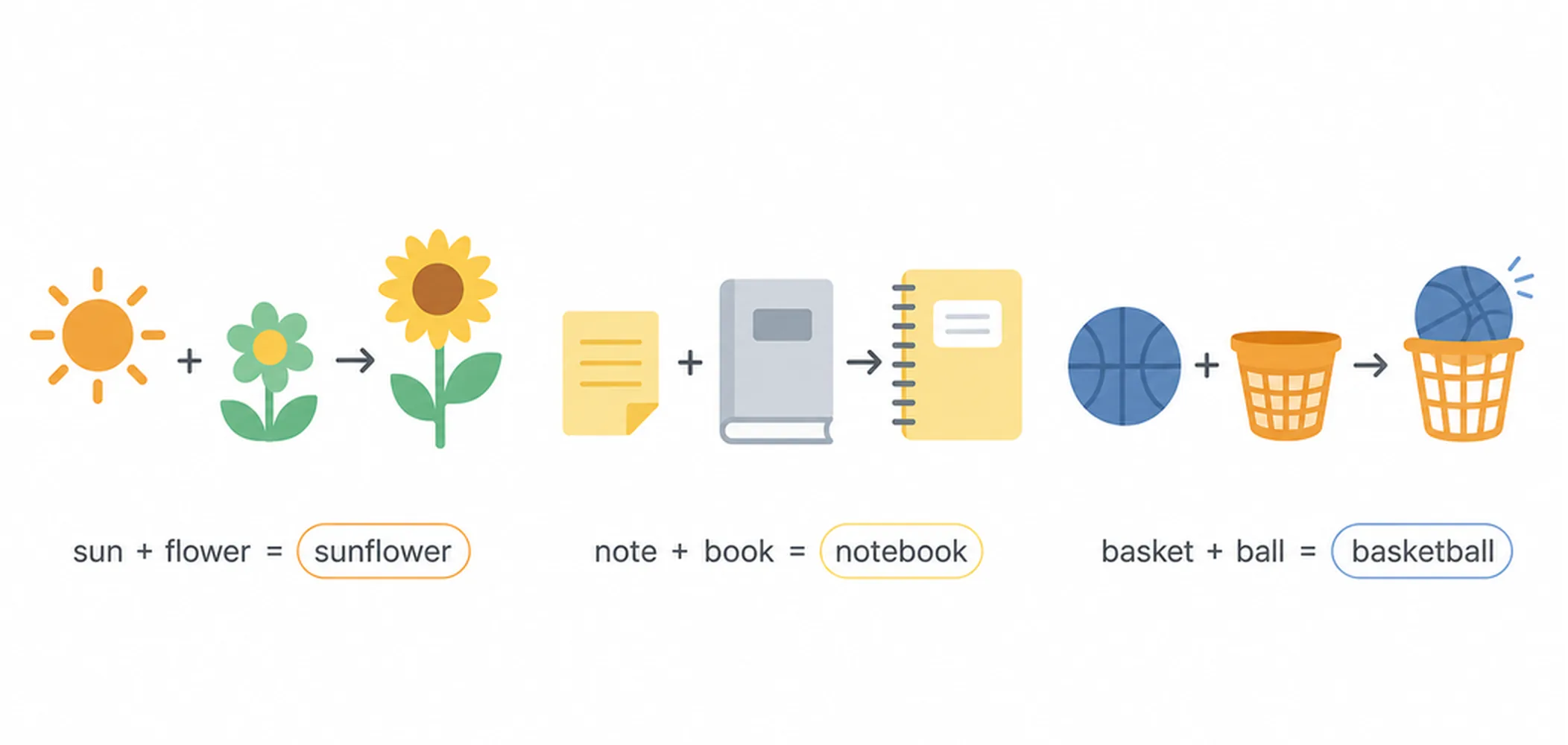
A compound noun is a noun made from two or more words joined together. These words combine to create one single noun with a new meaning. Compound nouns are very common in English. You use them every day without thinking about it!
Three Ways to Write Compound Nouns
Compound nouns can be written in three different ways. They can be two words written separately, like 'ice cream' or 'coffee cup'. They can be hyphenated, like 'mother-in-law' or 'well-being'. Or they can be written as one word, like 'football' or 'toothbrush'. All three forms are compound nouns. When you are not sure, check a dictionary to see the correct spelling.
Why Use Compound Nouns?
Compound nouns are useful because they help us name things quickly and clearly. Instead of saying 'a book you read before you go to bed', we can simply say 'a bedtime story'. Compound nouns make English more efficient and natural. Learning them helps you understand and speak English more fluently.
Types of Compound Nouns: How They Are Written
| Attribute | Open Form | Hyphenated Form | Closed Form |
|---|---|---|---|
| Definition | Two or more separate words written with a space between them that together express a single concept or noun. | Two or more words joined by a hyphen (-) to form a single compound noun, often signalling a transitional or ambiguous stage of the word. | Two or more words merged into one single word with no space or hyphen, forming a fully fused compound noun. |
| When to Use | Use when the compound is well understood but the words have not yet merged. Common in everyday English where each word retains its individual identity. | Use to prevent misreading, to link a prefix to a proper noun, or when a compound modifier precedes a noun. Also used when two vowels meet awkwardly. | Use when the compound has become so common and established in the language that it is now recognised as a single independent word. |
| Key Examples |
• ice cream • post office • full moon • living room • swimming pool |
• mother-in-law • editor-in-chief • six-year-old • well-being • runner-up |
• notebook • sunflower • toothpaste • bedroom • keyboard |
| Positive Example | She bought a coffee table for the living room. | His mother-in-law arrived early in the morning. | He opened his laptop to start working. |
| Negative Example (Incorrect Usage) | ❌ She bought a coffeetable for the living room. (incorrect closed form) | ❌ His motherinlaw arrived early. (missing hyphens) | ❌ He opened his lap top to start working. (incorrect open form) |
| Question Example | Is there a post office near the city centre? | Who is the editor-in-chief of that magazine? | Did you remember to buy toothpaste at the shop? |
| Key Signal Words / Clues | Words are familiar together but still feel like two distinct units; no dictionary entry as one word; space is natural. | Phrases with in-law, in-chief, compound modifiers before nouns, prefixes like re-, ex-, self-, well-. | Listed in dictionaries as a single entry; extremely high frequency of use; the original words are barely recognisable as separate. |
| Usage Tip | When in doubt, check a dictionary. If no single entry exists, the open form is usually the safest default choice for unfamiliar compounds. | Always hyphenate compound modifiers directly before a noun (e.g., a well-known author) but not after a linking verb (e.g., the author is well known). | Trust your dictionary — if the compound has a single entry without spaces or hyphens, always write it as one word to avoid appearing informal or incorrect. |
| 🔑 Key Difference: The three forms reflect the evolutionary lifecycle of a compound noun in English. Compounds typically begin as open forms (two separate words), transition into hyphenated forms (as usage increases and clarity is needed), and finally become closed forms (fully merged single words) once they are firmly established in the language. Because English is not always consistent, always consult an up-to-date dictionary to confirm which form is currently standard for a specific compound noun. | |||
Examples






What to Remember
- A compound noun combines two or more words to create one noun with a new meaning.
- Compound nouns can be written as two separate words, like ice cream or coffee cup.
- Some compound nouns are hyphenated, such as mother-in-law or well-being.
- Other compound nouns are written as one single word, like football or toothbrush.
- Check a dictionary when unsure how to write a compound noun correctly.