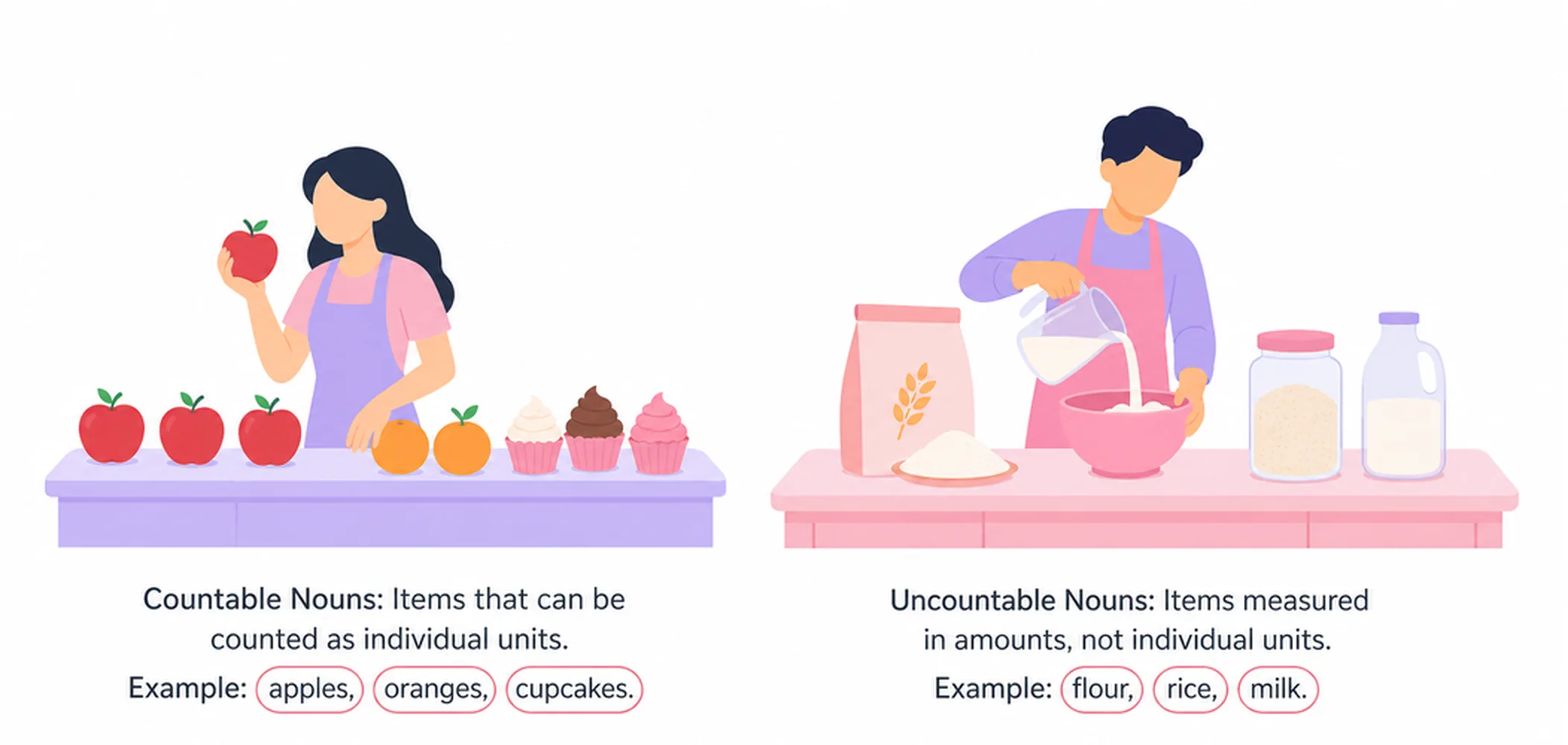
What are countable nouns?
Countable nouns are things you can count. You can have one, two, three, or more of them. They have a singular form (one thing) and a plural form (more than one thing). Most countable nouns add -s or -es to make the plural. Examples with food include: apple (one) → apples (many), egg → eggs, carrot → carrots.
What are uncountable nouns?
Uncountable nouns are things you cannot count individually. They do not have a plural form. You cannot say 'two waters' or 'three breads'. Instead, we use special words like 'a piece of', 'a glass of', or 'a slice of' to count them. Common uncountable food nouns include: water, milk, rice, sugar, flour, cheese, bread, and meat.
How to use articles with countable and uncountable nouns
With countable nouns in singular form, use 'a' or 'an' before them: 'a banana', 'an orange'. With plural countable nouns, use no article or 'some': 'apples', 'some apples'. With uncountable nouns, use 'some' or no article: 'some water', 'water'. Never use 'a' or 'an' with uncountable nouns.
Countable vs Uncountable Food Nouns — Side-by-Side Comparison
| Countable Nouns | Uncountable Nouns | |
|---|---|---|
| Form | Have both a singular and a plural form. A final -s or -es (or irregular change) marks the plural: apple → apples, tomato → tomatoes, loaf → loaves. | Have only one form — no plural ending is added. The noun looks the same whether you are talking about a little or a lot: rice, milk, bread, flour. |
| When to use | Use for individual items that can be separated and counted one by one: one egg, two biscuits, three oranges. Each item has a clear, discrete boundary. | Use for substances, liquids, powders, or foods that are treated as a mass rather than separate units: water, sugar, oil, cheese, pasta. |
| Article usage | Singular form requires an article (a / an or the) or another determiner: a banana, an egg, the apple. Plural form can appear without an article to express a general meaning: Apples are healthy. | Cannot be used with the indefinite article a / an. Used without any article to express a general meaning: Butter is fatty. Can take the when referring to a specific portion: Pass me the salt. |
| Quantity expressions | Use many, a few, few, several, a number of, and exact numbers: many strawberries, a few grapes, three sandwiches. | Use much, a little, little, a great deal of, a bit of: much olive oil, a little honey, a great deal of sugar. |
| Measuring / partitives | Counted directly: two carrots, five prawns. Containers or portions are optional and used for precision: a bag of crisps, a box of chocolates. | Must use a partitive (container, unit, or measure) to express a specific quantity: a cup of tea, a slice of bread, a jar of jam, 200 g of flour. |
| Food examples | apple, banana, orange, egg, biscuit, strawberry, grape, carrot, potato, sandwich, crisp, prawn, olive, lemon, peach | rice, bread, milk, water, sugar, flour, butter, cheese, pasta, honey, salt, pepper, oil, tea, coffee, soup, meat, fish |
| Positive example | There is an apple on the table. I bought three eggs this morning. |
There is some rice in the bowl. She added a little sugar to the cake. |
| Negative example | There aren't any bananas left. We don't have many biscuits. |
There isn't any milk in the fridge. We don't have much flour. |
| Question example | How many oranges do you need? Are there any eggs? |
How much pasta should I cook? Is there any bread left? |
| Key signal words | how many, many, a few, few, several, a number of, each, every, one / two / three…, a(n), any (plural) | how much, much, a little, little, a bit of, a great deal of, a piece / slice / cup / glass / bowl of, any (singular) |
| 🔑 Key Difference: Countable food nouns refer to individual, discrete items that can be tallied with numbers (one egg, two apples), so they take plural forms, the indefinite article a/an, and quantity words like many and a few. Uncountable food nouns refer to substances or masses with no natural boundaries (rice, milk, sugar), so they have no plural form, cannot take a/an, and require much, a little, or a partitive expression (a cup of, a slice of) to indicate quantity. | ||
Examples
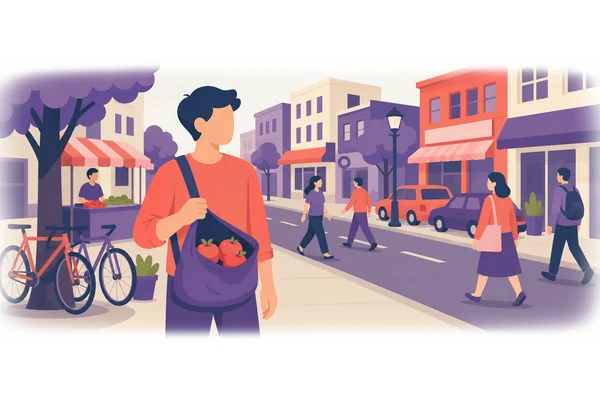

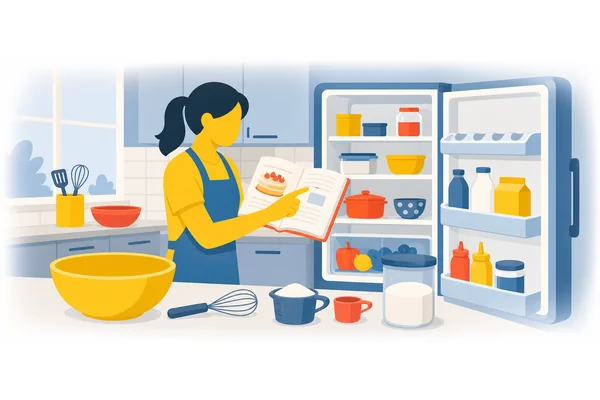


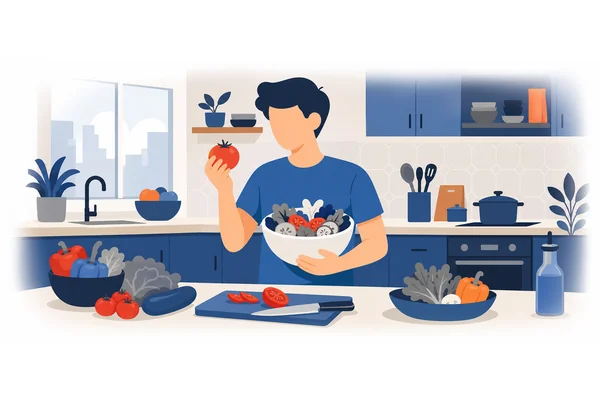
What to Remember
- Countable nouns can be counted and have both singular and plural forms.
- Most countable nouns add -s or -es to form the plural.
- Uncountable nouns cannot be counted individually and do not have plural forms.
- Never use numbers directly before uncountable nouns; use 'a piece of' instead.
- Common food examples: countable (apple, egg, carrot) and uncountable (water, bread, rice).