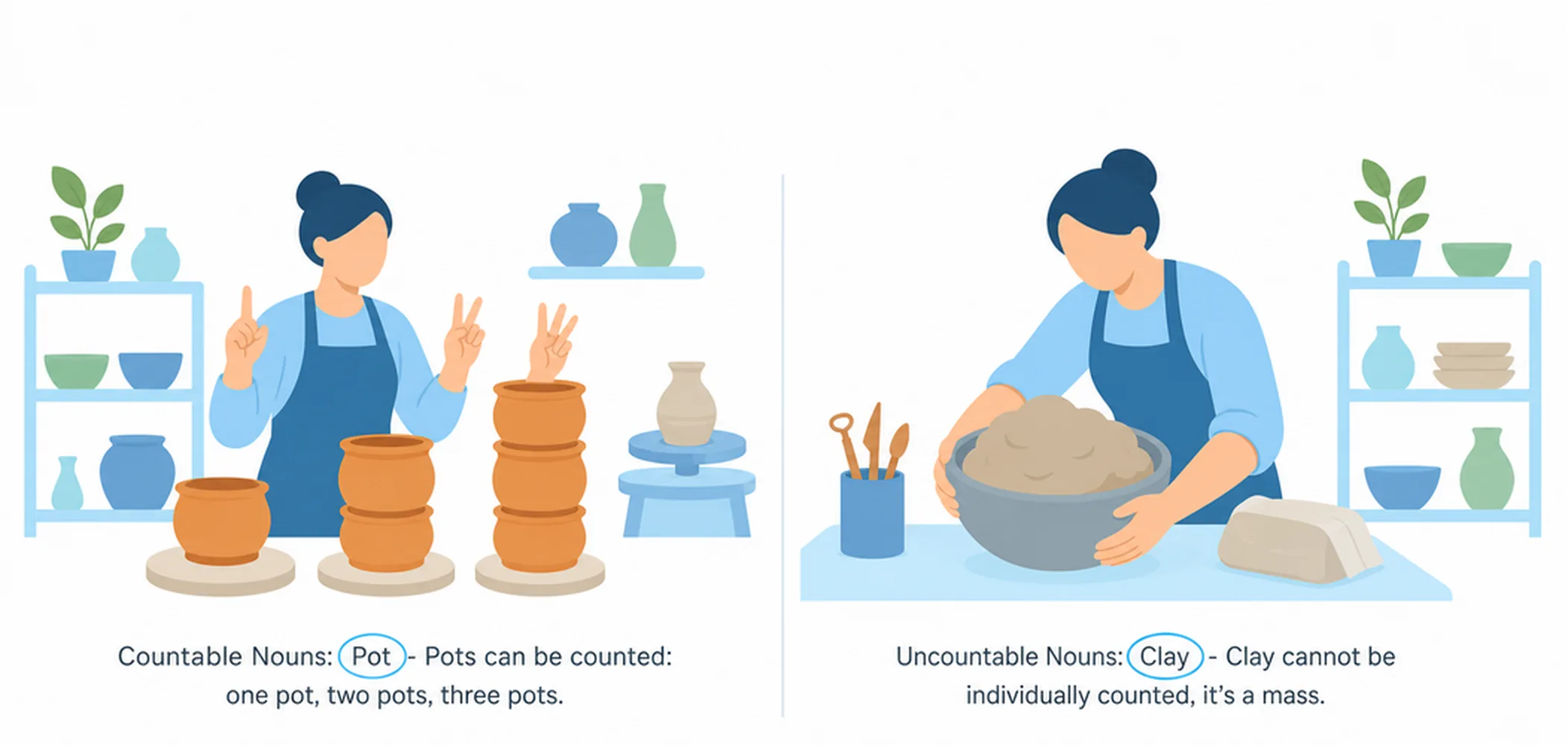
What are countable nouns?
Countable nouns are things we can count. We can say one, two, three, four of them. Examples are: apple, cat, book, chair, person, cup. Each countable noun is separate and individual. You can hold one apple, two apples, three apples. Countable nouns have both singular and plural forms: cat / cats, dog / dogs, table / tables.
How to use countable nouns
With countable nouns, we use the articles a and an before the singular form: a book, an apple, a pen. We also use numbers: one student, five birds, ten minutes. When we use the plural form, we do not use a or an. We say: books (not a books), apples (not an apples). We can also use some: some students, some apples.
Singular vs plural countable nouns
Most countable nouns add -s or -es to make the plural: cat → cats, box → boxes. Some nouns have irregular plurals: child → children, person → people, foot → feet. Remember: countable nouns can always be singular or plural, and you can count them.
Countable vs Uncountable Nouns
| Property | Countable Nouns | Uncountable Nouns |
|---|---|---|
| Definition | Nouns that refer to individual, separate items that can be counted one by one. | Nouns that refer to things treated as a whole mass or concept that cannot be counted individually. |
| Plural Form | Can take a plural form, usually by adding -s or -es. e.g., cat → cats, box → boxes |
Generally have no plural form and are used only in the singular. e.g., water (not waters), advice (not advices) |
| Use of a / an | Can be preceded by the indefinite article a or an in the singular. e.g., a book, an apple |
Cannot be used with a or an directly. e.g., ✗ a water, ✗ an advice |
| Use of Numbers | Can be directly preceded by cardinal numbers. e.g., two chairs, five dogs |
Cannot be directly preceded by cardinal numbers without a unit of measure. e.g., ✗ two rices → ✓ two bowls of rice |
| Quantifiers Used | many, few, a few, several, a number of e.g., many students, a few books |
much, little, a little, a great deal of, a amount of e.g., much sugar, a little milk |
| Use of some / any | Used with plural forms. e.g., some chairs, any questions |
Used with singular forms. e.g., some water, any information |
| Positive Example | She bought three oranges. There is a cat on the roof. |
She needs some help. There is water in the glass. |
| Negative Example | There aren't any chairs left. He doesn't have a pen. |
There isn't any milk. She doesn't have much time. |
| Question Example | How many apples do you need? Is there a bus stop nearby? |
How much sugar do you take? Is there any news? |
| Example Words | dog, house, idea, car, teacher, bottle, country, mistake | water, rice, music, advice, information, happiness, air, furniture |
| Key Signal Words | many, few, a few, several, a number of, each, every, both | much, little, a little, a great deal of, a bit of, a piece of |
| 🔑 Key Difference: The fundamental distinction is that countable nouns represent discrete, individual items that can be enumerated (one book, two books, three books), and therefore take plural forms, the articles a/an, and quantifiers like many and few. Uncountable nouns, by contrast, represent substances, concepts, or masses viewed as an indivisible whole; they do not naturally form plurals, cannot follow a/an directly, and pair with quantifiers like much and little. When you need to quantify an uncountable noun, you must use a unit of measure (e.g., a glass of water, a piece of advice). | ||
Examples






What to Remember
- Countable nouns can be counted individually and have both singular and plural forms.
- Use articles "a" or "an" before the singular form of countable nouns.
- You can use numbers with countable nouns: one book, two cats, five students.
- Each countable noun represents separate, individual items that can be counted distinctly.
- Plural countable nouns are formed by adding "-s" or "-es" to the singular.