What are irregular plural nouns?
Most nouns in English add -s or -es to make the plural. For example: cat → cats, box → boxes. But some nouns have special plural forms. These are called irregular plural nouns. They do not follow the regular rules. You must learn them by memory.
Common irregular plural nouns
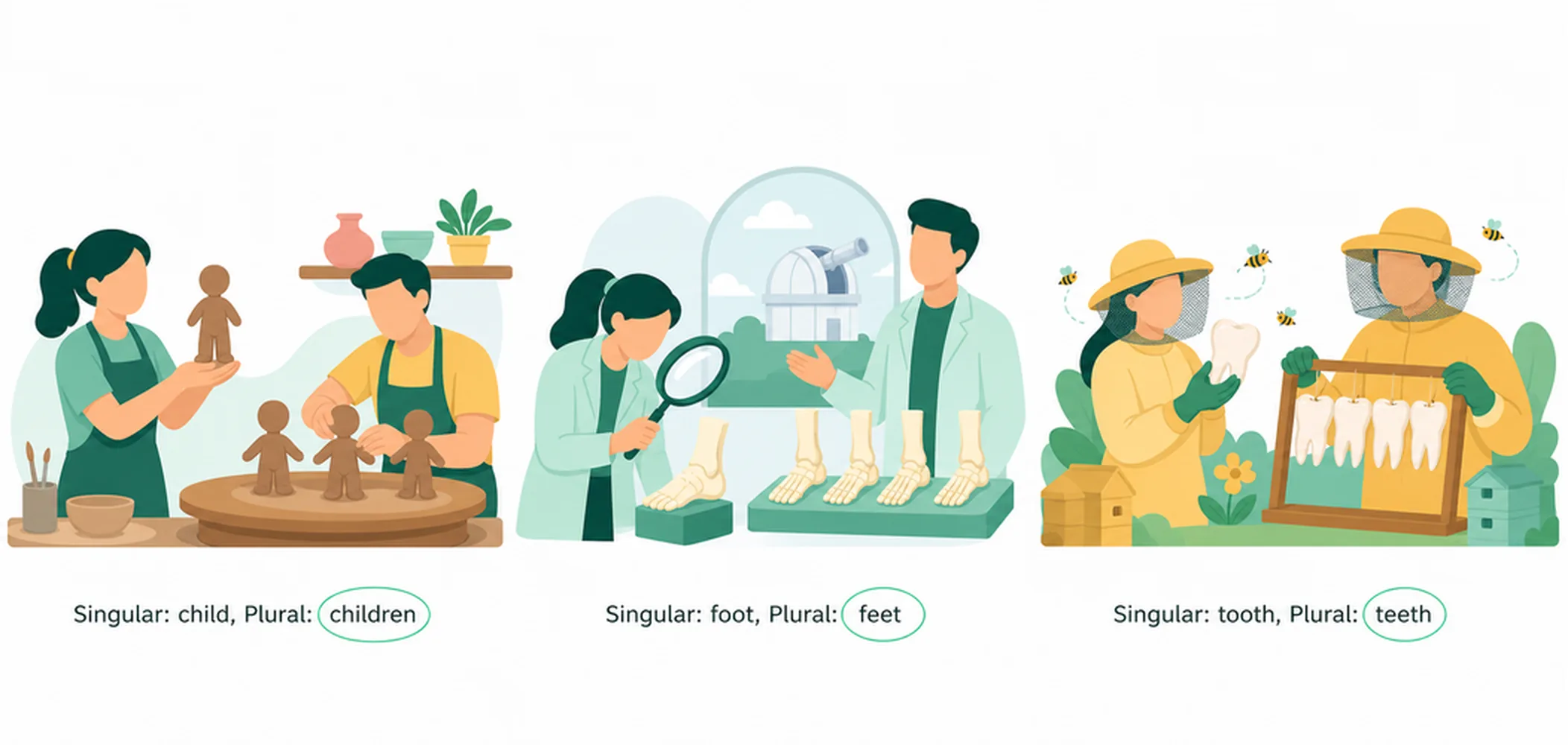
Some very common nouns have completely different plural forms. Child becomes children. Person becomes people. Foot becomes feet. Tooth becomes teeth. Mouse becomes mice. These nouns are very important to learn because we use them often in English.
Other types of irregular plurals
Some nouns have the same form for singular and plural. For example: sheep, fish, and deer. Some nouns from other languages keep their original plural forms, like man → men or goose → geese. Pay attention when you read and listen to English. This helps you remember these special forms.
Irregular Plural Nouns — Complete List
| Category | Singular | Plural | Note |
|---|---|---|---|
| Vowel-Change Plurals | |||
| Vowel change | man | men | a → e |
| Vowel change | woman | women | a → e |
| Vowel change | foot | feet | oo → ee |
| Vowel change | tooth | teeth | oo → ee |
| Vowel change | goose | geese | oo → ee |
| Vowel change | mouse | mice | ou → i |
| Vowel change | louse | lice | ou → i |
| Vowel change | dormouse | dormice | ou → i |
| -en Plurals | |||
| -en ending | ox | oxen | adds -en |
| -en ending | child | children | adds -ren |
| -en ending | brother | brethren | archaic/religious use |
| Zero-Change Plurals (Same Singular & Plural) | |||
| Zero change | sheep | sheep | no change |
| Zero change | deer | deer | no change |
| Zero change | fish | fish | "fishes" also accepted |
| Zero change | moose | moose | no change |
| Zero change | swine | swine | no change |
| Zero change | aircraft | aircraft | no change |
| Zero change | species | species | no change |
| Zero change | series | series | no change |
Examples





What to Remember
- Most English nouns add -s or -es to form the plural, but irregular nouns do not.
- Common irregular plurals have completely different forms: child/children, person/people, foot/feet, tooth/teeth, mouse/mice.
- Irregular plural nouns must be learned by memory because they do not follow standard rules.
- You cannot predict irregular plural forms by applying regular pluralization rules to these nouns.
- Learning irregular plurals is essential because these nouns are very frequently used in English.