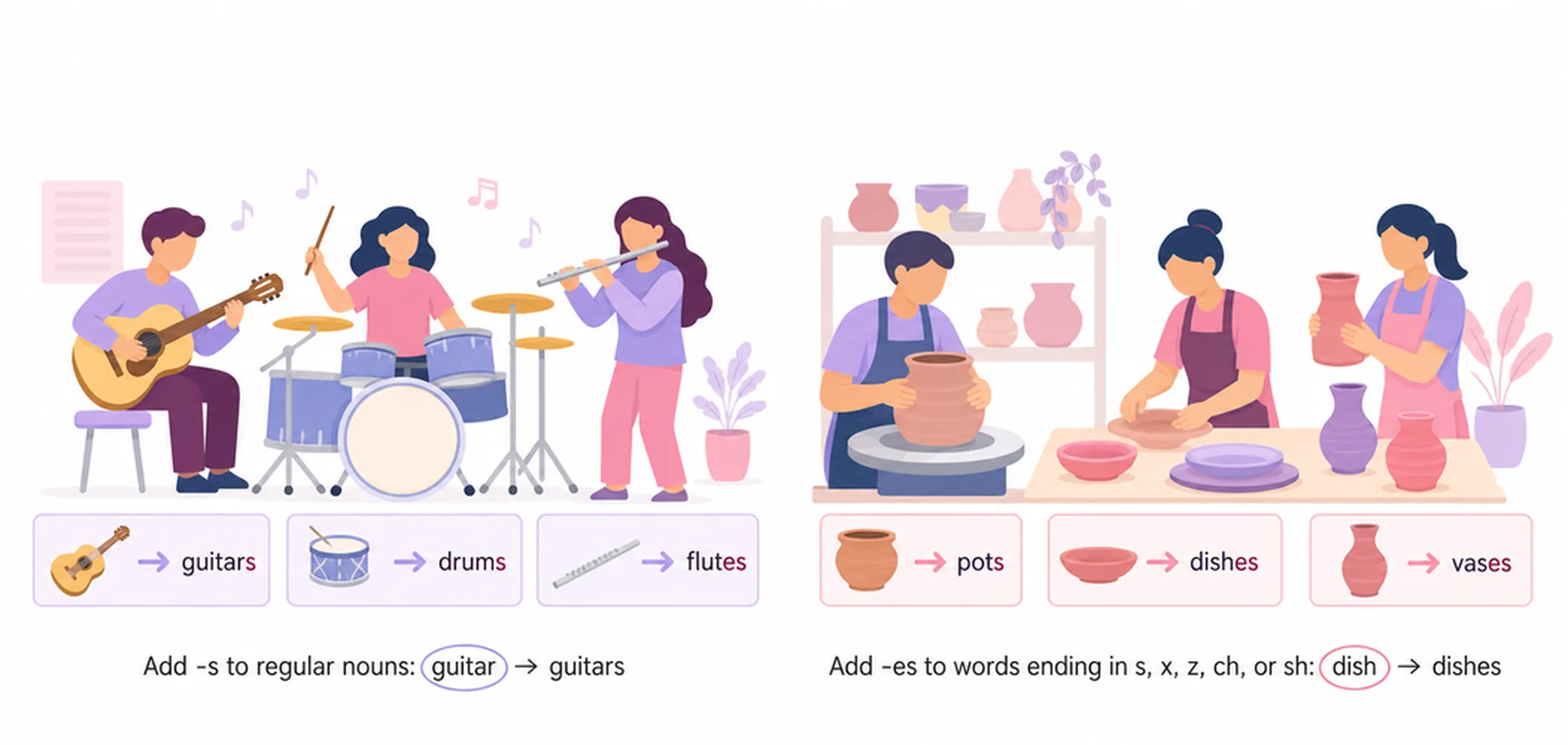
What are regular plural nouns?
In English, we use plural nouns when we talk about more than one thing. Most nouns follow a simple rule: we add -s or -es to make them plural. These are called regular plurals. For example, cat becomes cats, and box becomes boxes.
Rule 1: Add -s to most nouns
For most nouns, we simply add the letter -s to make the plural. This works for nouns that end in vowels (a, e, i, o, u) or consonants like b, c, d, f, g, h, k, l, m, n, p, r, t, v, w, z. Examples: dog → dogs, book → books, apple → apples, car → cars.
Rule 2: Add -es to nouns ending in -s, -ss, -sh, -ch, -x, -z, -o
Some nouns need -es instead of just -s. Add -es to nouns that end in s, ss, sh, ch, x, z, or o. We add -es because it helps us pronounce the word correctly. Examples: bus → buses, class → classes, dish → dishes, church → churches, box → boxes, tomato → tomatoes.
When to Add -s vs. -es: Side-by-Side Comparison
| Feature | Adding -s | Adding -es |
|---|---|---|
| Form | Base noun + s | Base noun + es |
| When to use | Used for most nouns whose singular form ends in a standard consonant or vowel (other than a sibilant or special ending). Simply attach -s directly to the end of the word. | Used when the singular noun ends in a sibilant or hissing sound: -s, -ss, -sh, -ch, -x, -z, or when it ends in -o (many cases), or in a consonant + -y (where -y changes to -ies). |
| Noun ending types covered |
Most consonants (e.g. -b, -d, -g, -k, -l, -m, -n, -p, -r, -t) Vowel endings (e.g. -a, -e, -i, -u) Words ending in -ay, -ey, -oy, -uy (vowel + y) |
Endings in -s or -ss Endings in -sh Endings in -ch Endings in -x Endings in -z Many nouns ending in -o Consonant + -y (drop y, add -ies) |
| Positive example |
cat → cats book → books table → tables toy → toys banana → bananas |
bus → buses brush → brushes church → churches box → boxes tomato → tomatoes city → cities |
| Negative example (wrong form) |
❌ busses (incorrect extra -s) ❌ boxs (missing -e) ❌ churchs (missing -e) |
❌ cates (wrongly adding -es to cat) ❌ bookes (wrongly adding -es to book) ❌ cityes (keeping y instead of changing to -ies) |
| Question example (usage in sentence) |
"How many cats do you have?" "Are those your books?" |
"How many buses stop here?" "Are there churches in this town?" |
| Key signal words / endings | Most endings that do not produce a hissing or buzzing sound when spoken aloud — the plural -s blends smoothly with the final consonant or vowel. | -s / -ss / -sh / -ch / -x / -z / -o / consonant+y — these endings already end in or produce a sibilant sound, so an extra vowel (e) is needed to make the plural syllable pronounceable. |
| Pronunciation effect | The added -s does not create an extra syllable. The word length stays the same in terms of syllable count (e.g. cat → cats: still one syllable). | The added -es creates an extra syllable (pronounced /ɪz/), making the word one syllable longer (e.g. church [1 syl.] → church·es [2 syl.]). |
| Special sub-rule | Nouns ending in a vowel + y (e.g. -ay, -ey, -oy) simply add -s without any change to the y: day → days, monkey → monkeys, boy → boys. | Nouns ending in a consonant + y drop the y and add -ies instead of -es alone: city → cities, baby → babies, fly → flies. |
| 🔑 Key Difference: The deciding factor is the sound at the end of the singular noun. If the noun already ends in a sibilant/hissing sound (-s, -ss, -sh, -ch, -x, -z), ends in many -o forms, or ends in a consonant + -y, you must add -es (or -ies) to create a new, pronounceable syllable. For all other nouns — those ending in sounds that blend naturally with a simple s — you add only -s. When in doubt, say the plural aloud: if adding just -s feels awkward or runs sounds together, you almost certainly need -es. | ||
Formula
Formula
noun (vowel/common consonant ending)
+
+ -s
cat + s = cats
Examples
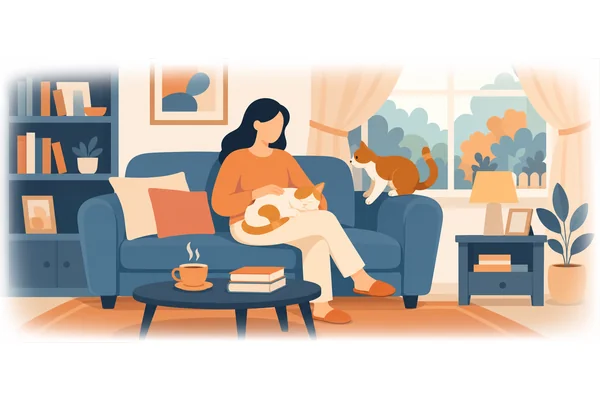
I have two cats at home.
Regular plural · Add -s
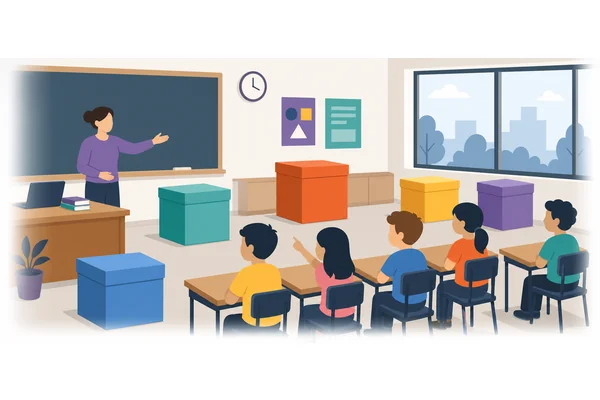
There are five boxes in the classroom.
Regular plural · Add -es
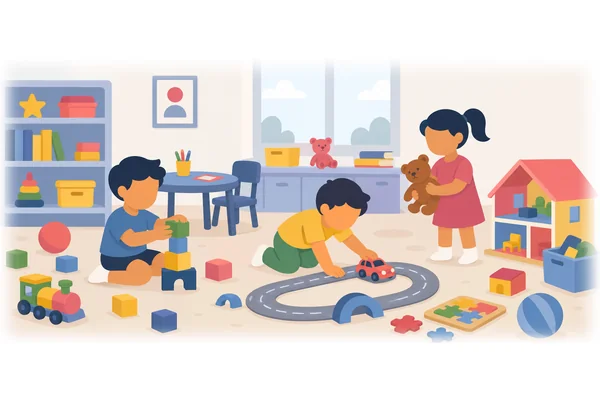
The children play with toys every day.
Regular plural · Add -s

We eat tomatoes with our lunch.
Regular plural · Add -es

The buses are red and yellow.
Regular plural · Add -es
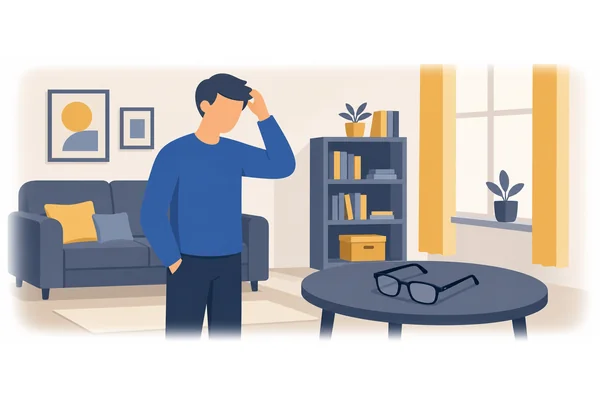
My glasses are on the table.
Regular plural · Add -es
When to use it
Shopping
Use regular plurals when talking about multiple items you want to buy.
"I need three apples, two oranges, and five potatoes."
Classroom
Use plural nouns to describe objects and people in your learning environment.
"There are twenty desks and two boxes of pencils in the classroom."
Home
Talk about things in your home using plural forms.
"My house has three bedrooms, two bathrooms, and a big kitchen."
Family
Describe family members and pets using plural nouns.
"I have two brothers and a dog. My parents have three cats."
Signal words
many
several
two
three
some
a lot of
numbers
plural endings
Common Mistakes
✕
Wrong
I see three book on the shelf.
✓
Correct
I see three books on the shelf.
Nouns after numbers need plural form. Add -s to book.
✕
Wrong
The classs are big rooms.
✓
Correct
The classes are big rooms.
Nouns ending in -ss add -es, not just -s. Do not double the -ss.
✕
Wrong
There are five boxs in the room.
✓
Correct
There are five boxes in the room.
Nouns ending in -x add -es, not just -s. Box becomes boxes.
✕
Wrong
I like to eat potatoe.
✓
Correct
I like to eat potatoes.
Nouns ending in -o add -es. Potato becomes potatoes.
KEY TAKEAWAYS
What to Remember
- Use -s to make most nouns plural: cat → cats, dog → dogs.
- Add -es to nouns ending in -s, -x, -z, -ch, -sh: box → boxes.
- Nouns ending in consonant + -y change to -ies: baby → babies.
- Nouns ending in vowel + -y simply add -s: boy → boys.
- These are regular plurals; irregular plurals follow different patterns entirely.