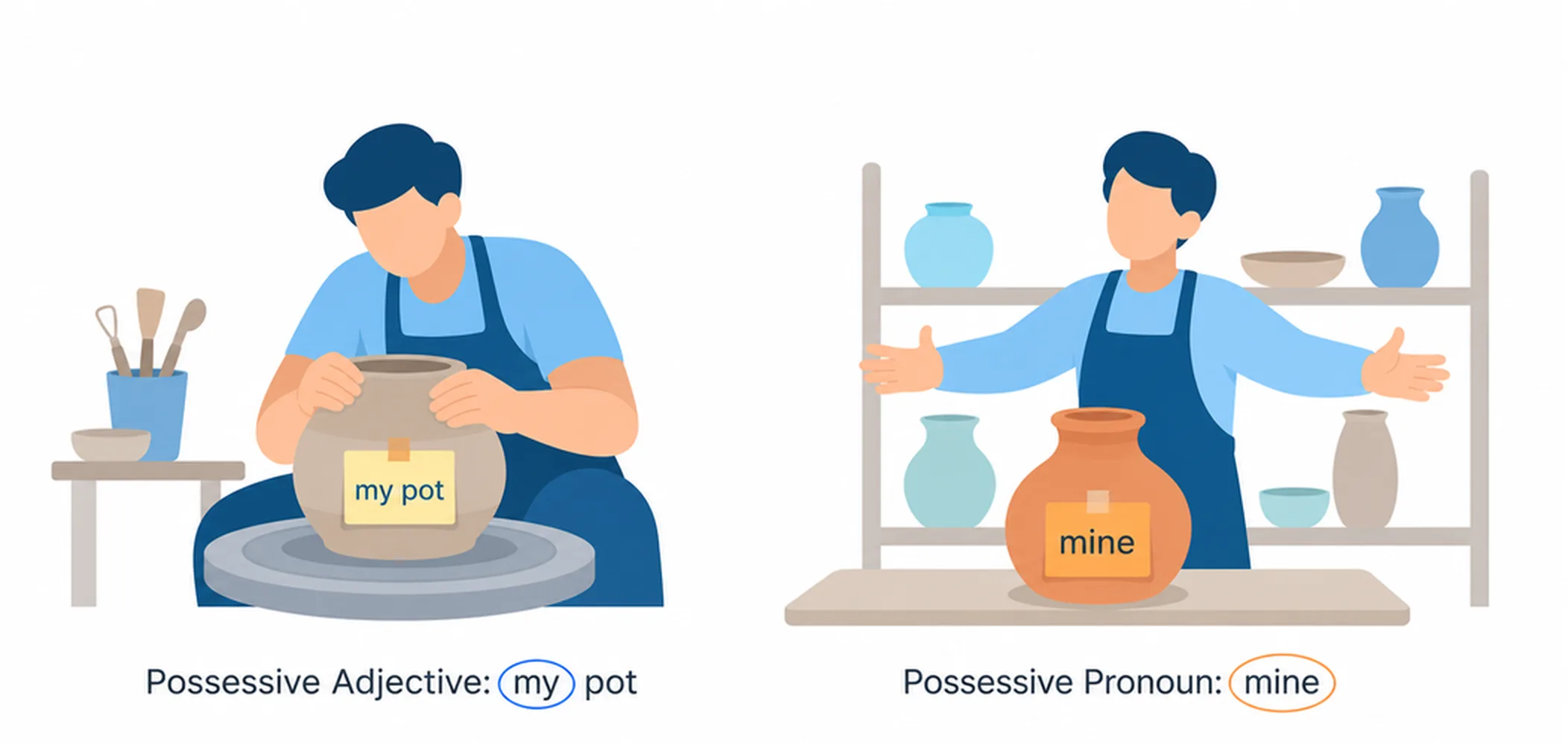
Possessive Adjectives vs Possessive Pronouns
Both possessive adjectives and possessive pronouns show that something belongs to someone. The key difference is simple: possessive adjectives come BEFORE a noun, while possessive pronouns stand ALONE without a noun. For example, "my book" uses the adjective my, but "this book is mine" uses the pronoun mine. Understanding this difference will help you speak and write correctly.
Side-by-Side Comparison
Possessive adjectives (my, your, his, her, its, our, their) always come before a noun to describe who owns something. Possessive pronouns (mine, yours, his, hers, its, ours, theirs) replace the noun entirely and stand alone. Notice that some forms look the same (his, its) but function differently depending on how you use them.
Quick Memory Trick
Try this: possessive adjectives are like a label on something (my pen, your bag). Possessive pronouns are like the owner speaking about their own item (this is mine, that is yours). If you can put a noun after the possessive word, use the adjective form. If nothing follows it, use the pronoun form.
Possessive Adjectives vs Possessive Pronouns: Full Comparison
| Person | Possessive Adjective | Example (Adjective) | Possessive Pronoun | Example (Pronoun) |
|---|---|---|---|---|
| 1st Person Singular | my | This is my book. | mine | This book is mine. |
| 2nd Person Singular / Plural | your | Is that your coat? | yours | Is that coat yours? |
| 3rd Person Singular (Male) | his | I borrowed his pen. | his | That pen is his. |
| 3rd Person Singular (Female) | her | She left her bag here. | hers | That bag is hers. |
| 3rd Person Singular (Neutral) | its | The dog wagged its tail. | — | No standard possessive pronoun form. English does not use a possessive pronoun equivalent for inanimate objects. |
| 1st Person Plural | our | We cleaned our room. | ours | That room is ours. |
| 3rd Person Plural | their | They parked their car outside. | theirs | That car is theirs. |
Examples






What to Remember
- Possessive adjectives (my, your, his, her, its, our, their) always come before a noun.
- Possessive pronouns (mine, yours, his, hers, its, ours, theirs) stand alone without a noun after them.
- Never use a possessive adjective when the noun is missing; use a pronoun instead.
- "My book" is correct, but "the book is my" is wrong; use "the book is mine."
- Both show ownership, but their position in the sentence determines whether you use adjective or pronoun.