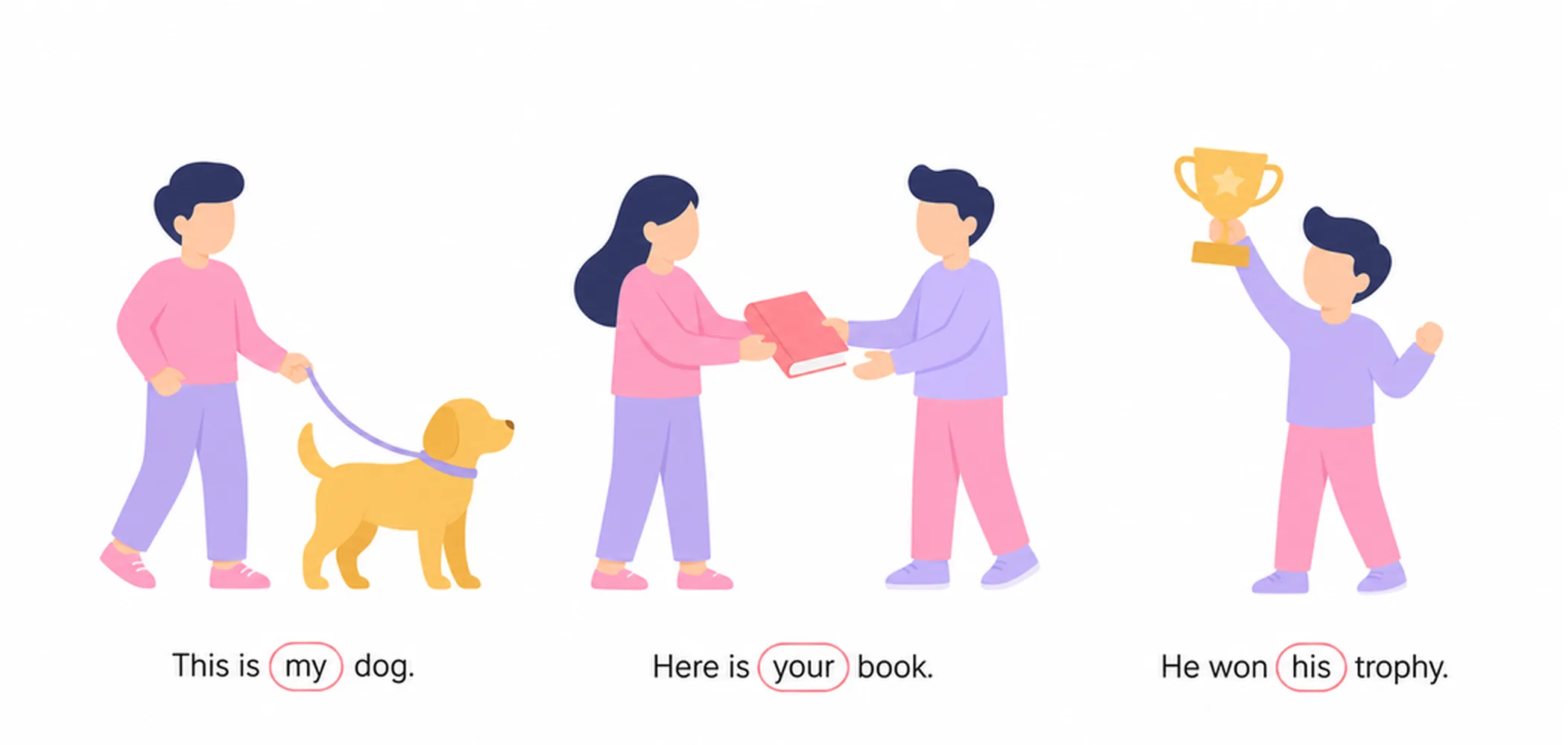
What Are Possessive Adjectives?
Possessive adjectives show that something belongs to or is connected to someone. They come before a noun to tell us who owns or possesses it. In English, we use possessive adjectives every day: my phone, your book, his car, her bag. These words never change form, no matter if the noun is singular or plural.
The Eight Possessive Adjectives
There are eight possessive adjectives in English. Each one matches a different subject pronoun. Learn them in pairs: I → my, you → your, he → his, she → her, it → its, we → our, they → their, and one → one's (formal).
Word Order: Where They Go
Possessive adjectives always go directly before the noun. You cannot put other adjectives between the possessive adjective and the noun. For example: "my blue car" (possessive + color + noun) is correct, but "blue my car" is wrong. The possessive adjective is the first word in the phrase.
Singular and Plural: No Difference
An important rule: possessive adjectives do not change when the noun becomes plural. We say "my book" and "my books" — the possessive adjective stays exactly the same. This is different from other languages. The same applies to all possessive adjectives: his, her, their, our, your, etc.
Complete List of Possessive Adjectives
| Subject Pronoun | Possessive Adjective | Example Phrase | Notes |
|---|---|---|---|
| I | my | my book | First person singular; always lowercase unless starting a sentence |
| you (singular) | your | your bag | Same form for both singular and plural you |
| he | his | his car | Third person singular masculine; irregular — does not end in -r |
| she | her | her house | Third person singular feminine; same form as the object pronoun her |
| it | its | its tail | Third person singular neuter; no apostrophe — it's = it is |
| we | our | our school | First person plural |
| you (plural) | your | your seats | Identical to singular your; context clarifies number |
| they | their | their garden | Third person plural; also used as a singular gender-neutral pronoun |
| one | one's | one's duty | Formal/generic; the only possessive adjective written with an apostrophe + s |
|
📌 Key Rules & Special Notes: 1. Possessive adjectives always come before a noun and never change form based on the noun's gender or number in English (e.g., my cat, my cats — my stays the same). 2. Do not confuse possessive adjectives with possessive pronouns: my (adjective) vs. mine (pronoun); your vs. yours; her vs. hers; our vs. ours; their vs. theirs. 3. its (possessive) has no apostrophe. it's is always a contraction of it is or it has. 4. their (singular gender-neutral) is widely accepted in modern English: Someone left their umbrella here. |
|||
Examples





What to Remember
- Possessive adjectives show who owns or possesses something before a noun.
- My, your, his, her, its, our, and their never change form for singular or plural.
- Always place the possessive adjective directly before the noun, never after it.
- Do not insert other adjectives between the possessive adjective and the noun.
- Possessive adjectives are different from possessive pronouns like mine, yours, his, hers.