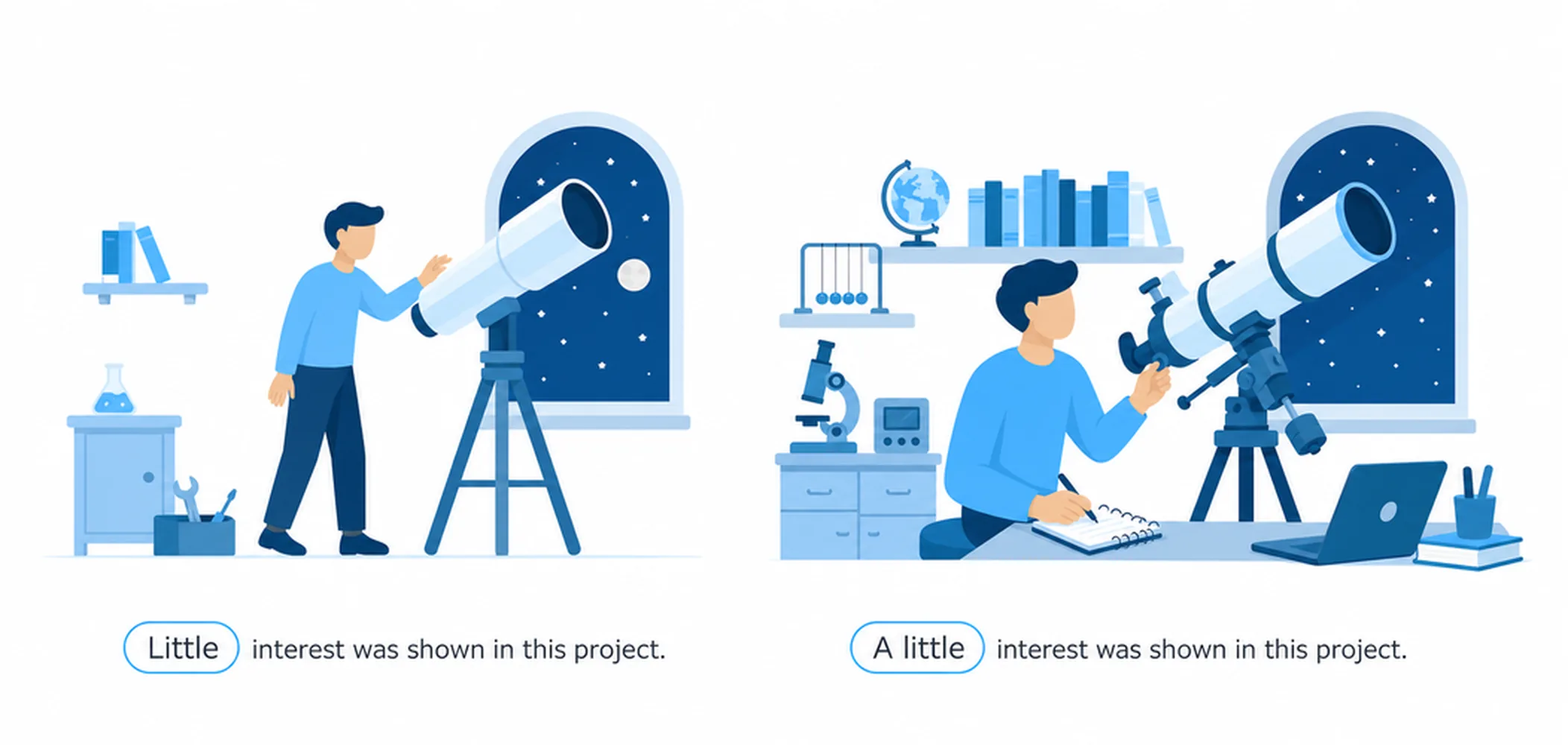
Understanding Little vs A Little
Both 'little' and 'a little' are quantifiers used with uncountable nouns (things you cannot count, like water, time, money, or information). The key difference is about meaning: 'little' has a negative meaning — it suggests 'not much' or 'not enough'. 'A little' has a positive meaning — it means 'some' or 'a small amount that is enough'. This small word 'a' changes the message completely.
Side-by-Side Comparison
Little (without 'a'): negative or insufficient amount. A little (with 'a'): positive or sufficient amount, even if small.
Little vs A Little: Key Differences at a Glance
| Category | little | a little |
|---|---|---|
| Form | Determiner / adjective used without an article; modifies uncountable nouns only | Determiner / adverb used with the indefinite article "a"; modifies uncountable nouns or verbs/adjectives |
| Meaning | Almost none; not enough; a very small amount that is insufficient or barely adequate — emphasises scarcity | Some; a small but sufficient amount — emphasises that something exists, even if the quantity is small |
| Connotation | Negative / pessimistic; implies a problem, shortage, or disappointment | Positive / optimistic; implies there is enough, or at least something useful present |
| When to use | Use when you want to stress that the amount is so small it is almost zero or not enough for the purpose | Use when you want to stress that some amount exists and it may be enough, or to soften a statement |
| Positive example | "There is little hope of finishing the project on time." (barely any hope) | "There is a little hope of finishing the project on time." (some hope exists) |
| Negative example | "She has little money left, so she cannot afford dinner." (almost none) | "She has a little money left, so she can afford a snack." (enough for something) |
| Question example | "Is there little time remaining before the deadline?" (implying there is almost no time) | "Is there a little time before the deadline?" (asking if any small amount of time exists) |
| Typical context | Formal writing, complaints, expressing concern, indicating a shortage or warning about insufficient quantity | Everyday speech, polite requests, encouraging statements, softening criticism or indicating partial fulfilment |
| As an adverb | "He little knew what was coming." (barely / scarcely — formal/literary) | "Can you move a little to the left?" (slightly / somewhat — common in everyday use) |
| Key signal words | hardly any, almost no, barely, not enough, insufficient, unfortunately | some, slightly, somewhat, at least, enough for now, fortunately |
| 🔑 Key Difference: The core distinction is one of perspective and sufficiency. Little (without the article) carries a negative meaning — it emphasises that the amount is so small it is nearly nothing and probably not enough. A little (with the article) carries a positive meaning — it acknowledges that a small amount does exist and may be sufficient. Both refer to a small quantity of an uncountable noun, but choosing one over the other completely changes the tone and implication of the sentence. A simple test: if you can replace it with "almost none," use little; if you can replace it with "some" or "a bit of," use a little. | ||
Examples

There is little time left to finish the project.
Negative meaning · Not enough time

Unfortunately, we have little money for the holiday.
Negative meaning · Insufficient amount

The doctor said he had little hope of recovery.
Negative meaning · Almost no hope

I have a little sugar to add to your coffee.
Positive meaning · Some sugar available

She speaks a little Italian, so she can help us.
Positive meaning · Some ability, enough to help

There is a little water left in the bottle.
Positive meaning · Some water remains
When to use it
Expressing Scarcity
Use 'little' when something is lacking or insufficient. This creates a problem or negative situation.
"The company has little money left for bonuses this year."
Expressing Availability
Use 'a little' when you have some of something and it is adequate or useful.
"I know a little about cars, so I can help you check the engine."
Academic or Professional
Both forms appear in formal writing. Choose based on whether the amount is insufficient (little) or adequate (a little).
"The research shows little evidence of this effect." vs "We found a little evidence supporting the theory."
Signal words
little — negative context, not enough
a little — positive context, some is available
not much
some
small amount
Common Mistakes
✕
Wrong
We have a little food, so we need to buy more.
✓
Correct
We have little food, so we need to buy more.
'A little' means enough, but the sentence says we need more. Use 'little' for insufficient amounts.
✕
Wrong
She has a little experience with this software.
✓
Correct
She has little experience with this software. OR She has a little experience with this software (if she can use it adequately).
The intended meaning matters. 'A little' suggests enough ability; 'little' suggests not enough skill.
✕
Wrong
There is little coffee left, would you like some?
✓
Correct
There is a little coffee left, would you like some?
Offering coffee suggests it is available and sufficient. Use 'a little' for this positive situation.
KEY TAKEAWAYS
What to Remember
- Both 'little' and 'a little' are quantifiers used only with uncountable nouns, never countable nouns.
- 'Little' without the article 'a' has a negative meaning: not much or insufficient.
- 'A little' with the article 'a' has a positive meaning: some or enough.
- The single word 'a' completely changes the message from negative to positive.
- Common mistake: using 'little' or 'a little' with countable nouns like books or people.