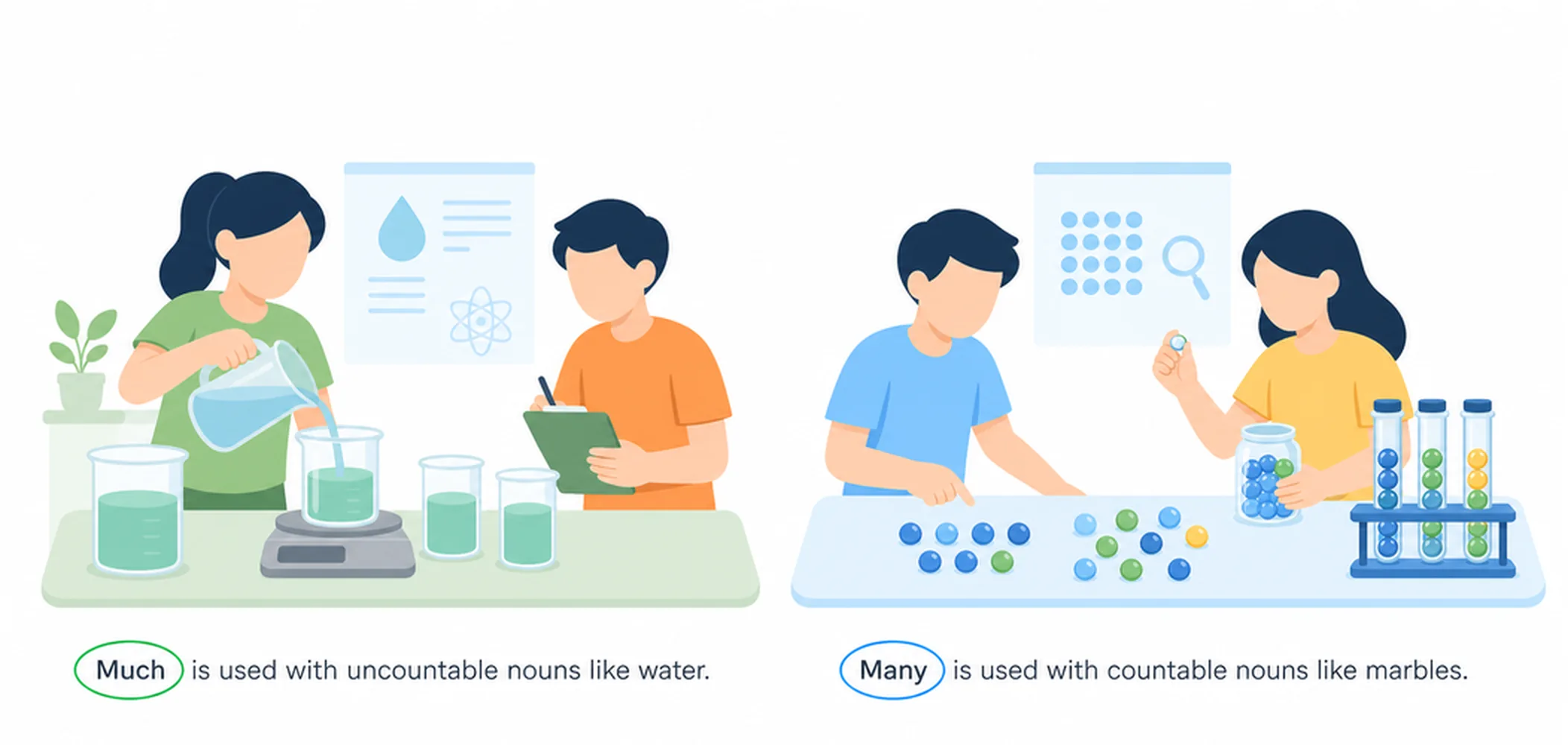
Much vs Many — The Key Difference
Much and many are quantifiers that express large amounts, but they are used with different types of nouns. Much is used with uncountable nouns (things you cannot count individually), while many is used with countable nouns (things you can count). This is one of the most important rules in English grammar. Understanding this distinction will help you speak and write more naturally.
Much vs Many — Side-by-Side Comparison
| Criteria | Much | Many |
|---|---|---|
| Form | Used with uncountable (mass) nouns — things that cannot be counted individually. | Used with countable nouns in their plural form — things that can be counted individually. |
| When to use | Use when referring to a large quantity of something that has no distinct units (e.g. water, time, money, information, advice). Most natural in questions and negative sentences. | Use when referring to a large number of separate, individual items (e.g. books, people, cars, ideas). Can be used in positive, negative, and question sentences naturally. |
| Positive example | "She has much experience in the field." (Formal; in informal speech, a lot of is more common in positive statements.) | "There are many students in the classroom." |
| Negative example | "There isn't much milk left in the fridge." | "There aren't many tickets available for the concert." |
| Question example | "How much sugar do you take in your coffee?" | "How many apples do you need from the store?" |
| Key signal words | water, rice, sand, money, time, information, advice, knowledge, traffic, furniture, luggage | books, chairs, friends, countries, hours, mistakes, people, ideas, opportunities, words |
| ⓘ Key Difference: The core distinction is simple — ask yourself whether the noun can be counted. If you can count it (one book, two books…), use many. If you cannot count it as individual units (you cannot say "one water, two waters" in standard usage), use much. A reliable test is the "How much / How many?" question: "How much water?" vs. "How many bottles?" Both words can be replaced by a lot of in most everyday positive sentences. | ||
Formula
✔ Positive
There
+
is/are
+
much/many
+
[noun]
There is much traffic on Monday mornings.
? Question
How
+
much/many
+
[noun]
+
do/does
+
you
How many books did you buy last week?
✖ Negative
Subject
+
don't/doesn't have
+
much/many
+
[noun]
I don't have many close friends in this city.
Examples
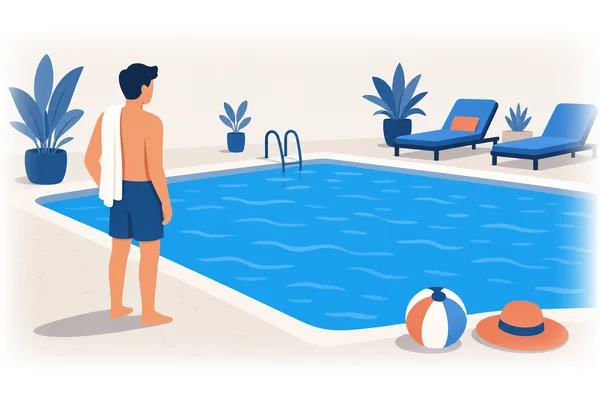
There is much water in the swimming pool.
Uncountable noun · Abstract concept

I don't have much time before my flight.
Uncountable noun · Daily conversation

She spent much money on new furniture.
Uncountable noun · Common expression

Many students attended the English class yesterday.
Countable noun · Plural form

How many people are coming to the party?
Countable noun · Question form

There are many reasons to visit London in spring.
Countable noun · Formal writing
When to use it
Asking about quantity
Use much and many in questions to ask how much or how many of something you want to know about.
How much sugar do you take in your coffee? / How many siblings do you have?
Negative statements
Both much and many are common in negative sentences to express a small quantity.
I don't have much experience with cooking. / There aren't many restaurants in my neighbourhood.
Expressing problems
Use much and many to talk about something being difficult or excessive.
There's much noise outside. / Too many cars make the air dirty.
Signal words
much
many
how much
how many
too much
too many
so much
so many
Common Mistakes
✕
Wrong
There are much people at the concert.
✓
Correct
There are many people at the concert.
People is countable, so use many, not much.
✕
Wrong
How many information do you need?
✓
Correct
How much information do you need?
Information is uncountable, so use much, not many.
✕
Wrong
She drank many coffee this morning.
✓
Correct
She drank much coffee this morning.
Coffee (as a substance) is uncountable, so use much.
KEY TAKEAWAYS
What to Remember
- Much is used with uncountable nouns like water, information, and advice.
- Many is used with countable nouns like books, people, and chairs.
- Use much in negative sentences and questions even with countable nouns.
- Don't use much with countable nouns in positive statements.
- A lot of works with both countable and uncountable nouns.