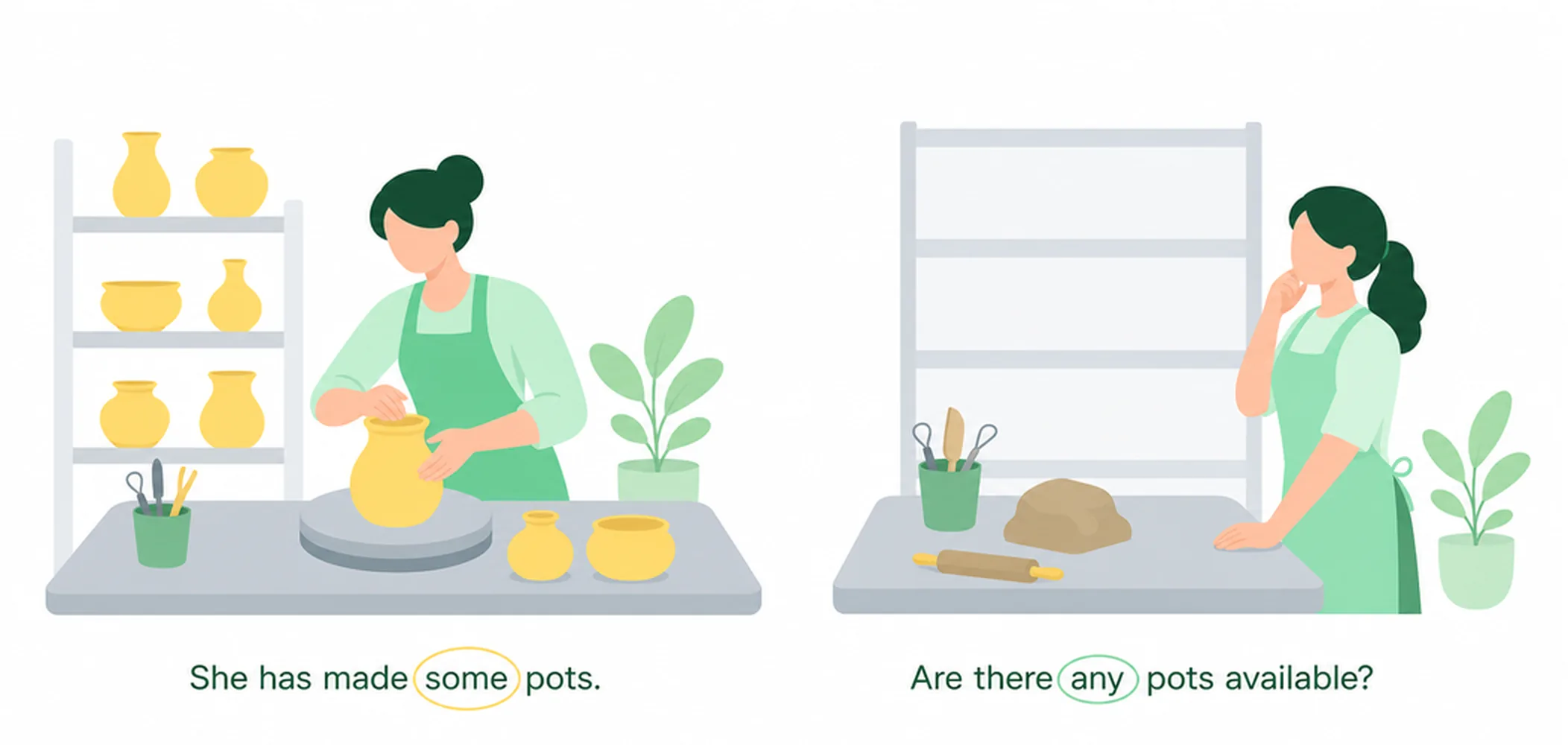
The Key Difference Between Some and Any
Both 'some' and 'any' are quantifiers that tell us about an amount of something, but they are used in different situations. 'Some' is used in positive statements when we are sure about something existing. 'Any' is used in questions and negative statements, or when we talk about it being uncertain or not important which specific thing we mean. Understanding when to use each one is essential for natural English at the B1 level.
Some vs Any: Side-by-Side Comparison
| Category | SOME | ANY |
|---|---|---|
| Form | Used with uncountable nouns and plural countable nouns. Implies a limited, indefinite quantity or number. | Used with uncountable nouns and plural countable nouns. Implies an open-ended, unrestricted quantity or number. |
| When to use | Use in affirmative (positive) statements; in questions when offering something or expecting a "yes" answer; when making requests that are likely to be granted. | Use in negative statements; in most questions (genuine enquiries); in conditional clauses; when the answer or outcome is uncertain or open. |
| Positive example |
There is some milk in the fridge.
She bought some apples at the market.
I need some help with this task.
|
Any can appear in positive statements to mean "it doesn't matter which":
Any student can join the club.
You can call me at any time.
|
| Negative example |
Some is not normally used with a negative verb.
There isn't
|
There isn't any milk left.
She doesn't have any friends in the city.
We didn't find any evidence.
|
| Question example |
Offers & polite requests:
Would you like some tea?
Can I have some of that cake?
Expecting "yes":
Did someone call while I was out?
|
Genuine enquiries (outcome unknown):
Is there any milk in the fridge?
Did you buy any apples?
Has anyone seen my keys?
|
| Open conditions (if / when) |
Rarely used in conditional clauses unless the speaker considers the condition likely:
If you need some advice, just ask.
|
Standard choice in open/neutral conditionals:
If you have any questions, let me know.
If there is any problem, call me immediately.
|
| Key signal words / contexts | Affirmative sentences · Offers · Polite requests · "Would you like...?" · "Could I have...?" · Expecting agreement | Negatives (not, never, without) · Genuine yes/no questions · Conditionals (if, unless, whether) · "It doesn't matter which" meaning |
Key Difference: Some suggests a specific, expected, or definite (though unspecified) quantity and is the default choice in positive statements and offers/requests where a positive response is anticipated. Any suggests an open, unspecified, or zero quantity and is the default choice in negative statements, genuine questions, and conditional clauses where the existence of something is uncertain or irrelevant. When any appears in a positive statement (e.g., "any student can join"), it shifts in meaning to "whichever / it doesn't matter which," conveying unrestricted choice rather than quantity.
Examples

I have some milk in the fridge.
Positive statement · Countable & uncountable nouns

There are some students waiting outside the classroom.
Positive statement · Countable nouns

Would you like some tea with your breakfast?
Polite offer · Uncountable nouns

Do you have any questions about the lesson?
Question form · Countable nouns

I don't have any money right now.
Negative statement · Uncountable nouns

You can choose any colour you like for your project.
Meaning 'it doesn't matter which' · Countable nouns
When to use it
Positive Statements
Use 'some' when you are making a positive statement about something that exists or is available.
"I bought some books at the market yesterday."
Questions
Use 'any' in most questions, unless you are making a polite offer, in which case 'some' is better.
"Is there any bread left?" or "Would you like some bread?"
Negative Statements
Always use 'any' in negative statements, not 'some'.
"We haven't got any sugar for the coffee."
No Specific Choice
Use 'any' when it doesn't matter which specific person, thing, or amount you mean.
"Any student can join the club. You don't need experience."
Signal words
positive statement → some
question → any
negative (don't, hasn't, isn't) → any
polite offer → some
no specific choice → any
Common Mistakes
✕
Wrong
I don't have some apples.
✓
Correct
I don't have any apples.
'Some' cannot be used in negative statements. Use 'any' instead.
✕
Wrong
Do you want some tea?
✓
Correct
Do you want any tea? / Would you like some tea?
'Some' in questions sounds strange unless making a polite offer. Use 'any' for general questions or 'some' for offers.
✕
Wrong
She didn't eat some cake at the party.
✓
Correct
She didn't eat any cake at the party.
Use 'any' in negative sentences, not 'some'; 'some' is only for positive statements.
KEY TAKEAWAYS
What to Remember
- Use 'some' in positive statements when you are certain something exists.
- Use 'any' in questions and negative statements to express uncertainty or negation.
- 'Any' is also correct in positive statements when the specific item doesn't matter.
- 'Some' can appear in questions when you expect or assume a positive answer.
- Remember that 'some' and 'any' cannot be used interchangeably in all situations.