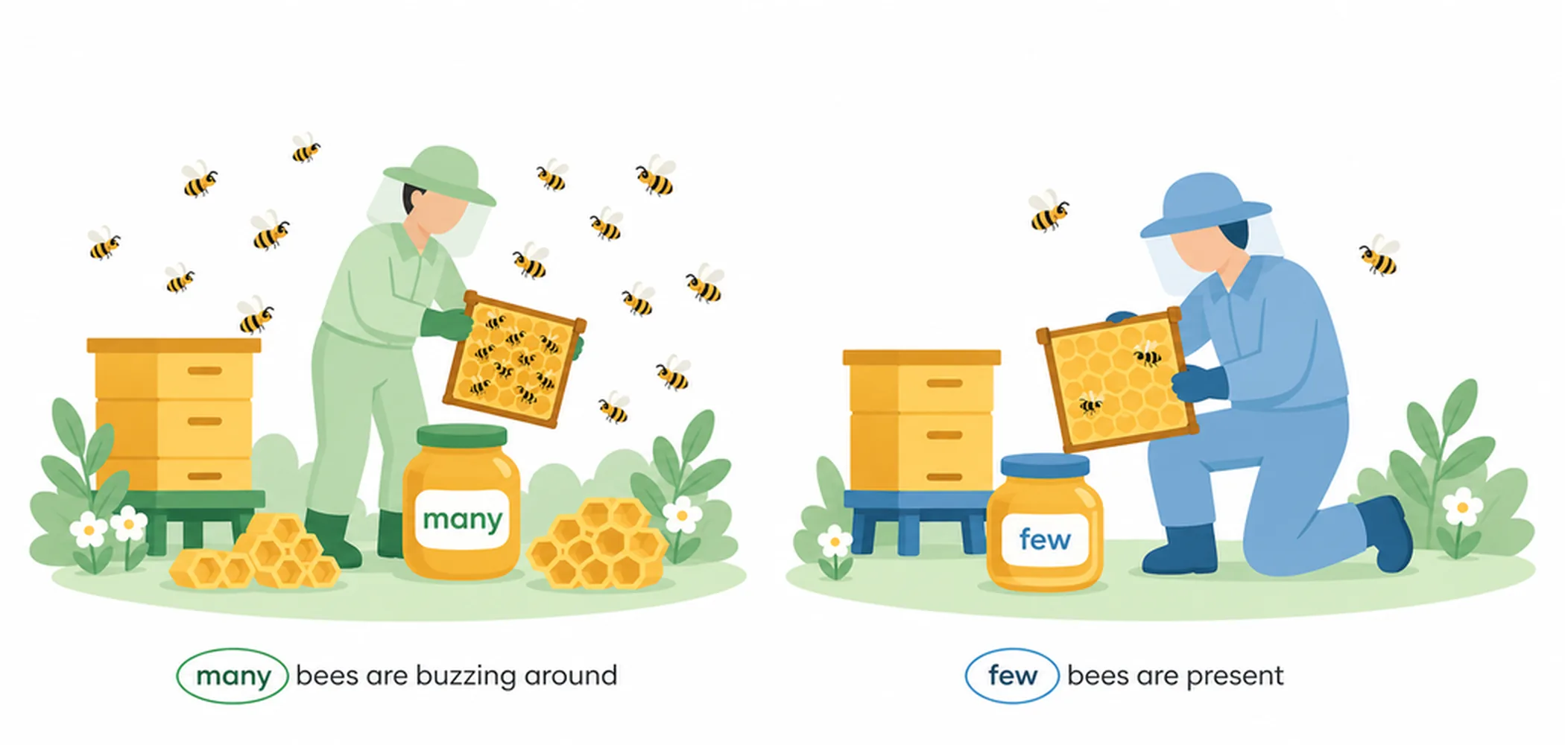
What are Quantifiers?
Quantifiers are words that describe the amount or quantity of something. They tell us how much or how many of something we are talking about. Instead of using exact numbers, quantifiers give us a general idea of the quantity. For example, if you say 'I have some coffee', you don't say exactly how much—just that there is a general amount. Quantifiers are very useful in everyday English because we don't always need to be precise about numbers.
Quantifiers with Countable and Uncountable Nouns
An important rule to remember is that some quantifiers work only with countable nouns (things you can count, like books or people), and some work only with uncountable nouns (things you cannot count, like water or information). Some quantifiers, like some and any, work with both types.
| Quantifier | Countable Nouns | Uncountable Nouns | Both Types |
|---|---|---|---|
| Many | Yes | No | |
| Much | No | Yes | |
| Some | Yes | ||
| Any | Yes | ||
| A lot of | Yes | ||
| Few / A few | Yes | No | |
| Little / A little | No | Yes |
Examples:
Common Quantifiers and Their Uses
The most common quantifiers in English include 'some', 'any', 'many', 'much', 'a few', 'a little', 'all', 'most', 'several', and 'enough'. Each one has a slightly different meaning and use. 'Many' and 'a few' describe larger or moderate quantities of countable things, while 'much' and 'a little' do the same for uncountable things. Learning which quantifier to use with which type of noun will help you speak and write more naturally.
Quantifiers at a Glance
| Quantifier | Countable? | Uncountable? | Example | Note |
|---|---|---|---|---|
| many | ✅ Yes | ❌ No | Many students passed. | Used in questions and negatives; also affirmatives in formal writing |
| much | ❌ No | ✅ Yes | Is there much time left? | Mainly questions and negatives; "a lot of" preferred in affirmatives |
| a few | ✅ Yes | ❌ No | I have a few friends here. | Positive meaning — some, but enough |
| few | ✅ Yes | ❌ No | Few people know the answer. | Negative meaning — not many; implies lack |
| a little | ❌ No | ✅ Yes | Add a little salt. | Positive meaning — some, but enough |
| little | ❌ No | ✅ Yes | There is little hope. | Negative meaning — not much; implies lack |
| some | ✅ Yes | ✅ Yes | I need some apples / some water. | Used in affirmatives and polite requests/offers |
| any | ✅ Yes | ✅ Yes | Do you have any questions / any milk? | Used in questions and negatives; affirmative = "whichever" |
| a lot of / lots of | ✅ Yes | ✅ Yes | She has a lot of friends / money. | Informal; works in affirmatives, questions, and negatives |
| plenty of | ✅ Yes | ✅ Yes | We have plenty of time / chairs. | Suggests more than enough; positive in tone |
| enough | ✅ Yes | ✅ Yes | Is there enough food / enough seats? | Means "as much/many as needed"; can precede or follow noun |
| no | ✅ Yes | ✅ Yes | There is no milk / no chairs left. | Stronger negation than "not any"; used with affirmative verb |
| each / every | ✅ Yes | ❌ No | Each student got a book. Every door was locked. | Used with singular countable nouns; verb is singular |
| all | ✅ Yes | ✅ Yes | All students must attend. All water was gone. | Refers to the whole group or amount; plural verb with countable |
| both |
Examples






What to Remember
- Quantifiers describe the amount or quantity of something without using exact numbers.
- Some quantifiers (some, many, few) are used with countable nouns; others with uncountable nouns.
- Use "much" with uncountable nouns and "many" with countable nouns in questions and negatives.
- Quantifiers provide a general idea of quantity when precision about exact numbers isn't necessary.
- Different quantifiers have different meanings: "a few" is positive; "few" is negative.