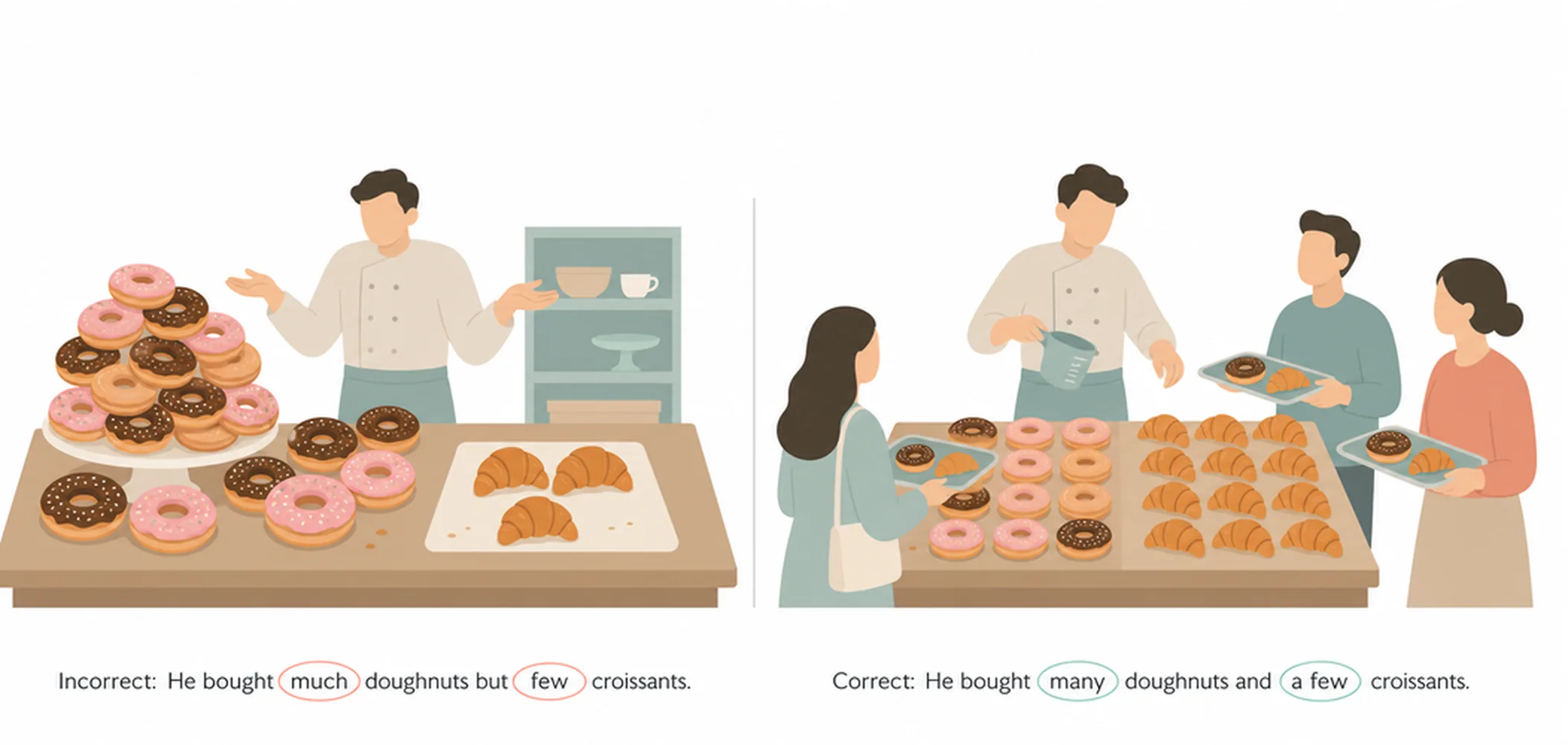
Why Learners Make These Mistakes
Quantifiers are tricky because they follow different rules depending on whether the noun is countable or uncountable. Learners often confuse "much" with "many," or "few" with "little." These mistakes happen because your native language might not make the same distinctions, or you might memorize the words without understanding when to use them. The good news is that once you understand the patterns, quantifier mistakes become easy to avoid.
Quantifier Mistakes at a Glance
| Category | Incorrect Usage | Correct Usage | Rule / Explanation |
|---|---|---|---|
| much / many — Form | much + countable noun many + uncountable noun |
much + uncountable noun many + countable noun (plural) |
much goes with uncountable nouns (water, advice, money); many goes with countable plural nouns (books, people, cars). Use mainly in negatives and questions. |
| much / many — In affirmatives | She has many money. He gave me much tips. |
She has a lot of money. He gave me many tips. |
In affirmative sentences, prefer a lot of or lots of over much or many for a more natural tone. Use many only with countable plural nouns. |
| much / many — In negatives | I don't have many time. There aren't much students. |
I don't have much time. There aren't many students. |
much and many are both natural and correct in negative sentences. Match the quantifier to the noun type: uncountable → much; countable plural → many. |
| much / many — In questions | How many sugar do you need? How much books did you read? |
How much sugar do you need? How many books did you read? |
How much and How many are common test items. The noun type determines which to use: sugar is uncountable → How much; books is countable plural → How many. |
| much / many — Key examples | — | Uncountable (much): water, rice, air, information, advice, traffic, knowledge Countable plural (many): cars, people, books, questions, mistakes, ideas |
Memorise common uncountable nouns — they never take a plural -s and never use many. |
| few / little — Form | few + uncountable noun little + countable noun |
few + countable noun (plural) little + uncountable noun |
few and little both mean "not enough" or "a small amount." few is used with countable plurals; little is used with uncountable nouns. Both have negative connotations. |
| few / little — few vs. a few | I have little friends here. (implies almost none) There is few hope left. |
I have a few friends here. (some; positive) There is a little hope left. (some; positive) |
The article a completely changes meaning: few and little are negative (almost none); a few and a little are positive (some, enough). |
| few / little — little vs. a little | She had a few patience with the students. We have few water. |
She had little patience with the students. We have little water. |
patience and water are uncountable nouns → must use little, not few or a few. Check the noun type first. |
| few / little — In polite requests | Could you spare few minutes? (sounds too negative / unnatural) | Could you spare a few minutes? | Polite requests and offers almost always use a few or a little because the speaker is asking for something positive and assumes a helpful response. |
| few / little — Key examples | — | Countable (few / a few): days, chances, suggestions, errors, people Uncountable (little / a little): time, money, energy, milk, progress |
Check whether the noun is countable or uncountable. Countable → few / a few. Uncountable → little / a little. |
| some / any — Form | any in affirmative sentences some in negatives and open questions |
some in affirmatives and offer/request questions any in negatives, open questions, and conditionals |
some and any both work with countable plurals and uncountable nouns. The choice depends on sentence polarity and expectation, not on noun type. |
| some / any — In affirmatives | I bought any eggs at the market. She found any useful information. |
I bought some eggs at the market. She found some useful information. |
In affirmative (positive) sentences, always use some, never any. The speaker is stating a fact about possession or existence. |
| some / any — In negatives | There isn't some milk left. He didn't make some mistakes. |
There isn't any milk left. He didn't make any mistakes. |
After not, no, never, or without, use any, not some. These negating structures require any. |
| some / any — In questions | Would you like any tea? (sounds cold / unfriendly) Is there some bread? (assumes the answer is yes) |
Would you like some tea? (polite offer) Is there any bread? (neutral, open question) |
Use some in offers and polite requests (where a "yes" answer is expected). Use any for open, neutral questions where the answer is genuinely unknown. |
| some / any — Key patterns | — | some: affirmatives, "Would you like…?", "Can I have…?", offers any: negatives, "Do you have…?" (neutral), "If there is…", conditionals |
Look at the surrounding words: a negative verb or an open question almost always signals any. |
| no / none — Form | none + noun directly no standing alone |
no + noun (as determiner) none alone or with of (as pronoun) |
no is a determiner and must be followed by a noun. none is a pronoun and stands alone or with of (e.g., "none of the students"). Never use both together in a double negative. |
| no / none — no before nouns | There is none problem. I have none idea. |
There is no problem. I have no idea. |
Before a noun, always use the determiner no, never the pronoun none. no directly precedes the noun. |
| no / none — Avoiding double negatives | There aren't no tickets left. I don't have no money. |
There are no tickets left. I don't have any money. |
Avoid double negatives: choose either not + any OR no — never both together. This is a fundamental rule of standard English grammar. |
| no / none — none as a pronoun answer | — | "Which ones did you like?" — "None of them." "How many are left?" — "None." |
none is the correct pronoun when the quantity is zero. no cannot stand alone as a short answer to a question. |
| no / none — Key patterns | — | no + noun: no time, no reason, no students, no water none / none of: None of the answers, None at all, None were correct |
Quick test: Is the next word a noun? → use no. Is it standing alone or followed by of? → use none. |
| every / each / all — Form | every / each + plural noun all + singular noun (without of) |
every / each + singular noun all + plural noun or uncountable noun |
every and each are used with singular countable nouns and take a singular verb. all can take a plural noun, uncountable noun, or of + plural noun. |
| every / each / all — each vs. every | Every students must submit their work. Each people have a different opinion. |
Every student must submit their work. Each person has a different opinion. |
every and each always take a singular noun and a singular verb (has, is, was, does). each emphasises individuals one by one; every treats the group as a whole. Both require singular agreement. |
| every / each / all — all with plurals | All student must attend. All the information are available. |
All students must attend. All the information is available. |
all can take a plural countable noun (all students) with a plural verb, or an uncountable noun (all information) with a singular verb. Match verb number to the noun that follows. |
| every / |
Examples

I eat many vegetables every day because they are healthy.
Countable noun · Positive statement

She doesn't drink much coffee in the afternoon because it keeps her awake.
Uncountable noun · Negative statement

We have a few hours before the train leaves, so we can have lunch together.
Countable noun · Small positive amount

There is very little sugar left in the kitchen, so we need to buy more.
Uncountable noun · Small amount
When to use it
Talking about food quantities
Use 'many' for countable items (apples, eggs, potatoes) and 'much' for uncountable things (milk, rice, oil).
"How many apples do you need? I have much milk at home."
Describing groups of people
Always use 'many' with 'people' because it's countable in English (unlike in some other languages).
"There were many people at the concert last night."
Discussing time and resources
Remember that 'time,' 'money,' and 'work' are uncountable, so use 'much' or 'a little' with them.
"I don't have much time, but I have a little money to help."
Signal words
much
many
few
a few
little
a little
some
any
lots of
a lot of
countable
uncountable
Common Mistakes
✕
Wrong
I don't have much friends.
✓
Correct
I don't have many friends.
Use 'many' with countable nouns (friends). 'Much' is only for uncountable nouns (time, money, water).
✕
Wrong
There is a few sugar in the bowl.
✓
Correct
There is a little sugar in the bowl.
'Little' is used with uncountable nouns (sugar, salt, water). 'A few' is for countable nouns. Use 'a little' for small amounts of uncountable things.
✕
Wrong
I have few money to spend this month.
✓
Correct
I have little money to spend this month.
'Money' is uncountable, so use 'little' or 'a little,' not 'few.' 'Few' and 'a few' are only for countable nouns.
✕
Wrong
How many information do you have about this topic?
✓
Correct
How much information do you have about this topic?
'Information' is uncountable, so use 'much,' not 'many.' Remember: countable nouns use 'many,' uncountable nouns use 'much.'
✕
Wrong
She bought some expensive cloths for the party.
✓
Correct
She bought some expensive clothes for the party.
'Clothes' (garments) is uncountable. 'Cloths' (pieces of fabric) is countable but rarely used. Always check if you need 'clothes' or individual items like 'shirts' or 'dresses.'
✕
Wrong
There aren't many people who enjoys this music.
✓
Correct
There aren't many people who enjoy this music.
This is partly a quantifier mistake: with 'many,' the subject is plural, so use the plural verb 'enjoy,' not 'enjoys.'
✕
Wrong
I have too few time to finish the project.
✓
Correct
I have too little time to finish the project.
'Time' is uncountable, so use 'little' or 'a little,' not 'few.' Use 'too little' to mean 'not enough.'
KEY TAKEAWAYS
What to Remember
- Use "many" with countable nouns and "much" with uncountable nouns.
- Use "few" with countable nouns and "little" with uncountable nouns.
- Remember that "a few" and "a little" have positive meanings; "few" and "little" sound negative.
- Different quantifiers follow different rules, so memorize patterns rather than individual words.
- Check whether your noun is countable or uncountable before choosing your quantifier.