Overview: Both, Either, Neither
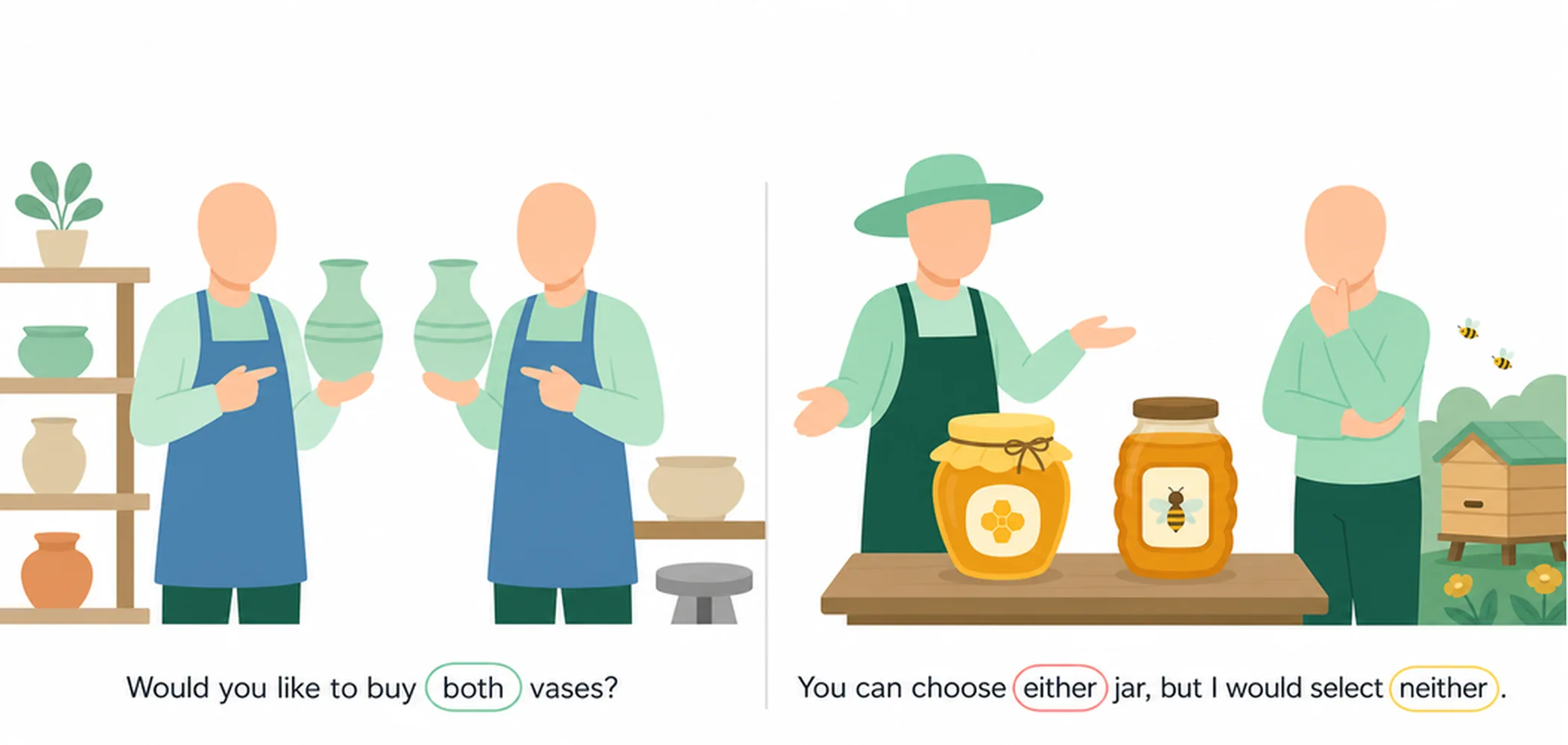
Both, either, and neither are quantifiers used to talk about two people, things, or groups. They answer the question "How many of two things?" Both means two things together. Either means one or the other of two things (but not both). Neither means not one and not the other — zero out of two. These three words are essential for comparing, choosing, and excluding options in everyday English.
Grammar Rules: Singular or Plural?
Both is always followed by a plural noun or plural verb: both students are here. Either and neither can be used with singular or plural forms depending on the structure. When either and neither stand alone as the subject, they take a singular verb: Neither option is good. When they introduce a phrase with "of + plural noun," the verb can be singular or plural, but singular is more common in formal English: Neither of the students was late. In spoken English, plural forms are also acceptable: Neither of them were happy.
Position and Common Patterns
Both, either, and neither appear in different positions in sentences. Both usually comes before a noun (both options), after a verb (they are both tired), or in the phrase "both of": Both of my parents work here. Either appears before a noun (either choice), in phrases like "either...or" (either Monday or Tuesday), or in "either of": Either of these books is fine. Neither appears before a noun (neither problem), in the negative phrase "neither...nor" (neither coffee nor tea), or in "neither of": Neither of the restaurants was open.
Both vs. Either vs. Neither: Side-by-Side Comparison
| Category | BOTH | EITHER | NEITHER |
|---|---|---|---|
| Form | Determiner, pronoun, or conjunction used with plural nouns | Determiner, pronoun, or conjunction used with singular nouns | Determiner, pronoun, or conjunction used with singular nouns |
| Meaning | The two things together; all two | One or the other (or both) of two options; used in affirmative or negative contexts | Not one and not the other; none of the two |
| Quantity Implied | Refers to two things inclusively (100% — both apply) | Refers to one of two options (50% — one applies, choice is open) | Refers to zero of two things (0% — neither applies) |
| Verb Agreement | Takes a plural verb Both students are ready. |
Takes a singular verb (formally); plural is accepted informally Either option is fine. |
Takes a singular verb (formally); plural is accepted informally Neither answer is correct. |
| When to Use | When two things are true or apply simultaneously; used in positive sentences | When presenting a choice between two options; also used in negative sentences instead of "both" | When two things are both untrue or do not apply; used in negative statements without an extra "not" |
| Positive Example | Both films were excellent. Both of them passed the exam. |
You can take either road to get there. Either day works for me. |
Neither film was interesting. Neither of them passed the exam. |
| Negative Example | Both is not typically used with "not" — use neither instead. ✗ I don't like both of them. ✓ I like neither of them. |
I don't like either of the options. (= I like neither of them) |
Neither already contains the negative; do not add "not". ✗ Neither of them didn't come. ✓ Neither of them came. |
| Question Example | Did both of them arrive on time? (Expecting the answer to involve two people) |
Can either of you help me? (Asking if at least one of two people can help) |
Neither is rarely used in direct questions; used in responses: "Which did you prefer?" — "Neither, actually." |
| As a Conjunction | Both … and … Both the teacher and the student were present. |
Either … or … You can have either tea or coffee. |
Neither … nor … Neither the teacher nor the student was present. |
| Key Signal Words | and, together, two of them, the two | or, choice, one of the two, doesn't matter which | nor, not one, not the other, none of the two |
| Common Mistakes | Using "both" with a singular verb: ✗ Both of them is here. ✓ Both of them are here. |
Confusing "either" with "both" in affirmative sentences: ✗ Either films were good. (meaning both) ✓ Both films were good. |
Double negatives with "neither": ✗ I don't want neither. ✓ I want neither. / I don't want either. |
| 🔑 Key Difference: Think of it as a scale: BOTH = two ✔✔ (inclusive, positive — both apply); EITHER = one of two ✔/✔ (selective — a choice or possibility); NEITHER = zero ✘✘ (exclusive, negative — neither applies). A quick memory trick: both → big (includes everything); either → elect (choose one); neither → none (nothing selected). Always remember that neither is already negative — never combine it with another "not." | |||
Examples






What to Remember
- Both refers to two things together and always requires a plural noun or verb form.
- Either means one or the other of two options, but not both at the same time.
- Neither means not one and not the other—zero out of two possible options.
- Either and neither can be used with singular or plural nouns depending on the construction.
- Use both for inclusion, either for alternatives, and neither for exclusion when discussing two items.