Understanding All, Every, and Each
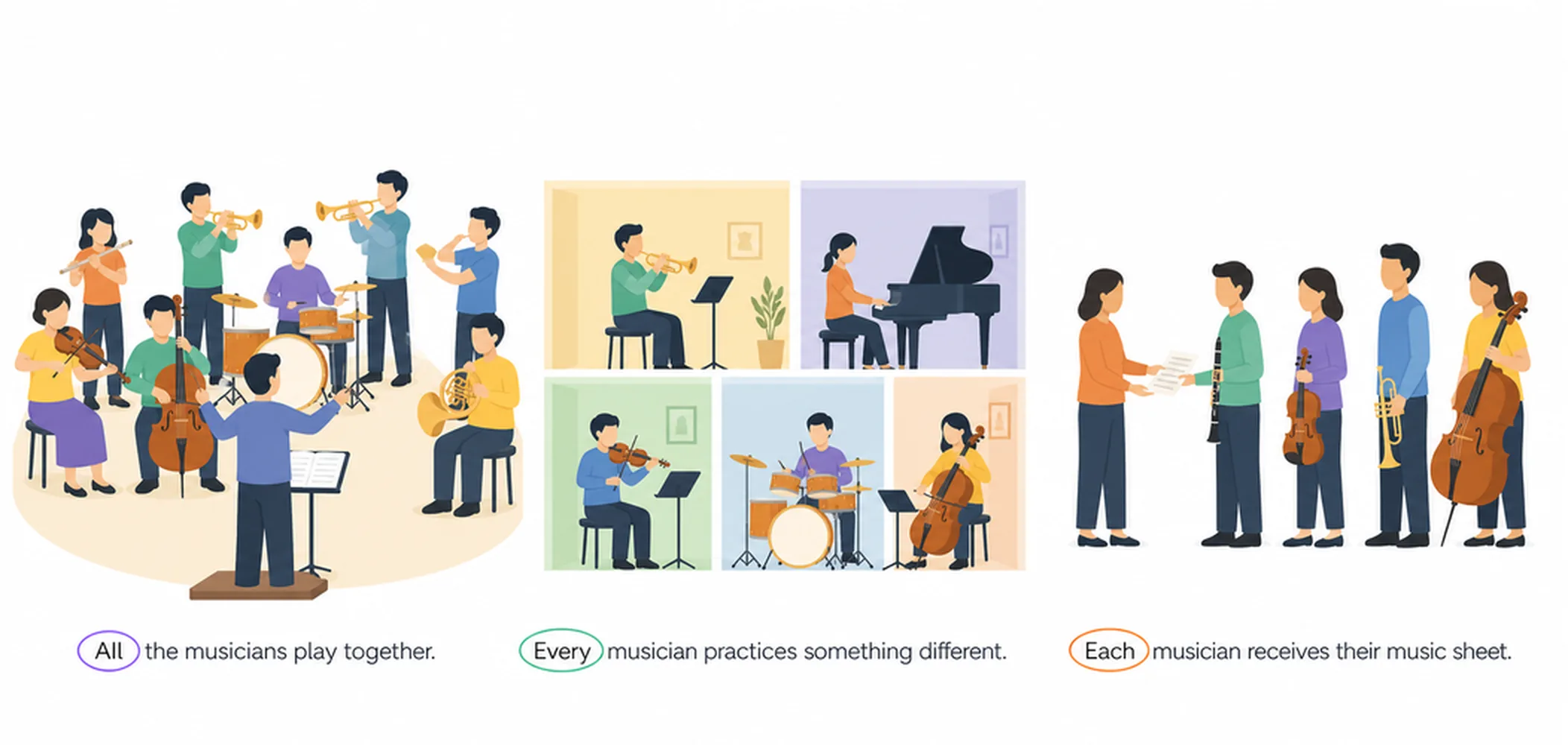
All, every, and each are quantifiers that refer to groups or individual items, but they work differently. All includes the complete group and can refer to things together. Every and each focus on individual members of a group, but every emphasizes a regular pattern or frequency, while each emphasizes individuality or consideration one by one. Understanding these differences helps you express your ideas more precisely in English.
Key Differences at a Glance
ALL is used for complete groups as a whole. It can work with both countable and uncountable nouns, and emphasizes totality. EVERY is used with countable nouns and stresses regularity, repetition, or that something applies to all members without exception. EACH is used with countable nouns and emphasizes individual consideration of each separate member, often used when distributing things one by one.
All vs Every vs Each: Side-by-Side Comparison
| Dimension | All | Every | Each |
|---|---|---|---|
| Form | Used with plural countable nouns (all students), uncountable nouns (all water), or with of (all of the books) | Used only with singular countable nouns (every student); cannot be used with uncountable or plural nouns | Used with singular countable nouns (each student) or with of + plural (each of the students) |
| Noun Type Compatibility | Plural countable nouns ✔ Uncountable nouns ✔ Singular countable nouns ✘ |
Plural countable nouns ✘ Uncountable nouns ✘ Singular countable nouns ✔ |
Plural countable nouns ✘ (direct) Uncountable nouns ✘ Singular countable nouns ✔ |
| Verb Agreement | Takes a plural verb with plural nouns (All students are…); singular verb with uncountable nouns (All the water is…) | Always takes a singular verb (Every student is…) | Usually takes a singular verb (Each student has…); plural verb possible informally with each of them |
| Focus: Group vs. Individual | Focuses on the group as a whole; treats members collectively; emphasises totality | Focuses on individual members but within a generalisation; treats them as a complete set without exception | Focuses on each individual separately; highlights distinctness and separateness of every member |
| When to Use | Use when referring to the entire group collectively, or when including uncountable quantities. Also used in negative and question forms more naturally than every/each. | Use for generalisations about all members of a group, especially in habits, rules, or universal truths. Implies no exceptions. | Use when treating members one by one, often in distributions or when individual attention matters. Common when the number is small or specific. |
| Positive Example | All the children enjoyed the party. All information is stored securely. |
Every child enjoyed the party. Every morning she goes for a run. |
Each child received a gift. Each of the players performed well. |
| Negative Example | Not all students passed the exam. ✔ All students didn't pass. ⚠ (ambiguous) |
Every is rarely used in direct negatives. Use not every carefully: Not every plan succeeds. | Each is rarely used in negatives. Prefer none of: None of them agreed. |
| Question Example | Did all the guests arrive? Is all the luggage here? |
Does every student have a book? Is every room booked? |
Did each participant sign the form? Has each of you been briefed? |
| Minimum Number Required | No minimum — can refer to two or more, or an uncountable mass | Typically implies three or more; sounds unnatural with only two items | Works naturally with two or more; preferred when the group is small or precisely numbered |
| Pronoun / Standalone Use | Can be used as a pronoun: All of them left. / All is well. | Cannot stand alone as a pronoun; must precede a noun: ✘ Every left. | Can be used as a pronoun with of: Each of them spoke. Also standalone: They each received one. |
| Typical Context of Use | Collective statements, totality, uncountable quantities, formal writing, negatives, and questions about the whole group | General rules, habits, universal truths, schedules, and repeated actions (every day, every time) | Distributions, individual attention, legal or formal documents, instructions that apply to separate people/items |
| Key Signal Words / Collocations | all of, all the, not all, all day, all year, above all, after all, all in all | every day, every time, every other, every single, nearly every, almost every | each of, each one, each other, each time, in each case, each and every |
| Key Difference: All treats a group as a single collective whole and is the most flexible — working with plural, uncountable, and negative/question structures. Every also covers all members of a group but individualises them through a general rule or universal truth, always requiring a singular noun and verb, and implying no exceptions exist. Each is the most individual of the three — it zooms in on members one at a time, often in the context of distribution or separate actions, and works naturally even when the group is as small as two. A useful rule of thumb: all = the whole group together; every = all without exception (generalisation); each = one by one (individually). | |||
Examples









What to Remember
- Use "all" to refer to a complete group together or individually.
- Use "every" to describe regular patterns, routines, or things that happen repeatedly.
- Use "each" to emphasize individual consideration or items one by one.
- "Every" and "each" focus on individuals, while "all" includes the entire group.
- Don't confuse "each" (individuality) with "every" (regular frequency or pattern).