Why Dependent Prepositions Are Tricky
Dependent prepositions are small words that follow verbs, adjectives, or nouns. They seem simple, but learners often use the wrong preposition because their native language might use a different one. For example, in English we say 'interested in' but your language might say something different. Learning which preposition goes with which word is important for sounding natural.
Common Dependent Preposition Mistakes at a Glance
| Common Mistake | Correct Form | Example (Correct) | Note |
|---|---|---|---|
| depend of | depend on | It depends on the weather. | Always "on"; "of" is never correct here |
| interested about | interested in | She is interested in art. | "About" is used with "curious", not "interested" |
| good in | good at | He is good at maths. | Use "at" for skills and abilities |
| afraid from | afraid of | She is afraid of spiders. | Fear collocations use "of": scared of, terrified of |
| married with | married to | He is married to Ana. | "With" is a common L1-transfer error |
| listen music | listen to | I listen to music every day. | "Hear" takes no preposition; "listen" always needs "to" |
| wait someone | wait for | I am waiting for the bus. | "Wait" is never directly transitive in standard English |
| agree with something (a plan) | agree to (a plan) / agree with (a person) | I agree with you. / She agreed to the proposal. | Preposition changes depending on the object type |
| responsible of | responsible for | She is responsible for the project. | Common Romance-language transfer error |
| proud about | proud of | They are proud of their daughter. | Feelings of pride always take "of" |
| search something | search for | We searched for the keys. | "Search" as transitive is only used with a place (search the room) |
| different of / different than | different from | This is different from what I expected. | "Different than" is informal AmE; "from" is safest |
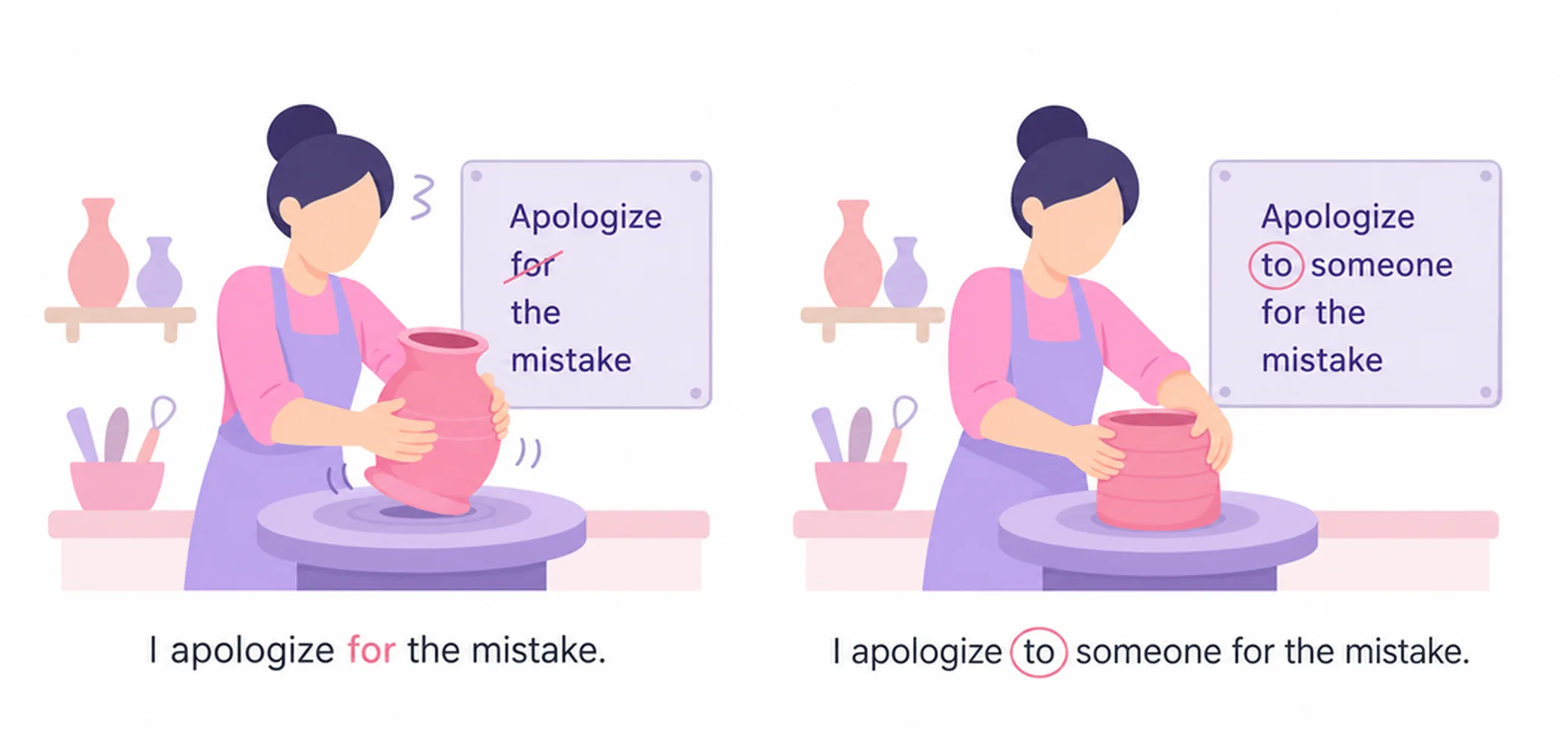
| apologise for someone | apologise to (person) for (reason) | He apologised to her for being late. | Two prepositions often needed together |
| consist in | consist of | The team consists of ten members. | "Consist of" = be made up of; no passive form |
| believe on | believe in | Do you believe in ghosts? | "Believe in" = have faith in; "believe" alone = think something is true |
| suffer of | suffer from | He suffers from anxiety. | Also: die from / of — both can be correct |
| congratulate of | congratulate on | I congratulated her on her promotion. | "Congratulate on" is always used with an achievement or event |
Examples

I am interested in learning English because it is useful for my job.
Adjective + preposition · Motivation

My sister is very good at playing the piano, so she practises every day.
Adjective + preposition · Ability

Children usually depend on their parents for food and education.
Verb + preposition · Relationship

We waited for the bus, but we were not afraid of missing it.
Adjective + preposition · Emotion
When to use it
School & Studies
When talking about subjects, abilities, or school life, remember to use the correct prepositions with adjectives.
"I am good at English but bad at science."
Relationships
When describing relationships and emotions, dependent prepositions help you express your feelings correctly.
"I am interested in meeting new people and I am not afraid of making mistakes."
Communication
Many verbs about listening, waiting, and looking need specific prepositions to be grammatically correct.
"Please listen to what I am saying and wait for my answer."
Signal words
interested in
good at
bad at
depend on
afraid of
married to
listen to
sure about
worried about
look for
wait for
Common Mistakes
✕
Wrong
I am interested on football.
✓
Correct
I am interested in football.
Use 'in' after 'interested', not 'on'. This is a fixed phrase in English.
✕
Wrong
She is good on mathematics.
✓
Correct
She is good at mathematics.
'Good at' is the correct form for skills or subjects. 'Good on' is not standard English.
✕
Wrong
I depend of my parents.
✓
Correct
I depend on my parents.
'Depend on' means to need or trust. Use 'on', not 'of'.
✕
Wrong
He is worried about the exam, but not afraid from it.
✓
Correct
He is worried about the exam, but not afraid of it.
'Afraid of' is the correct form. Use 'of', not 'from'.
✕
Wrong
I am not sure in my answer.
✓
Correct
I am not sure about my answer.
'Sure about' means uncertain regarding something. 'Sure in' is incorrect.
✕
Wrong
We listened the teacher.
✓
Correct
We listened to the teacher.
'Listen to' requires the preposition 'to'. You cannot listen something without 'to'.
✕
Wrong
She is married with John.
✓
Correct
She is married to John.
'Married to' is the standard form. 'Married with' is not correct.
KEY TAKEAWAYS
What to Remember
- Dependent prepositions are fixed word combinations that must be learned as single units, not predicted by rules.
- Dependent prepositions follow specific verbs, adjectives, and nouns and cannot be changed based on context or meaning.
- Common mistake: learners use prepositions from their native language instead of the correct English dependent preposition.
- For example, say "interested in" not "interested on" because English requires this specific preposition, not others.
- Learn dependent prepositions through memorization and practice, as there are few predictable patterns to help you.