What Are Verb + Preposition Collocations?
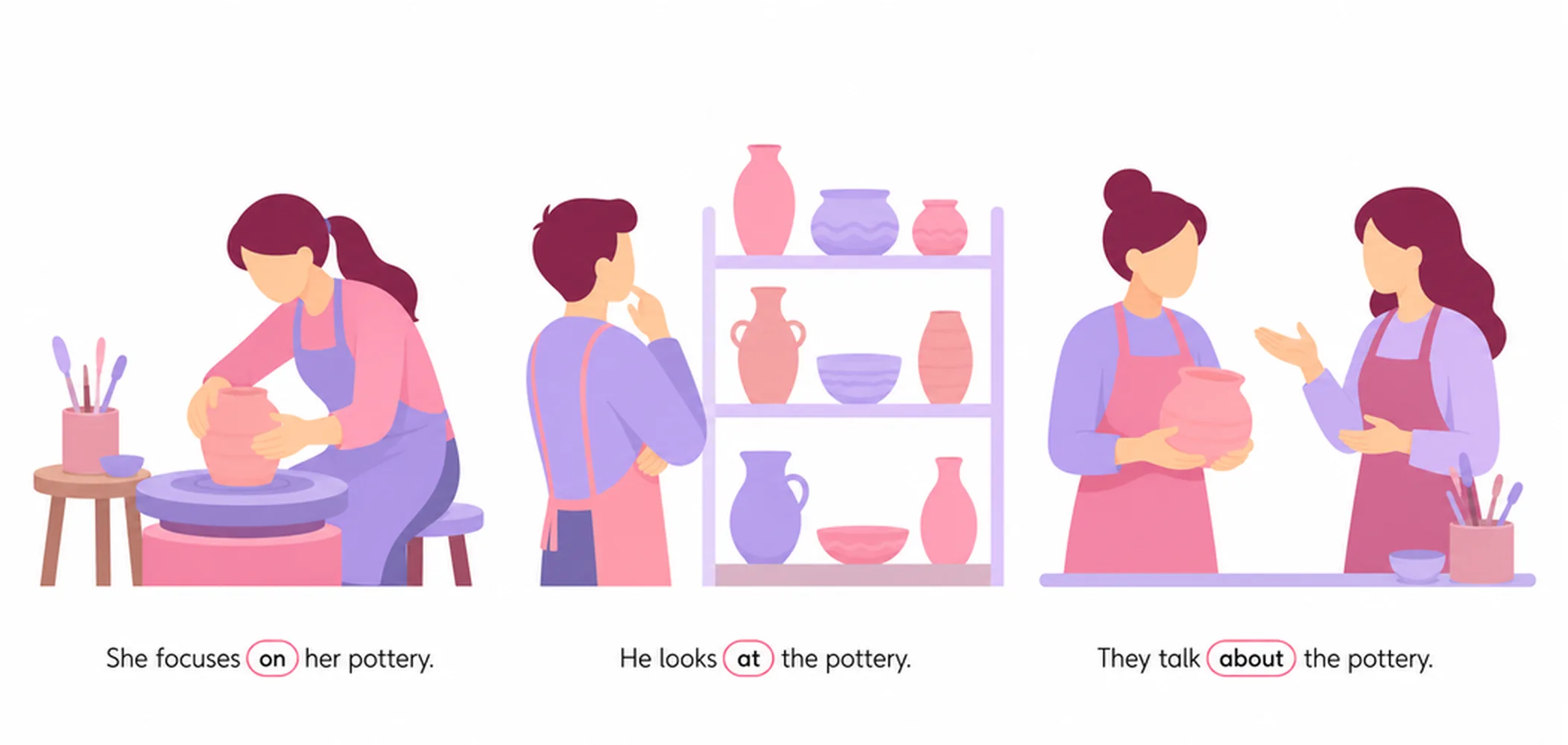
A collocation is a combination of words that naturally go together. Some verbs need a specific preposition after them. For example, we say 'listen to music' not 'listen music'. The preposition cannot change. These verb + preposition combinations are called dependent prepositions. Learning them helps you speak and write more naturally in English.
Why Do We Use Specific Prepositions?
English has many verb + preposition pairs, and sometimes there is no logical reason why. For example, 'depend on' and 'rely on' both mean similar things, but they use the same preposition 'on'. You cannot say 'depend in' or 'rely at'. You must learn these combinations as single units. The best way is to study them in context and practice them regularly.
How to Use Them
The structure is simple: verb + preposition + object. For example: 'I agree with you', 'She waits for the bus', 'They listen to the teacher'. The preposition always comes between the verb and the object. In questions, the preposition usually moves to the end: 'Who are you waiting for?' Remember: the preposition stays with the verb.
Common Verb + Preposition Collocations
Here are six essential combinations you will use every day.
Common Verb + Preposition Collocations List
| Verb | Preposition | Example Phrase | Note |
|---|---|---|---|
| agree | with / on | agree with someone; agree on a plan | with a person; on a topic/decision |
| apologize | for / to | apologize for the mistake; apologize to her | for the action; to the person |
| apply | for / to | apply for a job; apply to a university | for a position; to an institution |
| arrive | at / in | arrive at the airport; arrive in London | at small/specific places; in cities/countries |
| ask | for / about | ask for help; ask about the schedule | for a request; about information |
| believe | in | believe in equality | trust or have faith in something |
| belong | to | belong to a club | ownership or membership |
| care | about / for | care about the environment; care for a patient | about = concern; for = look after |
| complain | about / to | complain about the noise; complain to the manager | about the issue; to the person |
| concentrate | on | concentrate on your work | focus attention on something |
| consist | of | consist of three parts | never use consist in passive |
| deal | with | deal with a problem | handle or address something |
| depend | on | depend on the weather | do not say depend of |
| dream | about / of | dream about flying; dream of success | about = while sleeping; of = aspiration |
| insist | on | insist on paying the bill | demand firmly |
| laugh | at | laugh at a joke | can imply mockery in context |
| listen | to | listen to music | pay attention to sound |
Examples






What to Remember
- A collocation is a natural word combination; some verbs require a specific preposition that cannot be changed.
- Common verb + preposition pairs include 'listen to', 'depend on', and 'rely on' which must be memorized.
- The preposition after a verb is fixed; you cannot substitute it with a different preposition.
- There is often no logical reason why certain verbs take certain prepositions; learn them as single units.
- Using the correct verb + preposition combination helps you speak and write English more naturally and accurately.