What Are Dependent Prepositions?
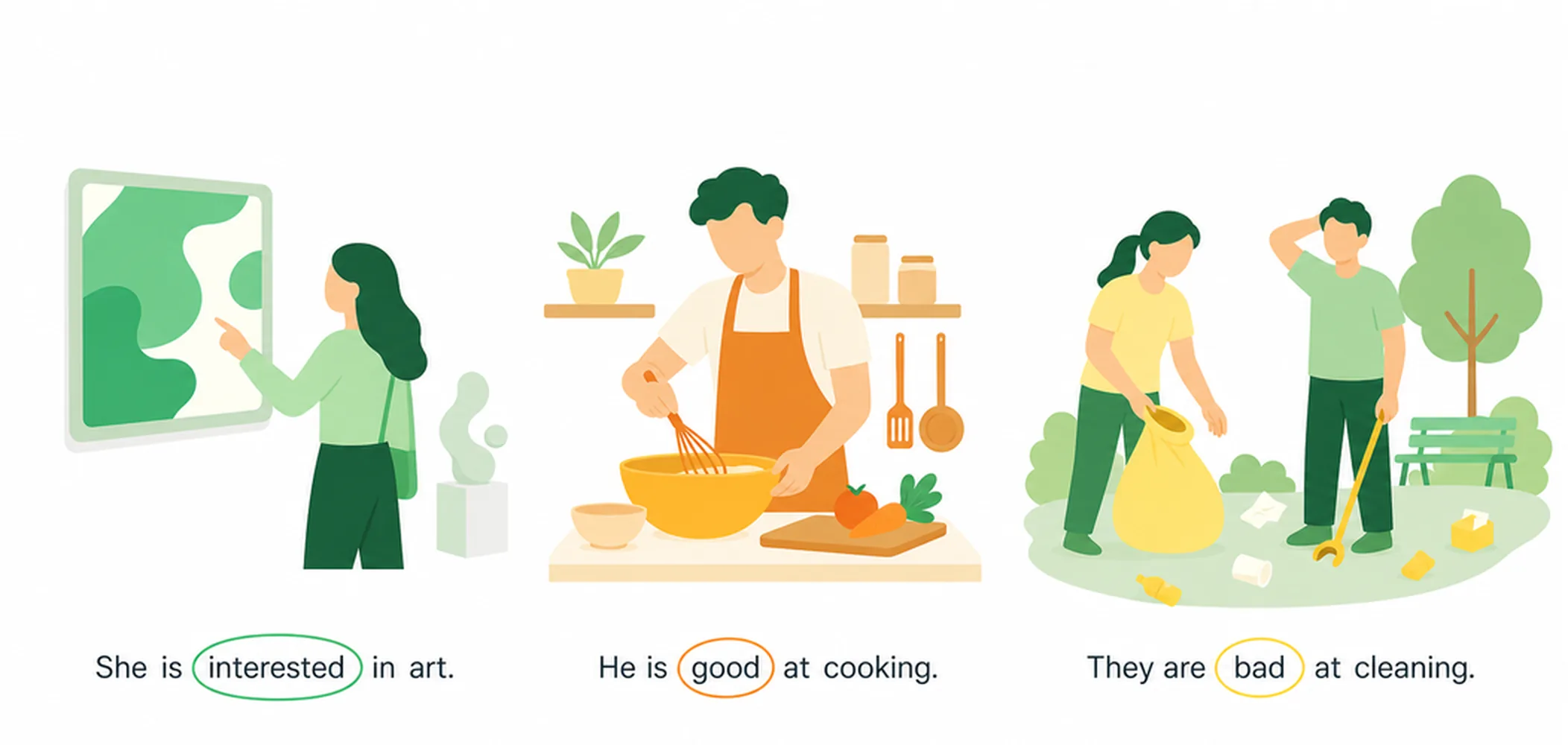
Some adjectives in English always need a specific preposition after them. We call these dependent prepositions. You cannot change or remove them—they are fixed patterns. In this lesson, we focus on three very common adjectives: interested, good, and bad. Learning these patterns will help you speak and write more naturally.
Interested + IN
When you want to say that someone likes or wants to know more about something, use interested + IN. This is the most common pattern with 'interested'. After 'interested in', you can use a noun or a gerund (verb + -ing form).
Good AT / Bad AT
To describe someone's ability or skill, use good/bad + AT. This pattern shows what someone does well or poorly. After 'good at' or 'bad at', you usually use a gerund (verb + -ing form), but you can also use nouns.
Quick Memory Tip
Remember: INTERESTED = IN (both start with 'in'). GOOD/BAD = AT (when talking about ABILITY). Use these mental links to remember the correct prepositions.
Examples in Context
She has always been interested in learning new languages.
Are you interested in joining our volunteer programme this summer?
My brother is interested in vintage motorcycles and spends every weekend restoring them.
The investors are interested in acquiring a stake in the start-up.
Marcus has always been good at maths, so studying engineering was a natural choice.
She is surprisingly good at remembering names, even years after meeting someone.
Regular exercise is good for both your physical and mental health.
This calcium supplement is good for strengthening bones and teeth.
He is not particularly good at public speaking, but he practises every day to improve.
I'm really bad at keeping secrets — I always end up telling someone!
She admitted she was bad at managing her time and decided to take an online course.
Eating too much sugar is bad for your teeth and can lead to serious health problems.
Staying up until 2 a.m. every night is bad for your concentration the next day.
The new regulations could be bad for small businesses that cannot afford the compliance costs.
What to Remember
- Use interested + IN when talking about liking or wanting to know more about something.
- Good + AT describes someone's skill or ability in doing something specific.
- Bad + AT means someone is not skillful or doesn't perform well at something.
- These dependent prepositions are fixed patterns; you cannot change or remove them.
- Learning these three patterns helps you speak and write English more naturally and correctly.