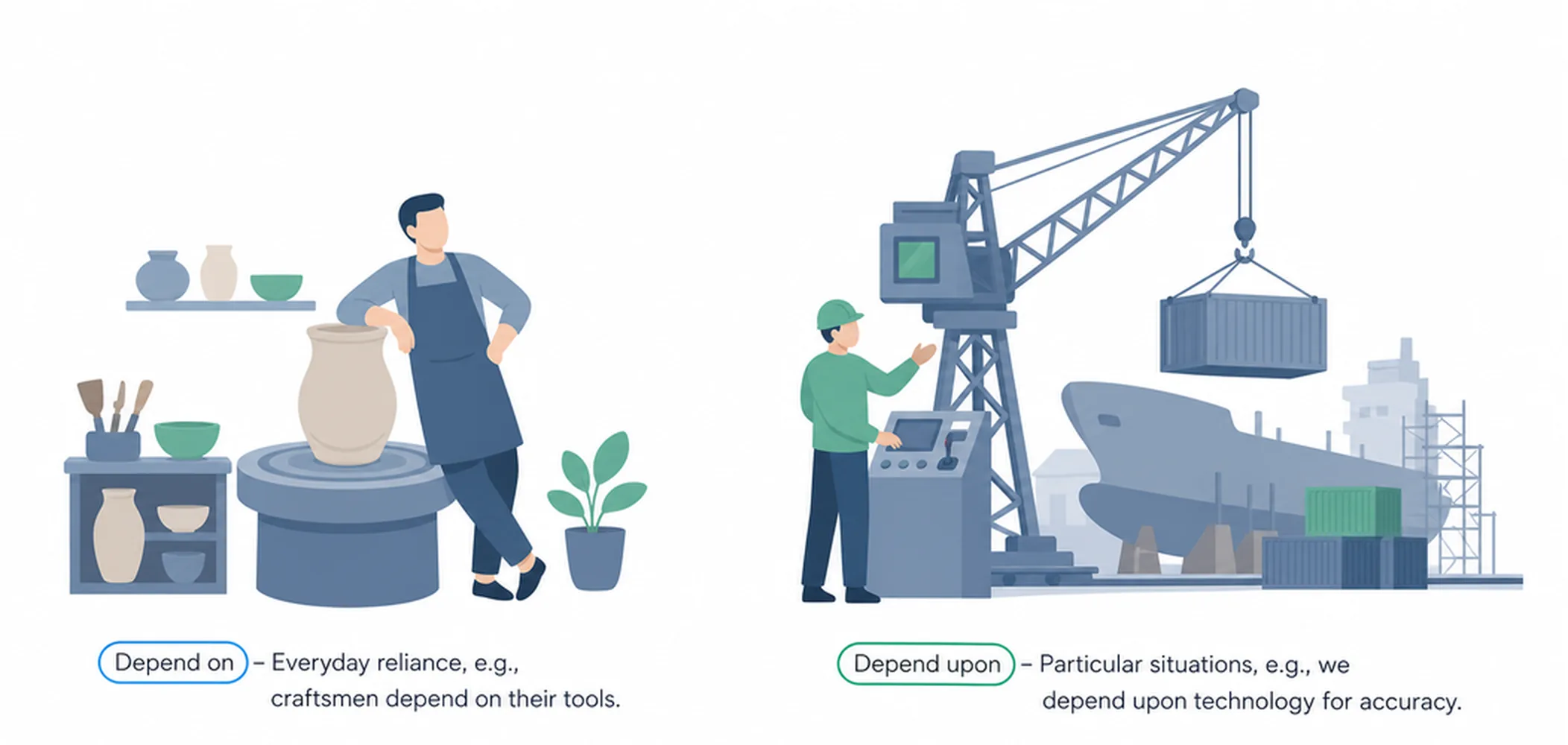
Depend On vs Depend Upon
Both 'depend on' and 'depend upon' have the same meaning: to need something or someone to help you, or to trust that something will happen. The main difference is frequency. 'Depend on' is much more common in everyday English, especially in spoken English and informal writing. 'Depend upon' is correct but sounds more formal and old-fashioned. In modern English, most people use 'depend on'.
Examples with 'Depend On'
Here are three common examples using 'depend on':
Depend On vs Depend Upon: Side-by-Side Comparison
| Dimension | Depend On | Depend Upon |
|---|---|---|
| Form | Phrasal verb using the preposition on | Phrasal verb using the preposition upon |
| Formality Level | Neutral to informal; suitable for everyday conversation and casual writing | Formal to very formal; preferred in academic, legal, literary, and official writing |
| Frequency of Use | Much more common in modern usage; the dominant form in both British and American English | Less frequent in modern usage; more commonly found in older texts, literature, and formal documents |
| Context (Spoken / Written) | Widely used in both spoken and written English; the natural choice in speech | Rarely used in spoken English; primarily appears in formal written contexts |
| Tone | Conversational, neutral, approachable | Elevated, authoritative, literary, ceremonial |
| When to Use | Use in everyday conversation, informal emails, general writing, and whenever a natural, modern tone is desired | Use in academic essays, legal contracts, formal speeches, literary prose, or when deliberately aiming for a formal or elevated register |
| Positive Example | "The children depend on their parents for support." | "The nation's prosperity depends upon the integrity of its institutions." |
| Negative Example | "You cannot depend on the weather to stay dry during the festival." | "One cannot depend upon mere assumptions when drafting legislation." |
| Question Example | "Can we depend on you to finish the project on time?" | "Upon what evidence does the committee depend upon to reach this conclusion?" |
| Key Signal Words / Typical Companions | Everyday nouns: friends, family, team, luck, weather, technology | Abstract or elevated nouns: principle, truth, justice, evidence, circumstance, integrity |
| Grammatical Interchangeability | Fully interchangeable with depend upon in terms of grammar and meaning | Fully interchangeable with depend on in terms of grammar and meaning |
| Regional Preference | Preferred in American English and increasingly dominant in British English | Slightly more retained in British English formal writing than in American English |
| 🔑 Key Difference: Depend on and depend upon are grammatically and semantically identical — both mean "to rely on" or "to be contingent on." The only real distinction is one of register and tone. Depend on is the standard, everyday choice suitable for most contexts, while depend upon carries a more formal, elevated, or literary quality and is best reserved for academic, legal, or ceremonial writing. When in doubt, depend on is always appropriate. | ||
Examples

I depend on my parents for money.
Everyday usage · Verb phrase

The success of the project depends on good teamwork.
Work/School · Present simple

Can I depend on you to help me tomorrow?
Informal question · Trust/Reliability

The harvest depends upon the weather.
Formal/Literary · Agriculture

We cannot depend upon him to arrive on time.
Formal speech · Negative

Their future depends upon this decision.
Formal writing · Consequence
When to use it
Family and relationships
Talk about relying on family members or close people for support.
"I depend on my sister for advice."
Work and business
Describe things that affect success or outcomes at work.
"Our company depends on good customer service."
Study and exams
Explain factors that influence results in school.
"My grade depends on the final test."
Signal words
depend on
depend upon
depends on
depends upon
depending on
depending upon
Common Mistakes
✕
Wrong
I depends on my friends.
✓
Correct
I depend on my friends.
Verb must match subject. 'I' takes 'depend' (no -s), not 'depends'.
✕
Wrong
My success depend on hard work.
✓
Correct
My success depends on hard work.
With singular subject 'success', use 'depends' (with -s), not 'depend'.
✕
Wrong
You can depend on I to help you.
✓
Correct
You can depend on me to help you.
After preposition 'on', use object pronoun 'me', not subject pronoun 'I'.
KEY TAKEAWAYS
What to Remember
- Both 'depend on' and 'depend upon' mean the same thing: to need or rely on someone or something.
- 'Depend on' is much more common in modern English, especially in spoken and informal writing.
- 'Depend upon' is grammatically correct but sounds formal and old-fashioned in contemporary usage.
- Use 'depend on' in everyday conversation and casual writing for natural, current English.
- These phrases always require a preposition; you cannot say 'depend' alone without 'on' or 'upon'.