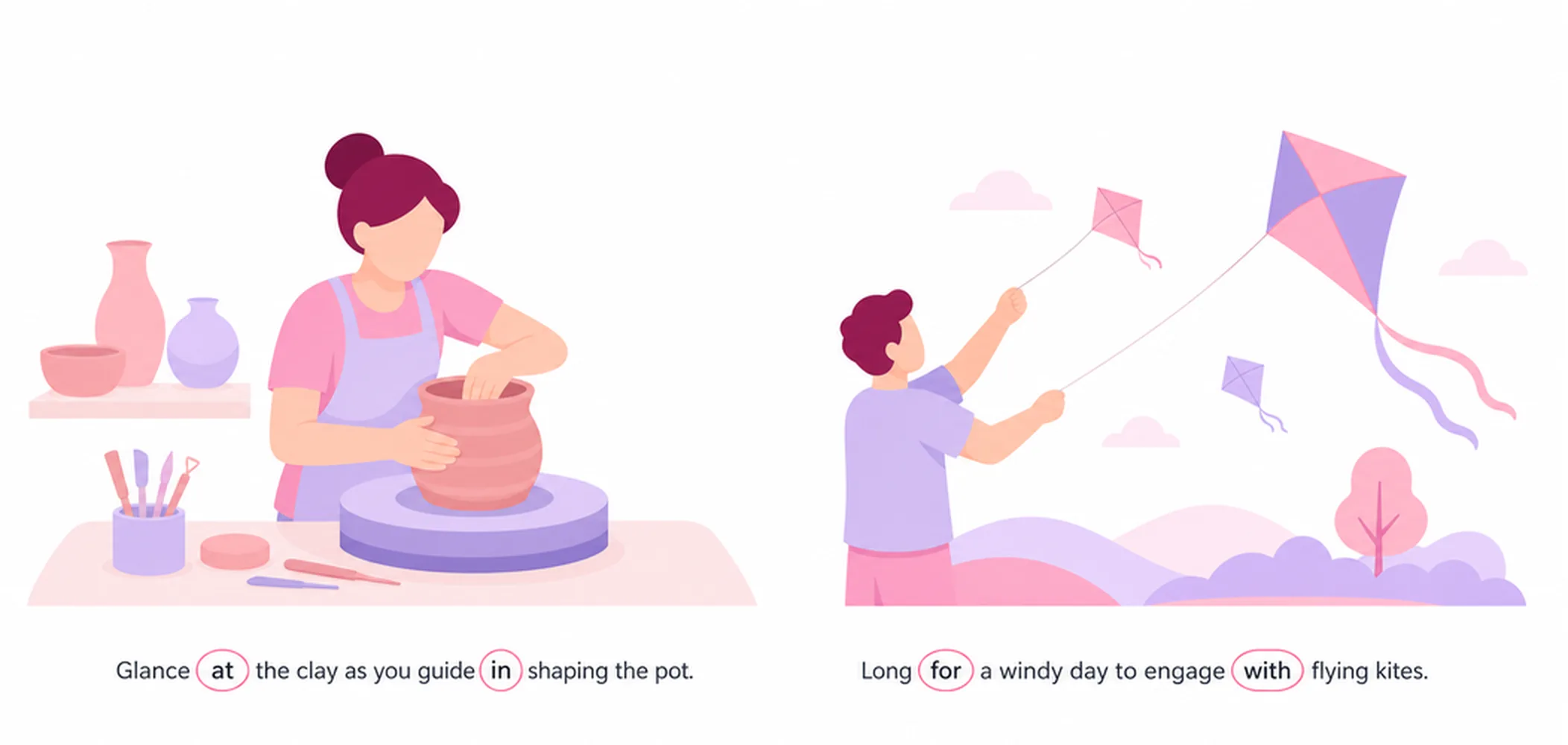
What Are Dependent Prepositions?
A dependent preposition is a preposition that always follows a specific verb. You cannot change or remove it without making the sentence wrong. For example, we say 'good at' not 'good in' or 'good for'. These combinations must be learned together as fixed phrases. This lesson covers verbs starting with letters G through Z.
Why Learn These Phrases?
Dependent prepositions are common in everyday English. Using the correct preposition helps you sound natural and communicate clearly. Native speakers always use these fixed combinations, so learning them is essential for speaking and writing correctly at the A2 level and beyond.
How to Study Dependent Prepositions
The best way to learn dependent prepositions is to study them in groups and use them in sentences. Say the phrase out loud several times. Write example sentences. Notice that some verbs can take different prepositions with different meanings. Always check a dictionary or grammar guide when you learn a new verb.
Verb + Preposition List (G–Z)
| Verb | Preposition | Example | Meaning Note |
|---|---|---|---|
| get | over | She finally got over her cold. | Recover from something |
| get | rid of | He got rid of old clothes. | Remove or discard |
| glance | at | She glanced at her watch. | Take a quick look at |
| glare | at | He glared at the rude driver. | Stare angrily at |
| graduate | from | She graduated from university. | Complete a course of study |
| guard | against | Guard against infection. | Protect oneself from |
| happen | to | What happened to him? | Occur to someone/something |
| hear | about / of | Have you heard about the news? | Receive information regarding |
| hear | from | I haven't heard from her. | Receive contact/communication from |
| help | with | Can you help me with this? | Assist someone in doing something |
| hint | at | She hinted at a surprise. | Suggest indirectly |
| hope | for | We hoped for good weather. | Wish that something will happen |
| insist | on | He insisted on paying. | Demand firmly |
| invest | in | They invested in stocks. | Put money/effort into |
| joke | about | Don't joke about serious things. | Make light of a topic |
| know | about | Do you know about this rule? | Be aware of / informed about |
| laugh | at | They laughed at the joke. | Find something amusing (or mock) |
| learn | about / from | We learn from our mistakes. | Gain knowledge through experience |
| listen | to | Listen to the teacher. | Pay attention to sound/speech |
| look | at | Look at the picture. | Direct one's gaze toward |
Examples




What to Remember
- A dependent preposition is a fixed preposition that always follows a specific verb and cannot be changed.
- Learn dependent prepositions as complete phrases with their verbs, not as separate grammar rules.
- You cannot substitute different prepositions for dependent prepositions without making the sentence grammatically incorrect.
- Common verb-preposition combinations like 'good at' and 'interested in' must be memorized together.
- Using correct dependent prepositions helps you sound natural and communicate clearly like a native speaker.