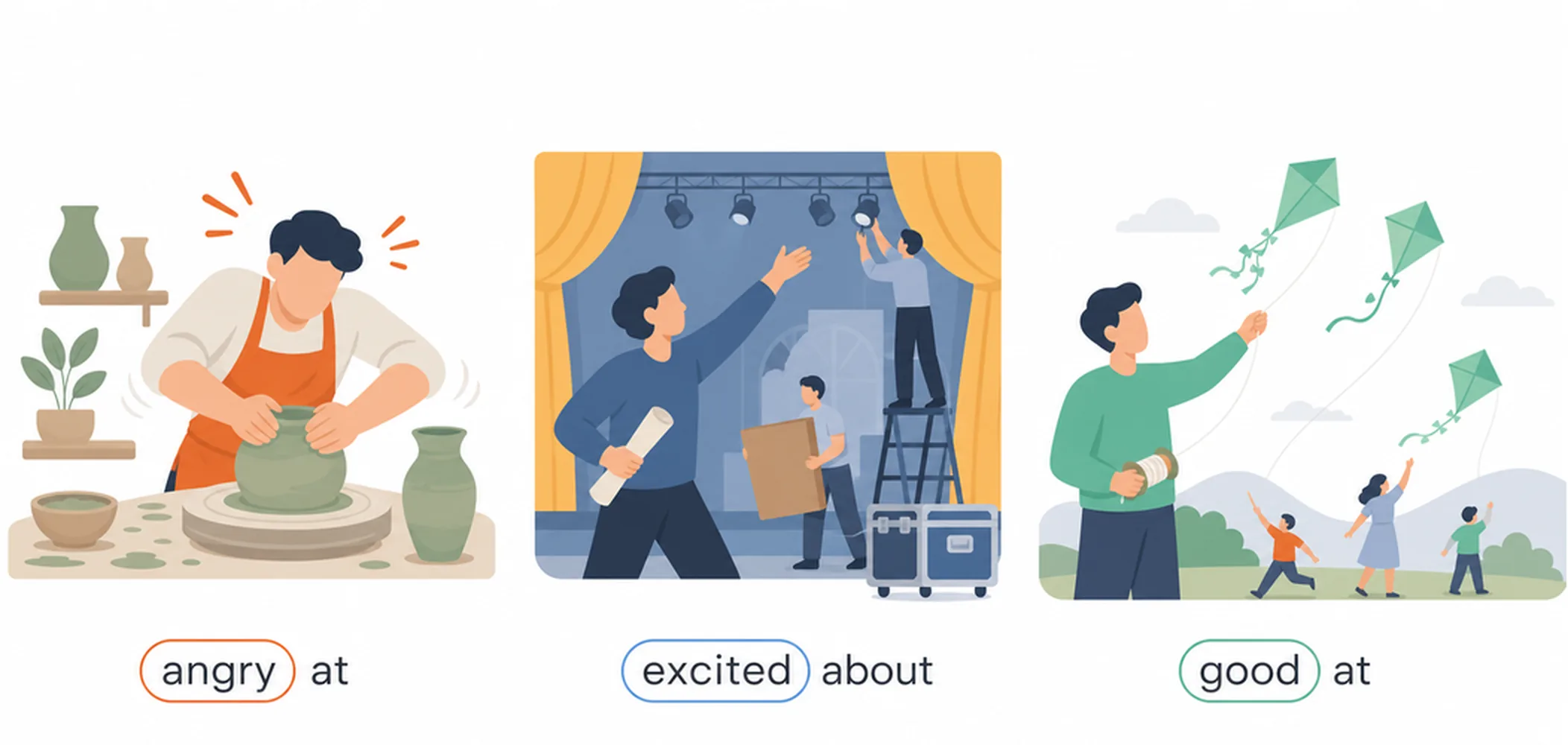
What are dependent prepositions?
A dependent preposition is a preposition that always follows a specific adjective. We cannot change or remove it. The adjective and preposition work together as a fixed phrase. For example, we say 'afraid of' and not 'afraid to' or 'afraid for'. Learning these phrases helps you speak and write more naturally in English.
Why are they important?
English speakers always use the same preposition with the same adjective. If you use the wrong preposition, it sounds incorrect—even if a native speaker understands you. For this reason, it is best to learn adjective + preposition combinations as single units, just like vocabulary.
Structure: adjective + dependent preposition
The pattern is simple: adjective + preposition + noun or gerund (verb + -ing). For example: 'I am interested in learning Spanish' or 'She is good at drawing'. The dependent preposition comes immediately after the adjective and before the object.
Adjective + Preposition List (A–M)
| Adjective | Preposition | Example Phrase | Note |
|---|---|---|---|
| absent | from | absent from school | not present at a place |
| accustomed | to | accustomed to the noise | familiar through habit |
| afraid | of | afraid of spiders | feeling fear about something |
| amazed | at / by | amazed at her talent | both prepositions accepted |
| angry | about / with / at | angry about the delay; angry with him | about = situation; with/at = person |
| annoyed | about / with / at | annoyed about the mistake | same pattern as angry |
| anxious | about / for | anxious about the results | for = eager; about = worried |
| ashamed | of | ashamed of his behaviour | feeling guilt or embarrassment |
| associated | with | associated with crime | linked or connected to |
| aware | of | aware of the risks | having knowledge of |
| bad | at / for | bad at maths; bad for health | at = skill; for = effect |
| based | on / in | based on facts; based in London | on = foundation; in = location |
| bored | with / by | bored with the routine | both prepositions common |
| brilliant | at | brilliant at chess | exceptionally skilled |
| capable | of | capable of great things | having the ability to do |
| careful | about / with / of | careful about spending; careful with money | multiple prepositions depending on context |
| certain | of / about | certain of success | confident something is true |
| characteristic | of | characteristic of the region | typical or distinctive feature |
| close | to | close to the station | near in distance or relationship |
| committed | to | committed to the cause | dedicated or bound to |
Examples






What to Remember
- A dependent preposition always follows a specific adjective and cannot be changed or removed.
- The adjective and preposition together form a fixed phrase that must be learned as one unit.
- Using the wrong preposition with an adjective sounds incorrect, even if native speakers understand your meaning.
- English speakers always use the same preposition with the same adjective without variation.
- Memorize dependent prepositions with their adjectives to speak and write more naturally in English.