What Are Dependent Prepositions?
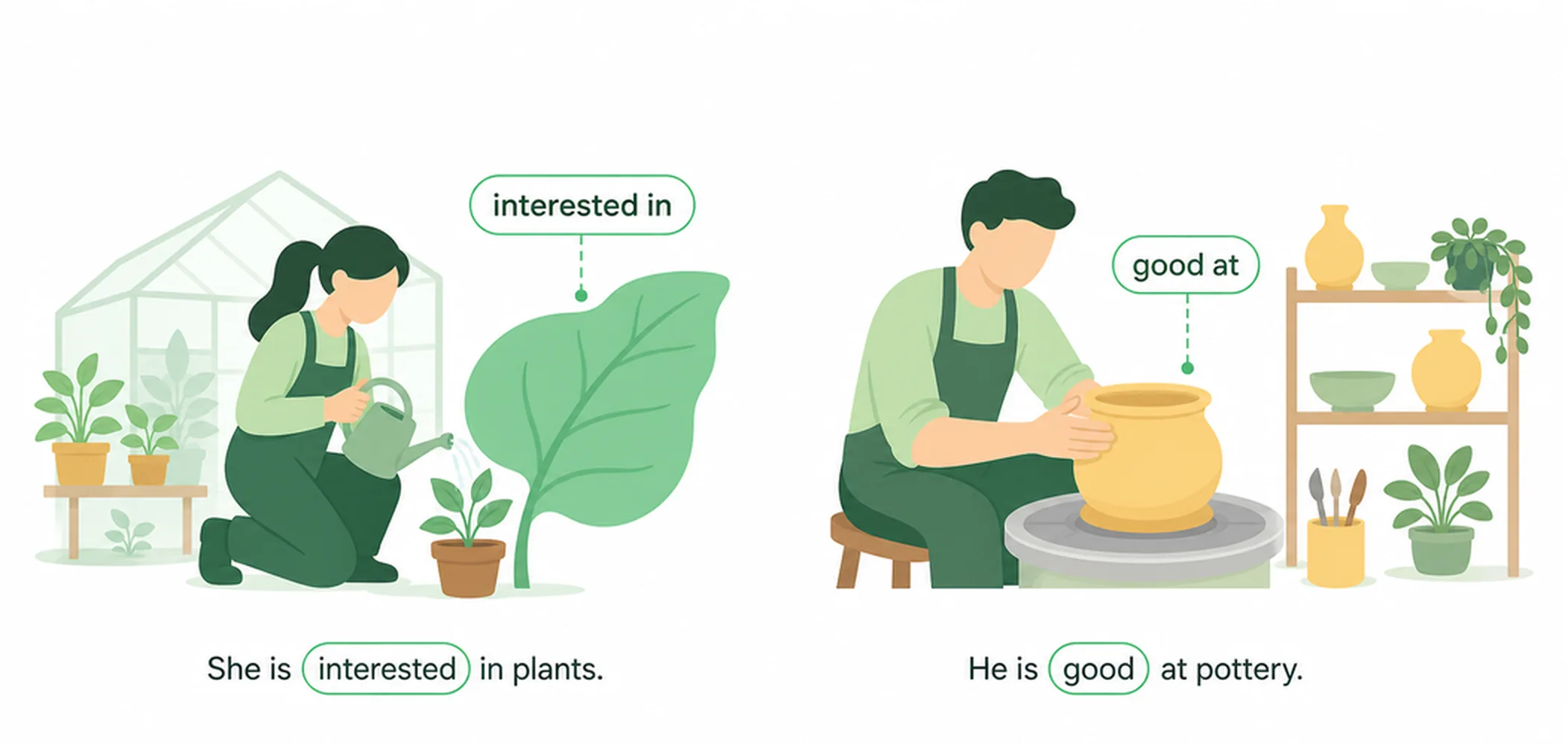
A dependent preposition is a preposition that always follows a specific verb or adjective. You cannot change it or leave it out. The preposition depends on the word before it. For example, we say 'interested in' not 'interested on' or 'interested for'. The preposition 'in' is dependent on the adjective 'interested'.
Dependent Prepositions with Verbs
Many common verbs need a specific preposition. When you 'listen to' music, you must use 'to'. When you 'look at' something, you must use 'at'. When you 'wait for' someone, you must use 'for'. These prepositions are not optional—they are part of the verb phrase. Learning these verb + preposition combinations is important for sounding natural in English.
Dependent Prepositions with Adjectives
Adjectives also have dependent prepositions. We say 'good at' (not 'good in'), 'afraid of' (not 'afraid for'), and 'different from' (not 'different than'). When you use an adjective, the preposition must match. This is a fixed pattern in English, and it is important to memorize these combinations to use English correctly.
Common Dependent Prepositions at a Glance
| Verb / Adjective | Preposition | Example |
|---|---|---|
| VERBS | ||
| agree | with | I agree with you. |
| apologize | for | She apologized for being late. |
| apply | for | He applied for the job. |
| arrive | at / in | We arrived at the station / in Paris. |
| ask | for | She asked for help. |
| believe | in | I believe in hard work. |
| belong | to | This bag belongs to me. |
| care | about / for | She cares about the environment. |
| complain | about | They complained about the noise. |
| concentrate | on | Please concentrate on the task. |
| consist | of | The team consists of ten people. |
| deal | with | We must deal with the problem. |
| depend | on | It depends on the weather. |
| dream | of / about | She dreams of travelling the world. |
| insist | on | He insisted on paying. |
| laugh | at | They laughed at the joke. |
| listen | to | Listen to the teacher. |
| look | at / for / after | Look at this! / look for keys / look after the kids. |
| pay | for | I paid for the meal. |
| refer | to | He referred to the manual. |
| rely | on | You can rely on her. |
| search | for | Police searched for clues. |
| specialize | in | She specializes in tax law. |
| succeed | in | He succeeded in passing the exam. |
Examples





What to Remember
- A dependent preposition is a preposition that must follow a specific verb or adjective and cannot be changed.
- The correct preposition depends on the word before it, not on the meaning of the sentence.
- Common verb + preposition combinations include 'listen to', 'look at', 'wait for', and 'interested in'.
- You must memorize dependent prepositions because they cannot be replaced with other prepositions without sounding wrong.
- Each verb or adjective has only one correct dependent preposition that must always be used with it.