What are Dependent Prepositions?
Some English verbs always go with a specific preposition. We call these dependent prepositions. The preposition changes the meaning of the verb. You cannot change or remove the preposition—it is part of the verb phrase. Learning these combinations helps you speak and write more naturally.
Common Verb + Preposition Combinations
Different prepositions work with different verbs. For example, we say "believe in" (not "believe at"), "listen to" (not "listen at"), and "wait for" (not "wait at"). Each verb has its own correct preposition. You need to learn these as fixed patterns.
Why Learn Verb + Prepositions?
Native speakers use these combinations every day. If you use the wrong preposition, your meaning becomes unclear or sounds unnatural. Learning verb + preposition pairs is one of the fastest ways to improve your fluency and sound more like a native English speaker.
Verb + Preposition List: in, at, on, for, to, with
| Preposition | Verb | Example | Note |
|---|---|---|---|
| in | believe in | She believes in hard work. | To have faith or confidence in something |
| specialise in | He specialises in tax law. | Focus on a particular area | |
| result in | The storm resulted in flooding. | Cause a particular outcome | |
| succeed in | She succeeded in passing the exam. | Achieve something | |
| invest in | They invested in real estate. | Put money or effort into | |
| involve in | Don't involve me in this. | Include someone in an activity | |
| participate in | Everyone participated in the discussion. | Take part in an activity | |
| at | look at | Look at this photo! | Direct your eyes toward something |
| laugh at | They laughed at his joke. | React with laughter (can be mocking) | |
| aim at | She aimed at the target. | Direct toward a goal or object | |
| arrive at | We arrived at the station late. | Reach a specific place (not cities) | |
| shout at | He shouted at the driver. | Raise voice in anger toward someone | |
| stare at | Stop staring at me! | Look steadily and intently | |
| surprise at | I was surprised at the news. | React with astonishment | |
| on | concentrate on | Concentrate on your work. | Focus attention on something |
| depend on | It depends on the weather. | Be affected or determined by | |
| insist on | She insists on paying. | Demand or firmly maintain | |
| rely on | Can I rely on you? | Trust or be dependent on | |
| spend (time/money) on | She spent hours on the report. | Devote resources to something | |
| comment on | He commented on her work. | Give an opinion about | |
| congratulate on | Congrats on your promotion! | Praise someone for an achievement | |
| for | apply for | She applied for the job. | Make a formal request for something |
| account for | How do you account for the difference? | Explain or give reason for | |
| ask for | Can I ask for a favour? | Request something from someone | |
| care for | She cares for her elderly mother. | Look after or feel affection for | |
| search for | I'm searching for my keys. | Try to find something | |
| apologise for | He apologised for being late. | Express regret for something | |
| blame for | Don't blame me for this mistake. | Hold responsible for | |
| to | listen to | Listen to this song! | Pay attention with the ear |
| speak to | Can I speak to the manager? | Talk directly with someone | |
| talk to | She's talking to her friend. | Converse with someone | |
| write to | Write to us if you have questions. | Communicate in writing with someone | |
| turn to | She turned to me for advice. | Seek help or support from someone | |
| respond to | He didn't respond to my email. | Reply or react to something | |
| object to | I object to this decision. | Express disagreement or protest | |
| with | agree with | I agree with you on this. | Have the same opinion as someone |
| cope with | How do you cope with stress? | Deal with or manage something difficult | |
| deal with | I'll deal with it tomorrow. | Handle or take action concerning | |
| disagree with | I disagree with your opinion. | Have a different opinion from someone | |
| fight with | Don't fight with your siblings. | Argue or struggle against someone | |
| compare with | Compare this with the previous model. | Examine similarities and differences | |
| communicate with | I need to communicate with the team. | Exchange information with someone |
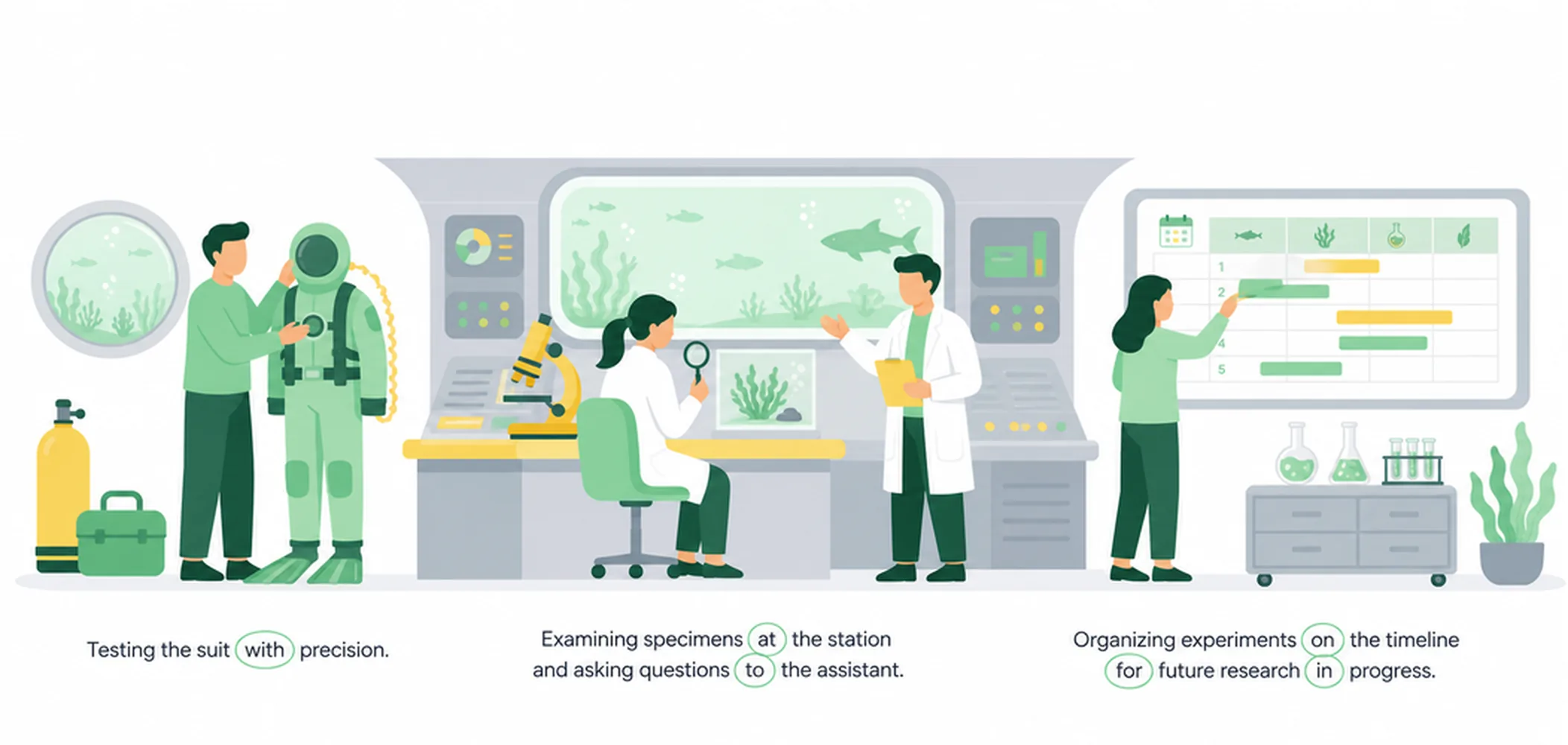
Examples






What to Remember
- Some English verbs always need a specific preposition that cannot be changed or removed.
- Common verb + preposition combinations include: believe in, listen to, wait for, and look at.
- You cannot replace the preposition with another one—say "believe in" never "believe at."
- Each verb has only one correct dependent preposition, so learn them as fixed phrases.
- Dependent prepositions are part of the verb phrase and change the verb's meaning.