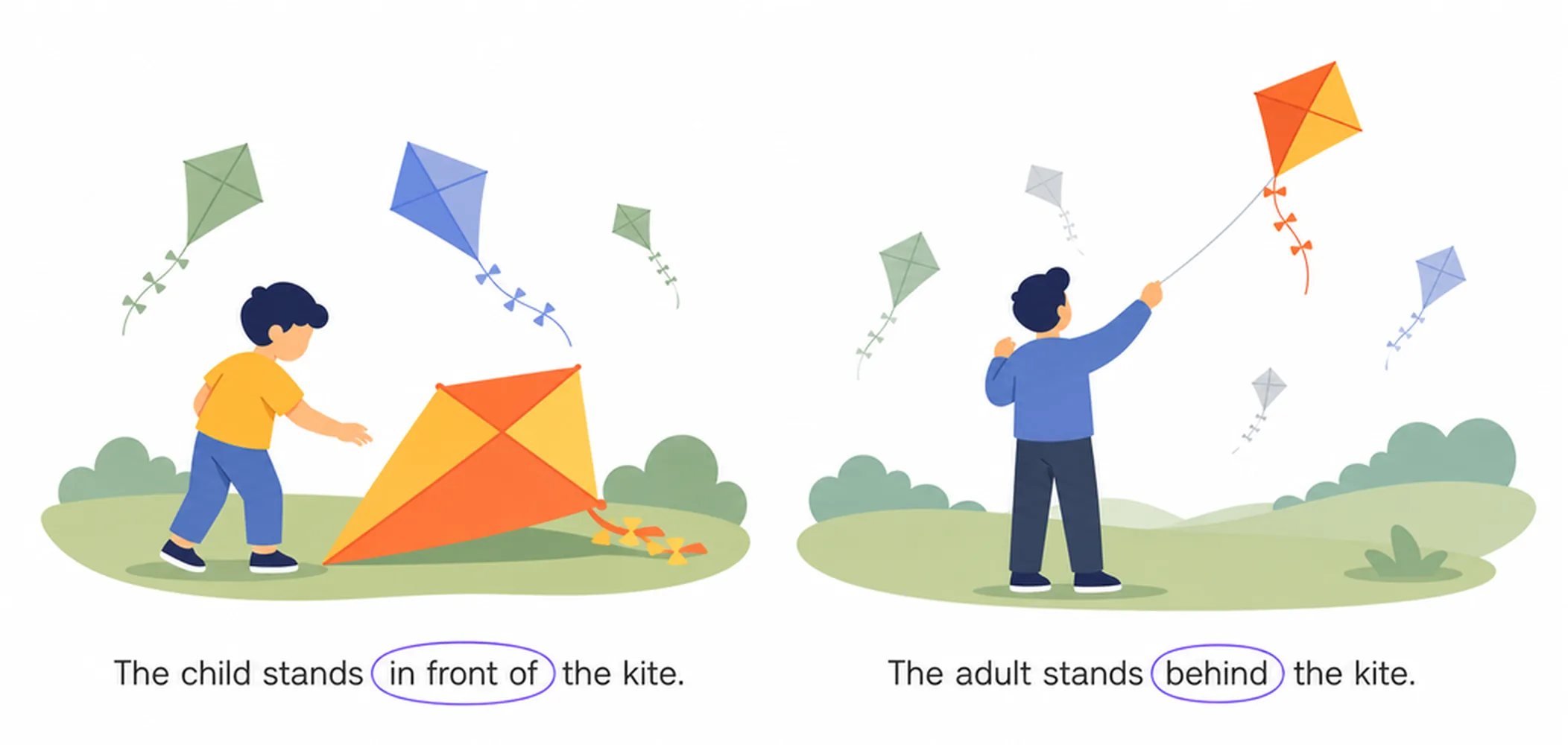
The Key Difference
In front of and behind are opposite prepositions of place. Use in front of to show that something is ahead or facing forward. Use behind to show that something is at the back or hidden. Both prepositions help you describe where people and things are positioned in relation to other things.
In Front Of vs Behind
In front of means before or facing something. It describes the space ahead or the forward position. Behind means at the back or on the other side. It describes the space at the rear or what is hidden from view.
In Front Of vs Behind: Side-by-Side Comparison
| Dimension | In Front Of | Behind |
|---|---|---|
| Form | Three-word prepositional phrase: in + front + of | Single-word preposition: behind |
| Meaning | Indicates that something or someone is positioned at the forward-facing side of a reference point; facing the front. | Indicates that something or someone is positioned at the rear or back side of a reference point; at the back. |
| Position Described | Forward / anterior position — closer to the direction something faces or is oriented toward. | Rearward / posterior position — further from the direction something faces, at the back. |
| When to Use | Use when describing something located at the front of a place, object, or person; when something precedes or faces another thing. | Use when describing something located at the back of a place, object, or person; when something follows or is hidden from the front view. |
| Positive Example | The car is parked in front of the house. She stood in front of the mirror. |
The garden is behind the house. He was hiding behind the tree. |
| Negative Example | There is no bench in front of the school today. Nobody was standing in front of the stage. |
There is nothing behind the curtain. No one was waiting behind the building. |
| Question Example | Is there a parking space in front of the shop? Who is standing in front of you? |
What is behind that door? Is someone hiding behind the sofa? |
| Key Signal Words / Contexts | Facing, forward, ahead, entrance, audience, queue (first in line), visible side | Rear, back, hidden, following, last in line, concealed, back yard/garden |
| Common Mistakes | Omitting "of" — saying "in front the car" instead of "in front of the car" is incorrect. | Confusing with "after" in time contexts — "behind" refers to physical position, not sequence in time. |
| Figurative / Extended Use | In front of can mean in someone's presence: "Don't say that in front of the children." | Behind can mean lagging or being the cause: "She is behind schedule." / "He is the brain behind the project." |
| 🔑 Key Difference: In front of and behind are opposite prepositions of place. In front of places something at the forward-facing or visible side of a reference object, while behind places something at the rear or hidden side. They are directional opposites — if A is in front of B, then B is automatically behind A. Note that in front of always requires the preposition "of" and consists of three words, whereas behind is a single word that stands alone. | ||
Examples
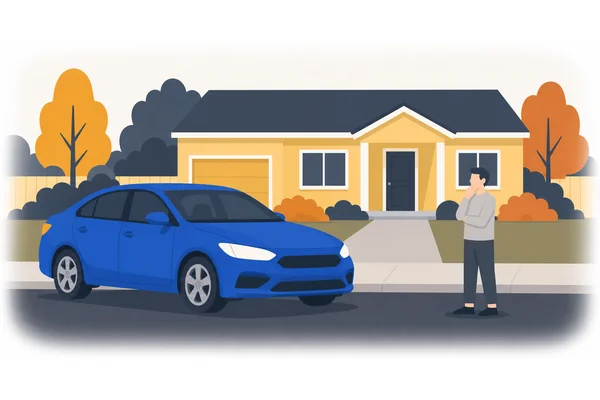
There is a car in front of the house.
Position · Preposition of place

The teacher stood in front of the class.
Everyday usage · Classroom

I sat in front of you at the cinema.
Seating arrangement · Social situation
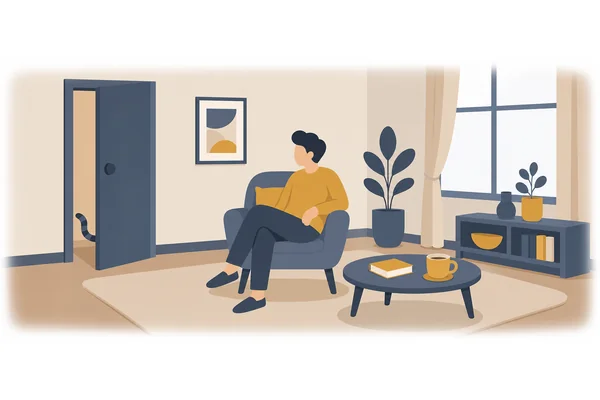
The cat is behind the door.
Position · Preposition of place

He walked behind his friend on the path.
Movement · Walking together

There is a garden behind the restaurant.
Location · Buildings
When to use it
Describing Buildings
Use these prepositions when you talk about where buildings or rooms are located near each other.
"There is a parking lot behind the shopping mall."
Describing People's Position
Use them to show where people stand, sit, or walk in relation to others.
"Can you stand in front of me so I can take a photo?"
Describing Objects
Use them to explain where objects are placed or parked in relation to other things.
"My car is behind the house, not in front."
Signal words
in front of
behind
ahead
at the back
facing
in the rear
Common Mistakes
✕
Wrong
The shop is behind of the station.
✓
Correct
The shop is behind the station.
Behind does not use 'of'. Use only 'behind + noun'.
✕
Wrong
She sat before me in the bus.
✓
Correct
She sat in front of me on the bus.
Use 'in front of' for position, not 'before'. 'Before' means earlier in time.
✕
Wrong
The park is in the back of the library.
✓
Correct
The park is behind the library.
Use 'behind' for location. 'In the back of' is less common in modern English.
KEY TAKEAWAYS
What to Remember
- Use in front of when something is ahead or facing forward toward another thing.
- Use behind when something is at the back or hidden from view.
- In front of and behind are opposite prepositions describing opposite positions.
- Both prepositions describe where people and things are positioned in relation to others.
- Remember: in front of needs "of" — don't say "in front the car."