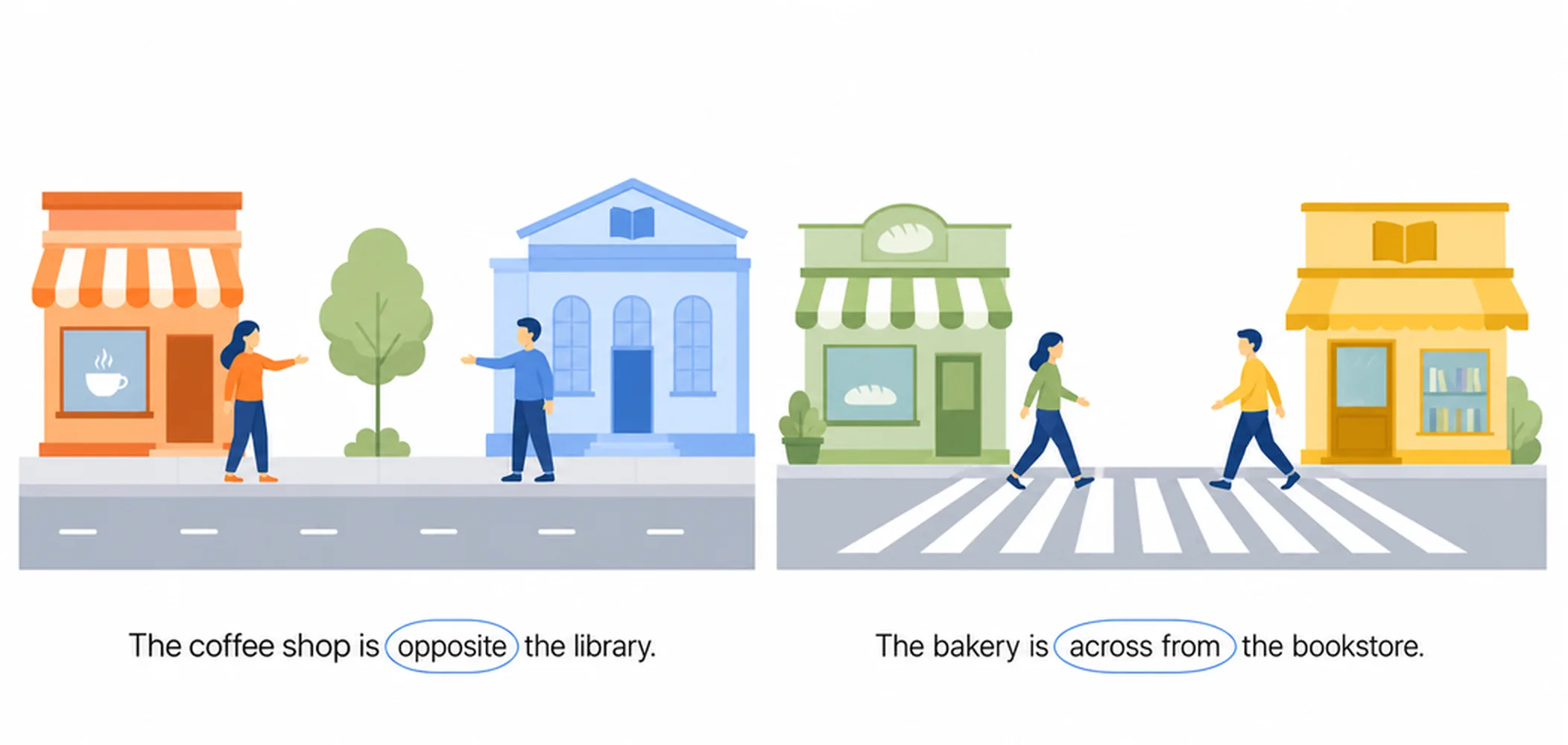
Opposite vs Across From
Both 'opposite' and 'across from' describe when two things are on different sides of something, facing each other. They are very similar in meaning and often interchangeable. However, 'opposite' is more common in British English and formal contexts, while 'across from' is more common in American English and everyday speech. Both are correct—choose the one that fits your region or style.
Key Differences
Use 'opposite' when you want a simple, direct description of facing positions. Use 'across from' when you want to emphasize the distance or separation between two places. 'Across from' is often preferred in American English, while 'opposite' is traditional British English.
Opposite vs Across From: Side-by-Side Comparison
| Dimension | Opposite | Across From |
|---|---|---|
| Form | Single preposition/adjective used alone or followed by a noun phrase (e.g., opposite the bank) | Two-word prepositional phrase always followed by a noun phrase (e.g., across from the bank) |
| Regional Preference | Strongly preferred in British English; common in most varieties of English worldwide | Strongly preferred in American English and Canadian English; less common in British English |
| Formality Level | Slightly more formal; widely used in both written and spoken contexts, including formal documents, literature, and journalism | Slightly more informal and conversational; common in everyday speech and casual writing |
| When to Use | Use when writing formally or for a British English audience; also used when the word appears at the end of a sentence without a following noun | Use in everyday American or Canadian English speech and writing; always requires a noun or pronoun to follow it |
| Typical Context | Directions, descriptions of physical locations, theatre/stage directions, real estate listings, formal writing | Everyday directions, casual conversation, informal descriptions of location, American English writing |
| Positive Example | The library is opposite the post office. | The library is across from the post office. |
| Negative Example | The café is not opposite the hotel; it is further down the road. | The café is not across from the hotel; it is further down the road. |
| Question Example | Is the pharmacy directly opposite the school? | Is the pharmacy directly across from the school? |
| Sentence Structure | Can stand alone at end of a clause (They sat opposite) or precede a noun (opposite the door); more flexible positioning | Must always be followed by a noun or pronoun; cannot stand alone at the end of a sentence (*They sat across from is incomplete) |
| Key Signal Words | directly opposite, right opposite, just opposite, sat opposite, stood opposite | directly across from, right across from, just across from, sitting across from, standing across from |
| 🔑 Key Difference: Both opposite and across from convey the same core meaning — facing or directly on the other side of something. The primary distinction is regional: opposite is the standard choice in British English and is slightly more formal, while across from is the natural equivalent in American and Canadian English and is more conversational in tone. Grammatically, opposite is more flexible and can end a sentence on its own, whereas across from always requires a following noun. Either form is universally understood, so choosing between them mainly depends on your target audience and regional style. | ||
Examples

The bank is opposite the supermarket.
British English · Preposition of place

She sat opposite me at the dinner table.
Formal usage · Showing position
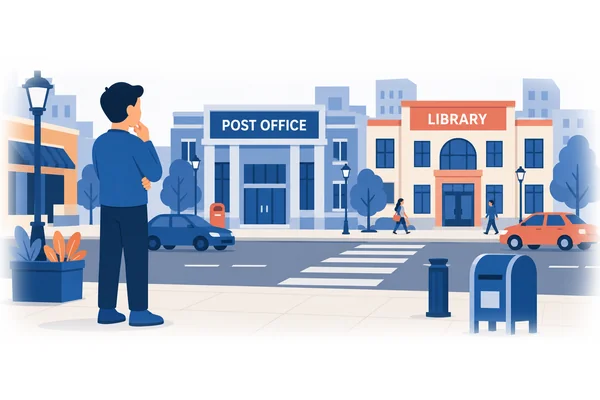
The post office is opposite the library on this street.
Location description · Common in UK

The coffee shop is across from my office.
American English · Everyday usage
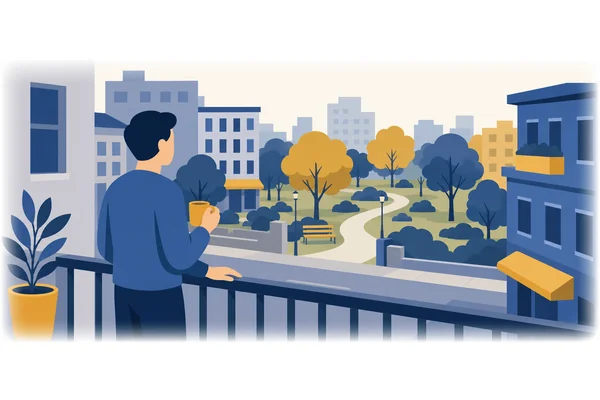
I live across from a park.
Conversational · Describing a neighbor

The school is across from the bus station.
American usage · Giving directions
When to use it
Describing Shop Locations
Use these prepositions to help someone find a shop or building on a street. Both forms work equally well.
"The bookstore is opposite the cinema" or "The bookstore is across from the cinema."
Seating Arrangements
When talking about where people sit at a table or facing each other, 'opposite' is very common.
"Please sit opposite me so we can talk easily."
Giving Directions
Both forms help give clear directions by showing what landmark is across the street or road.
"Turn right at the traffic light. The hotel is across from the park."
Signal words
opposite
across from
facing
on the other side of
adjacent to
Common Mistakes
✕
Wrong
The restaurant is opposite from the hotel.
✓
Correct
The restaurant is opposite the hotel. OR The restaurant is across from the hotel.
'Opposite' does not use 'from.' Only 'across from' uses 'from' after it.
✕
Wrong
He stood across the table from me.
✓
Correct
He stood opposite me at the table. OR He stood across from me at the table.
'Across' alone needs 'from' after it to show facing position. Use 'opposite' or 'across from' instead.
✕
Wrong
The two houses are opposite of each other.
✓
Correct
The two houses are opposite each other. OR The two houses are across from each other.
'Opposite' does not use 'of' when showing position. Both 'opposite' and 'across from' are correct without 'of'.
KEY TAKEAWAYS
What to Remember
- Both 'opposite' and 'across from' mean two things are on different sides facing each other.
- 'Opposite' is more common in British English and formal writing contexts.
- 'Across from' is more common in American English and casual conversation.
- Both prepositions are correct; choose based on your region or style preference.
- These prepositions describe physical position, not movement or direction between locations.