Understanding In, Inside, and Within
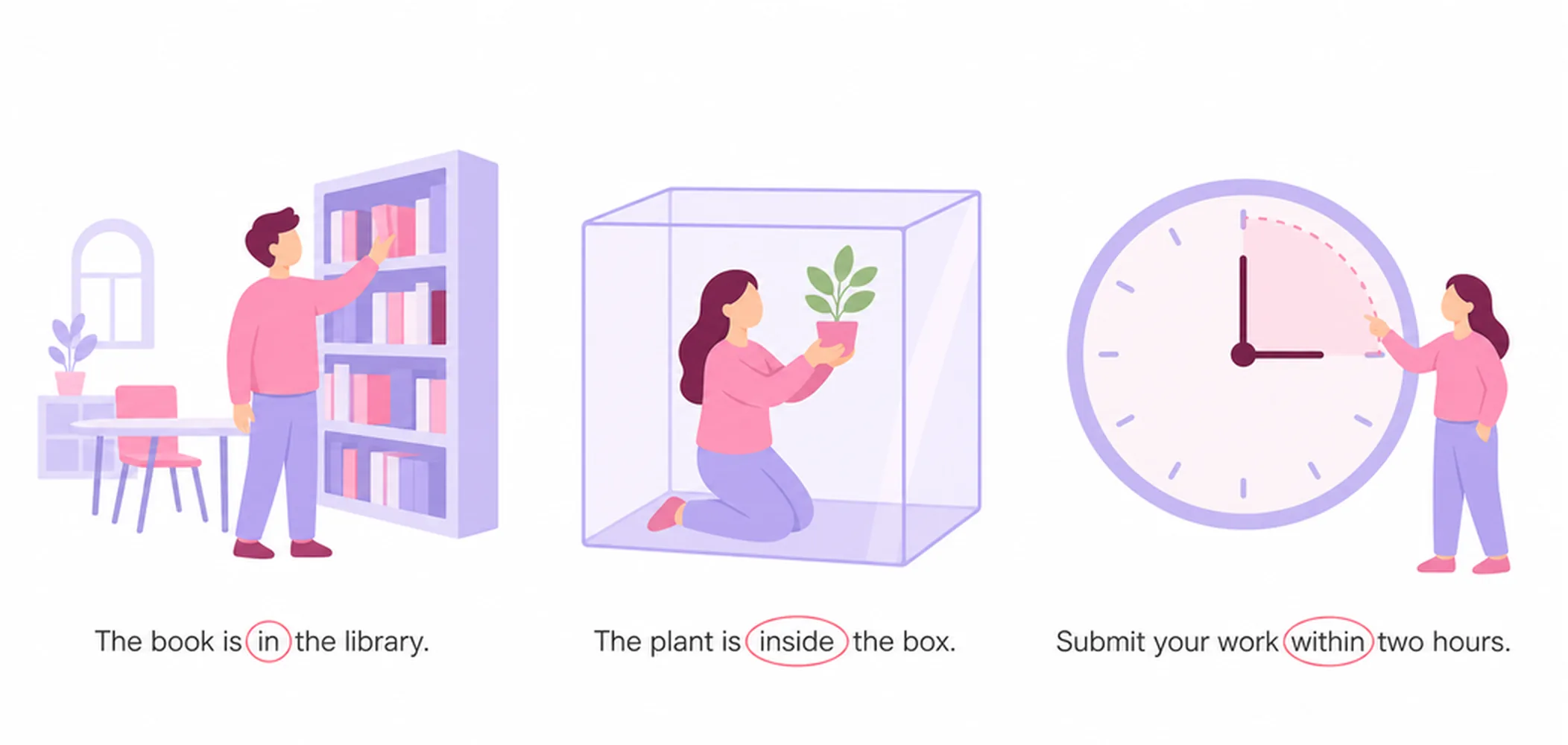
In, inside, and within are all prepositions of place, but we use them differently. In is the most common and general preposition for location. Inside means within the boundaries or interior of something. Within means inside a limit or range—we often use it for time, distance, or abstract ideas. All three can describe location, but they have different uses.
IN: General Location
Use in for general position inside something or a place. It is the most common preposition for location. You can use it for rooms, containers, cities, countries, and more.
In vs Inside vs Within: Side-by-Side Comparison
| Dimension | In | Inside | Within |
|---|---|---|---|
| Form | Preposition / adverb; the most basic and versatile of the three | Preposition / adverb / adjective; emphasises the interior of something with clear boundaries | Preposition only; formal register, often used with limits, ranges, or distances |
| When to use | Use for general location inside a space, group, time period, or abstract concept; the default everyday choice | Use when stressing the interior versus the exterior of a physical container or place; adds contrast or emphasis | Use for boundaries, limits, and ranges — especially time limits, distances, or abstract constraints; preferred in formal or professional writing |
| Formality level | Neutral — fits any register, from casual conversation to formal writing | Neutral to slightly informal — common in everyday speech; less frequent in highly formal documents | Formal — common in legal, business, academic, and official contexts |
| Physical contexts | Yes — works for any physical location or space (e.g., in the room, in the box) | Yes — strongly tied to physical interiors with clear boundaries (e.g., inside the building, inside the bag) | Yes, but less common for pure physical location; used mainly when implying a boundary or limit (e.g., within the compound) |
| Abstract contexts | Yes — widely used for abstract ideas, groups, and time (e.g., in doubt, in an hour, in society) | Limited — occasionally used for abstract interiors (e.g., inside information, inside her mind) but less natural for time or groups | Yes — especially strong for abstract limits, rules, or ranges (e.g., within the law, within reason, within budget) |
| Positive example | "The keys are in the drawer." "She will call back in ten minutes." |
"The cat is hiding inside the wardrobe." "Stay inside the building until the storm passes." |
"Please submit the report within 48 hours." "All prices must remain within budget." |
| Negative example | "There is nothing left in the fridge." "He is not in the office today." |
"There is no signal inside the tunnel." "Nothing was found inside the vault." |
"This action is not permitted within our guidelines." "The task was not completed within the agreed timeframe." |
| Question example | "Is there any milk in the fridge?" "Can you finish this in an hour?" |
"Is anyone still inside the building?" "What did you find inside the box?" |
"Can this be resolved within the next few days?" "Is this action within your authority?" |
| Key signal words / collocations | in the morning, in time, in doubt, in charge, in a group, in the city, in an hour | inside the house, inside information, inside out, inside a container, stay inside | within reach, within limits, within budget, within the law, within 24 hours, within reason |
| Can act as adverb? | Yes — "Come in!" | Yes — "Let's go inside." | No — within must always be followed by a noun phrase |
| 🔑 Key Difference: In is the all-purpose default — use it for general location, time, and abstract ideas in any register. Inside adds emphasis on the interior versus the exterior, making it ideal when the contrast between inside and outside matters; it is most natural with physical spaces. Within highlights boundaries, limits, and ranges, and is preferred in formal writing whenever you mean "not exceeding" or "no further than" a given limit. If in doubt, in is almost always safe; choose inside for physical emphasis and within for formal boundaries. | |||
Formula
Formula
Something/Someone
+
is
+
in
+
a place
The pen is in the drawer.
Examples

The book is in the bag.
General location · Everyday usage

I work in London.
City location · Formal/Informal

She is in the kitchen.
Room location · Everyday usage

The dog is inside the house.
Interior/Boundary · Formal/Informal

Please stay inside during the storm.
Safety instruction · Everyday usage

Inside the box, there are chocolates.
Container interior · Formal/Informal

We must finish within one hour.
Time limit · Formal usage

The park is within five kilometers of here.
Distance range · Formal/Informal

Within the rules, you can choose any team.
Abstract boundaries · Formal usage
When to use it
Objects in Containers
Use in for everyday objects in bags, boxes, drawers, and pockets. This is the most natural choice.
"My passport is in my bag."
Being Inside Buildings
Use inside or in for being in a house, office, or building. Inside emphasizes being within the boundaries.
"Wait inside the café until I arrive."
Time and Distance Limits
Use within for time deadlines and distance ranges. It means 'not more than' or 'within a limit.'
"The delivery will arrive within 2 days."
Rules and Boundaries
Use within for abstract ideas like rules, laws, and limits. It shows something is inside a boundary or acceptable range.
"Act within the law and you will be safe."
Signal words
General location
Container/pocket
Room/building
Time deadline
Distance limit
Rules and boundaries
Interior emphasis
Common Mistakes
✕
Wrong
The keys are inside my pocket.
✓
Correct
The keys are in my pocket.
For small containers like pockets, use 'in,' not 'inside.'
✕
Wrong
Come inside the room quickly.
✓
Correct
Come inside quickly. / Come into the room quickly.
'Inside the room' is redundant. Use 'inside' alone or 'into' for movement.
✕
Wrong
You must finish within the next 30 minutes.
✓
Correct
You must finish in 30 minutes. / You must finish within 30 minutes.
'Within the next' is wordy. Use 'within' or 'in' alone for time.
KEY TAKEAWAYS
What to Remember
- In is the most common and general preposition for describing location anywhere.
- Inside means within the boundaries or interior of a physical space or container.
- Within describes being inside a limit, range, or abstract idea like rules.
- Use within for time and distance measurements, not in or inside.
- Within sounds more formal than in or inside in most contexts.