On vs Onto — What's the Difference?
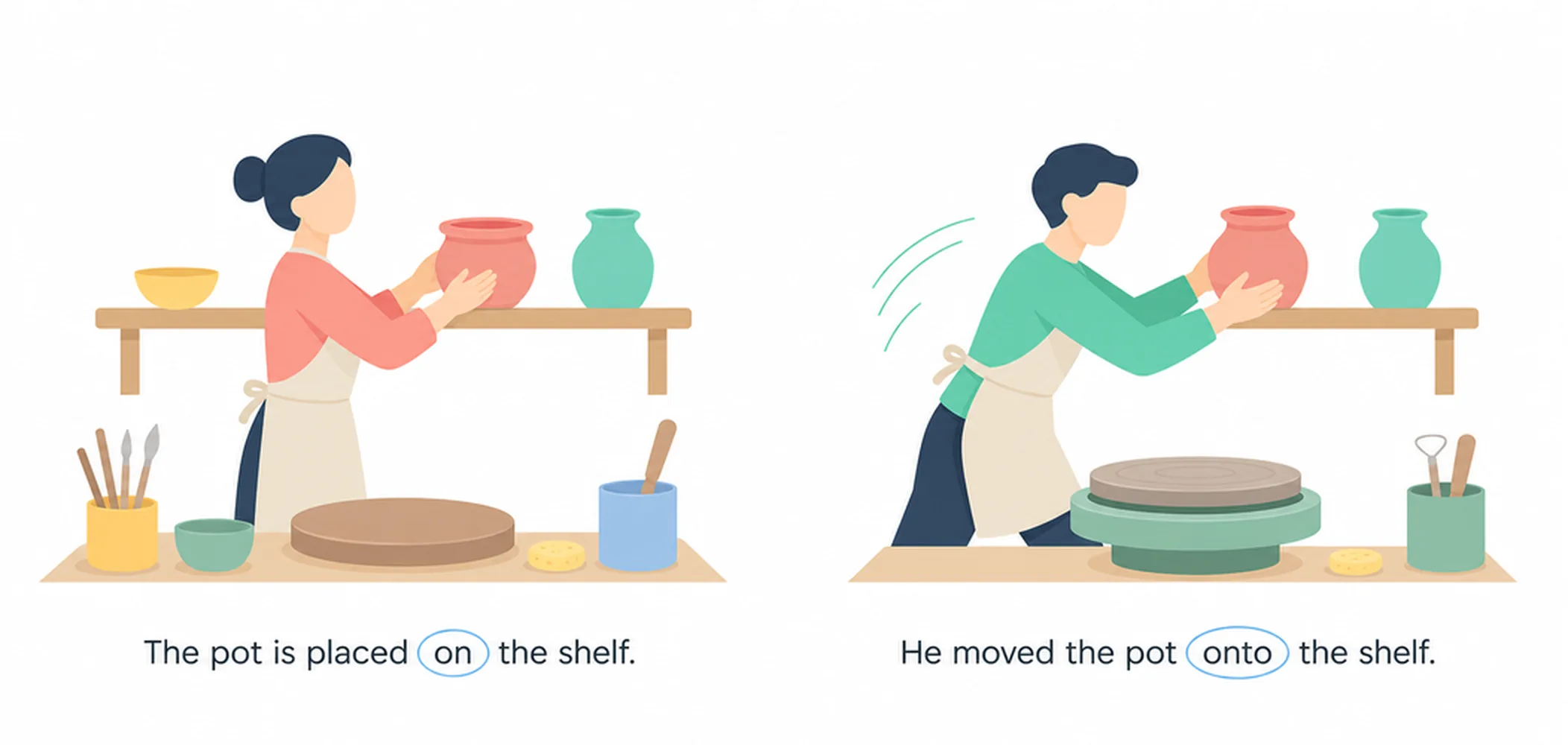
Both 'on' and 'onto' talk about position and surfaces, but they have different meanings. 'On' describes where something is already located or positioned. 'Onto' describes movement — when something moves to a surface or position. Understanding this difference will help you use prepositions correctly and speak more naturally.
On — Position or Location
Use 'on' when something is already in contact with or resting on a surface. It describes a static position — the thing is already there. You don't need to show movement.
On vs Onto — Side-by-Side Comparison
| Category | On | Onto |
|---|---|---|
| Form | Single preposition: on | Combined preposition: on + to = onto |
| Core Meaning | Indicates a static position or location; something resting or situated on a surface | Indicates movement or direction toward and then upon a surface; implies a change of position |
| Function (Static vs. Movement) | Static — describes where something already is, with no sense of motion involved | Movement — describes the action of moving from one place to a surface or position |
| When to Use | Use on when describing the position or state of something already placed or existing on a surface, or when talking about time, dates, days, and contact | Use onto when a verb of motion is involved and something is moving to land on or reach a surface or place; also used figuratively to mean "aware of" |
| Typical Usage Context |
• Describing location (the cup is on the table) • Time references (on Monday, on 5 July) • Contact with a surface (a picture on the wall) • Continuation of activity (carry on) |
• Motion toward a surface (she jumped onto the stage) • Transferring something (load the boxes onto the truck) • Figurative awareness (the detective is onto something) • Digital navigation (log onto the system) |
| Positive Example | The book is on the shelf. (Static position — the book is already there.) |
She climbed onto the roof to fix the antenna. (Movement — she moved from somewhere else up to the roof.) |
| Negative Example | ❌ He jumped on the train platform from the tracks. (Incorrect here — movement is involved, so onto is needed.) |
❌ The laptop is sitting onto the desk. (Incorrect here — no movement is occurring, so on is needed.) |
| Question Example | Is the report on his desk yet? (Asking about location/state.) |
Did you upload the files onto the server? (Asking about a completed movement/transfer.) |
| Key Signal Words / Verbs | is, are, was, were, sits, lies, rests, remains, stands, placed, located — verbs of state or existence | jump, climb, move, fall, step, load, transfer, log, upload, throw, drag, put — verbs of motion or action |
| Common Mistakes | Using on when a motion verb is present, e.g., ❌ The cat leapt on the counter (should be onto) | Using onto with phrasal verbs where on and to are separate, e.g., ❌ Hold onto your opinion can be correct, but ❌ She moved onto can be confused with moved on to (meaning "proceeded") |
| Figurative / Idiomatic Use | on topic, on time, on fire, on edge, on purpose — used in many fixed expressions relating to state or condition | be onto someone (suspect or be aware of them), hold onto (keep), latch onto (grasp an idea) — often implies discovery or awareness |
| 💡 Key Difference: The essential distinction between on and onto comes down to static position vs. directional movement. Use on when something is already situated on a surface with no motion involved (e.g., The keys are on the counter). Use onto when a subject or object is actively moving from one place and landing on or arriving at a surface (e.g., She tossed the keys onto the counter). A quick test: if you can insert the word "up" before the preposition and the sentence still makes sense (she jumped up onto the stage), onto is likely the correct choice. | ||
Examples

The book is on the table.
Position · Static location

I sat on the chair all morning.
Position · Already sitting

Your keys are on the desk.
Position · Object already there

She jumped onto the bed.
Movement · Action toward surface

The cat climbed onto the roof.
Movement · Action of going up

He stepped onto the platform.
Movement · Action of stepping
When to use it
Sitting or Resting
When something is already positioned on a surface. No movement is happening.
"The dog is sleeping on the sofa."
Moving to a Surface
When something actively moves toward or goes on top of something else.
"The airplane landed onto the runway."
Fixed Position
When describing where something stays or is attached in one place.
"The poster is on the wall."
Signal words
is
are
was
were
sit
lie
stand
jump
climb
step
move
put
place
throw
Common Mistakes
✕
Wrong
I jumped on the trampoline.
✓
Correct
I jumped onto the trampoline.
'Jump' is a movement verb, so use 'onto' to show moving to the surface.
✕
Wrong
The picture is hanging onto the wall.
✓
Correct
The picture is hanging on the wall.
'Hanging' describes position, not movement. Use 'on' for static location.
✕
Wrong
He put the cup onto the table, and now it is onto the table.
✓
Correct
He put the cup onto the table, and now it is on the table.
Use 'onto' for the action of putting, then 'on' to describe where it stays.
KEY TAKEAWAYS
What to Remember
- Use 'on' to describe something that is already positioned or resting on a surface.
- Use 'onto' to describe movement toward a surface or position from somewhere else.
- 'On' is static; 'onto' shows action and change of location.
- Don't confuse them: "The book is on the table" versus "She put the book onto the table."
- 'Onto' is less common in everyday speech, but using it correctly shows better English control.