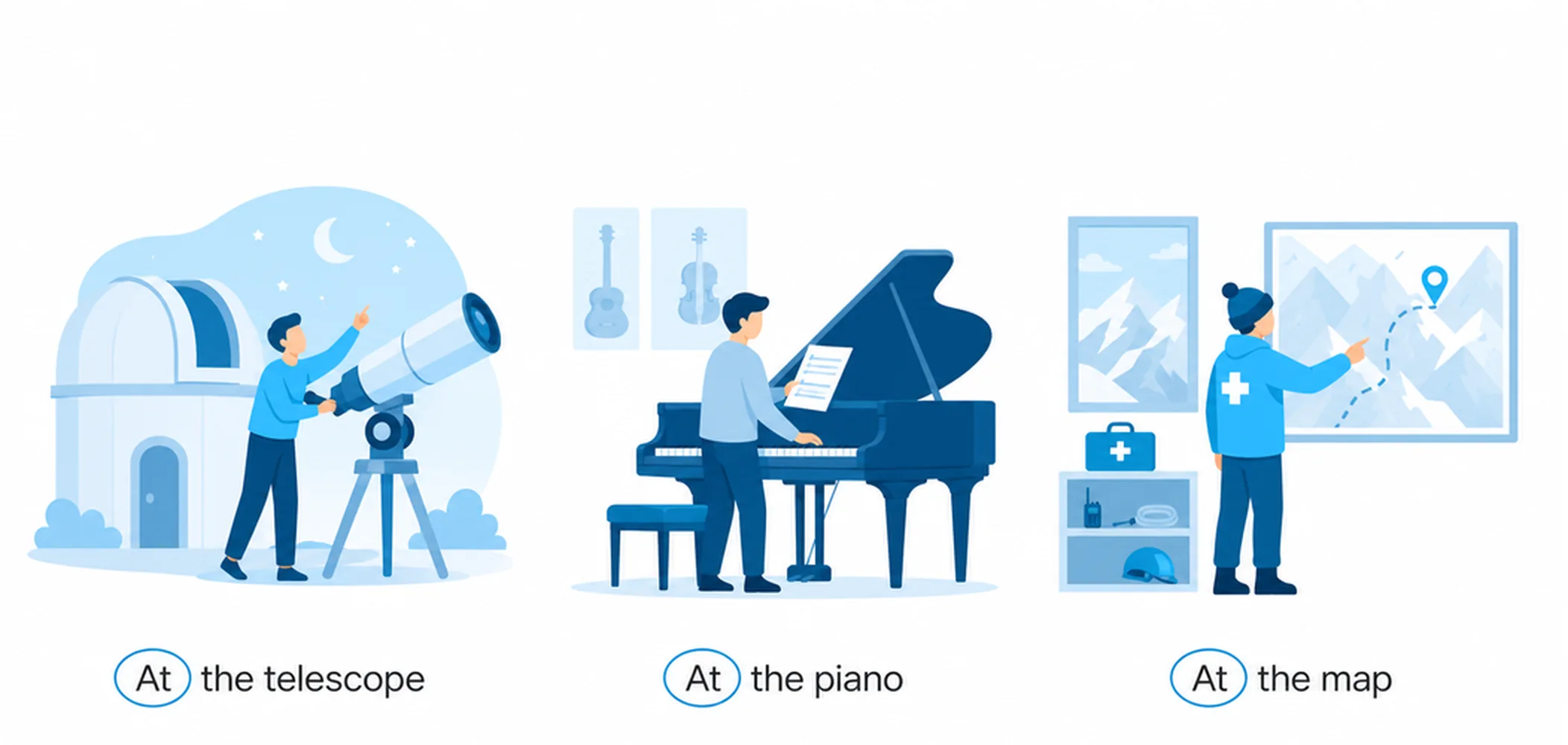
What is 'At' for Position and Location?
The preposition 'at' is used to show where something or someone is. It indicates a specific point or place. 'At' is often used for small, defined locations like buildings, addresses, or events. We use 'at' when we think of a place as a point rather than an area.
When Do We Use 'At'?
Use 'at' for: specific addresses and building numbers, places where activities happen (school, work, the cinema), events and occasions, and destinations you visit for a specific reason. For example: 'I live at 5 Main Street' or 'I work at the hospital.' We also use 'at' with small, defined locations that are important for what happens there, not the space itself.
'At' vs 'In' — Key Difference
While this article focuses on 'at', it is helpful to understand how 'at' and 'in' differ when describing position and location. Both prepositions can refer to places, but they are used in different contexts.
| Preposition | Use | Example |
|---|---|---|
| At | A specific point, a place where an activity happens, or a destination | I arrived at the station. She works at the hospital. |
| In | Inside something, within an enclosed space, or within a larger geographic area | The book is in the box. He lives in New York. |
At vs In vs On — Position and Location Compared
| Criteria | AT | IN | ON |
|---|---|---|---|
| Form | at + place/point | in + enclosed space/area | on + surface/line |
| When to use | Use at for a specific point or exact location, an address (without street type), events, or places viewed as a single point rather than an area (e.g. stations, airports, desks, counters). | Use in when something is inside or enclosed within a three-dimensional space, a container, a city, country, region, or any defined area with boundaries. | Use on when something is resting on or touching a surface (horizontal or vertical), a floor of a building, a street (with full address), or a transport line (bus, train, plane). |
| Positive example | She is at the bus stop. He works at the reception desk. We met at the conference. |
The keys are in my bag. They live in Paris. She was born in Canada. |
The book is on the table. His office is on the third floor. They live on Baker Street. |
| Negative example | She is not at her desk right now. He was not at the meeting yesterday. We are not at the airport yet. |
There is nothing in the box. I am not in the office today. She does not live in London. |
The remote is not on the sofa. His name is not on the list. There is no picture on the wall. |
| Question example | Is she at the station? Are they at the party? Was he at the front door? |
Is the cat in the garden? Are you in the kitchen? Do they live in New York? |
Is your phone on the desk? Which floor is the office on? Is her name on the door? |
| Key signal words | the corner, the top, the bottom, the end, home, work, school, the airport, the station, a desk, a counter, an event/party/concert, a specific address (number only) | a box/bag/room/building, a city/town/village, a country/continent, a forest/park/field, a photograph/picture, a newspaper/book (content inside) | a table/floor/wall/ceiling, a page/screen/map, a bus/train/plane/ship, a street (full name), a floor number, a list/menu/sign |
|
Key Difference: Think of location in terms of dimensions. AT treats a place as a single, precise point — a dot on a map with no size (e.g. at the door, at the corner). IN treats a place as a three-dimensional enclosed space — you are surrounded by it or inside it (e.g. in a room, in a country). ON treats a place as a two-dimensional surface — you are touching or resting on top of it (e.g. on the table, on the floor). The same physical place can take different prepositions depending on the speaker's perspective: "at the school" (arriving at the point) vs. "in the school" (inside the building) vs. "on the school grounds" (on the surface/area).
|
|||
Examples






What to Remember
- Use 'at' for specific addresses and building numbers like "at 5 Main Street."
- Use 'at' for places where activities happen, such as school, work, or the cinema.
- Use 'at' for events and occasions you attend or visit for a specific reason.
- Think of 'at' as a point or specific location, not a large area or region.
- Use 'at' when the place is small and defined, not for broad geographical locations.