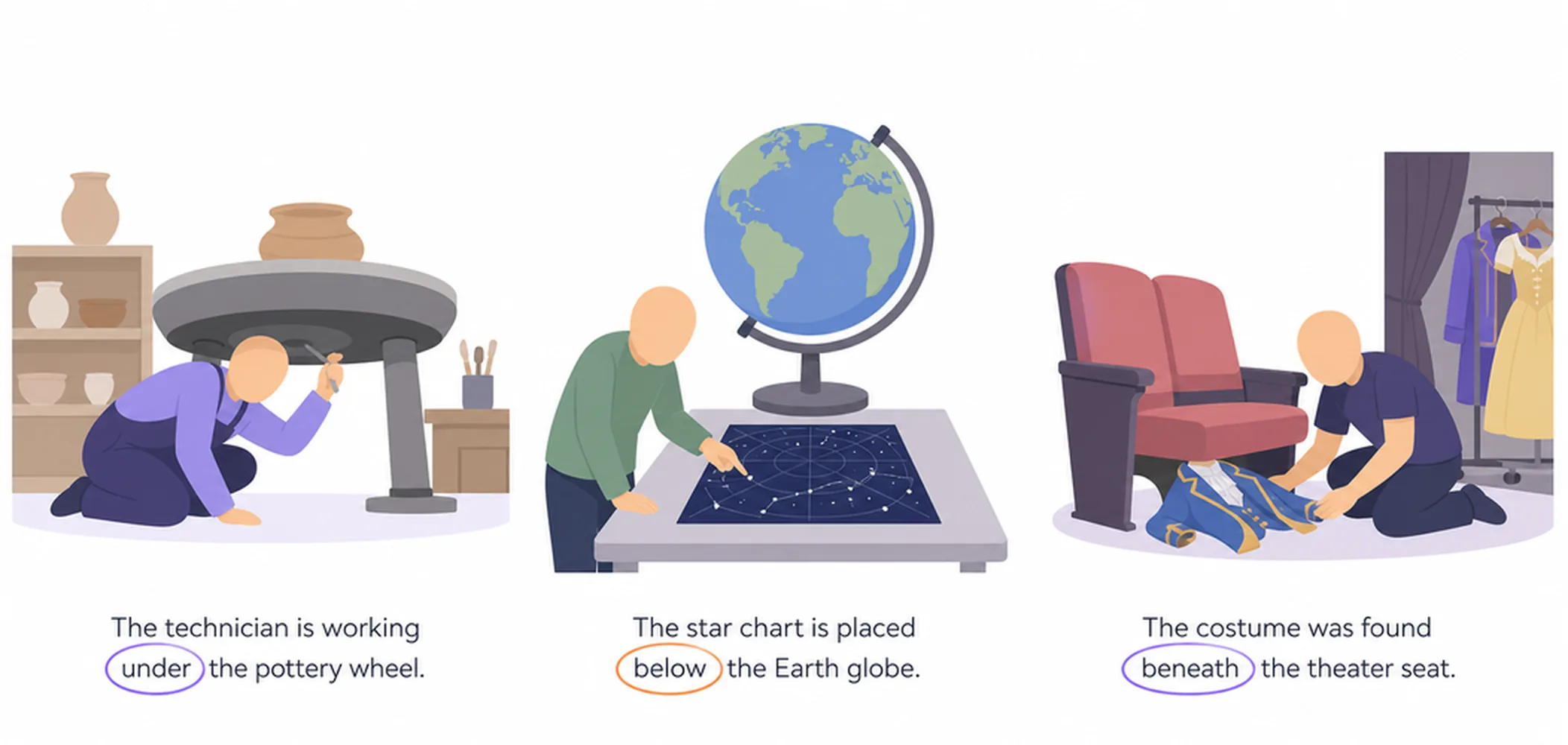
Understanding Under, Below, and Beneath
Under, below, and beneath are prepositions that show position. They all mean something is lower than something else, but we use them in different situations. Under is the most common preposition and means directly below something. Below means lower in position but not necessarily directly underneath. Beneath is more formal and literary, and it means under or below something.
Key Differences
Use UNDER when something is directly below another thing, often with contact or protection. Use BELOW when something is lower in position or level, but not necessarily touching. Use BENEATH when you want a more formal or literary meaning—it often suggests being hidden or covered by something.
Under vs Below vs Beneath: Side-by-Side Comparison
| Dimension | Under | Below | Beneath |
|---|---|---|---|
| Core Meaning | Directly lower than something, often with a sense of covering, control, or movement through a space | At a lower level, position, or value than something; does not require being directly underneath | Directly under, often touching or very close; also used figuratively to express unworthiness or social status |
| Level of Formality | Neutral; suitable for both everyday speech and formal writing | Neutral to slightly formal; common in technical, scientific, and academic contexts | Formal or literary; less common in casual conversation; often sounds poetic or old-fashioned |
| Physical Contact Implied? | Not necessarily; can imply contact or a gap (e.g., under a bridge — no contact) | No contact implied; refers to relative position or level at a distance | Often implies close proximity or direct contact (e.g., buried beneath the soil) |
| Directness of Position | Usually directly below; strongly associated with vertical alignment | Can be directly or indirectly lower; focuses on relative level rather than exact vertical alignment | Directly under; emphasises close vertical proximity, often with a covering or pressing sense |
| Figurative / Abstract Use | Very common: under pressure, under control, under the law, under supervision | Common for quantities and rankings: below average, below zero, below expectations | Common in literary or moral contexts: beneath one's dignity, beneath contempt, hidden beneath the surface |
| Typical Contexts of Use | Physical position, authority and control, movement through a space, conditions or circumstances | Measurements, temperatures, rankings, grades, levels on a scale, map references | Literary prose, poetry, formal writing, moral judgements, physical burial or covering |
| Positive Example | "The cat is sleeping under the table." | "The village sits below the mountain." | "She hid the letter beneath her pillow." |
| Figurative Example | "The project is under review." | "Her score was below average." | "He considered the task beneath him." |
| Incorrect / Unnatural Use | ❌ "Temperatures dropped under zero." (below is more natural for measurements) | ❌ "She stood below the umbrella." (under is more natural for shelter/covering) | ❌ "The office is beneath new management." (under is the correct choice here) |
| Key Signal Words / Phrases | under the table, under the bridge, under control, under pressure, under age, under the law | below sea level, below average, below zero, below the line, below the surface, see below | beneath the surface, beneath contempt, beneath one's dignity, buried beneath, just beneath |
| Interchangeability | Often interchangeable with beneath for physical position; rarely interchangeable with below in figurative/measurement uses | Sometimes interchangeable with under for physical space, but preferred for levels, grades, and measurements | Often interchangeable with under for physical position, but carries a more formal or literary tone |
| 🔑 Key Difference: Under is the most versatile and common choice, implying direct vertical position, covering, or figurative control. Below focuses on relative level or measurement and does not require direct vertical alignment — use it for temperatures, scores, and rankings. Beneath shares the core physical meaning of under but carries a more formal, literary, or moral tone, and often implies very close contact or social unworthiness. When in doubt, under is usually the safest everyday choice, while below suits numbers and levels, and beneath suits elevated or figurative writing. | |||
Examples
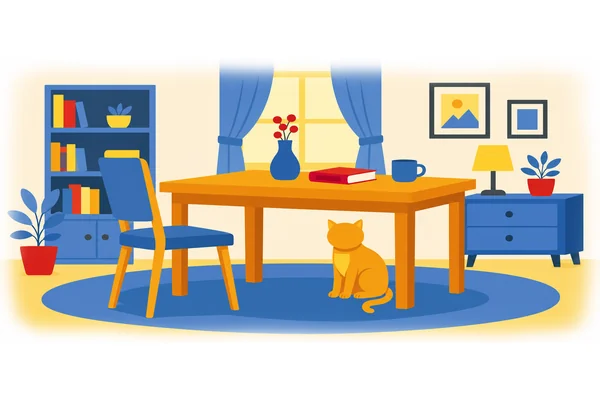
The cat is sitting under the table.
Everyday usage · Preposition of place (directly below)

I hid my money under the mattress.
Common usage · Protection/concealment

The children played under the bridge.
Descriptive usage · Covered position

The swimmers dived below the surface of the water.
Formal usage · Lower level (not necessarily touching)

The temperature dropped below freezing.
Technical usage · Level/measurement

We live five floors below the penthouse.
Positional usage · Vertical distance
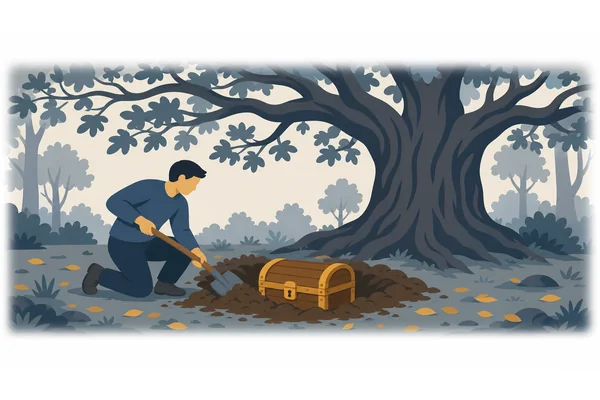
The treasure was buried beneath the old oak tree.
Literary usage · Hidden under

She wore a warm sweater beneath her winter coat.
Formal usage · Layer underneath

The city lies beneath the mountains.
Descriptive usage · Under/covered
When to use it
Everyday Objects
Use UNDER when something is directly below and protected by another object.
"My passport is under the pillow."
Measurements & Levels
Use BELOW when comparing levels, temperatures, or positions on a scale.
"The price is below €50."
Literary & Formal Writing
Use BENEATH for formal or literary descriptions of things that are covered or hidden.
"Secrets beneath the surface revealed themselves."
Signal words
directly below
in contact with
lower level
measurement
comparison
hidden
covered
formal writing
Common Mistakes
✕
Wrong
The book is below the table.
✓
Correct
The book is under the table.
Use 'under' when something is directly beneath another object, especially with contact.
✕
Wrong
I put my shoes beneath the bed.
✓
Correct
I put my shoes under the bed.
'Beneath' is too formal for everyday situations. Use 'under' for common, practical placements.
✕
Wrong
The swimmer swam under the ocean.
✓
Correct
The swimmer swam below the surface.
'Below' is better for levels or measurements. 'Under' suggests being covered or protected.
KEY TAKEAWAYS
What to Remember
- Under is the most common preposition, used when something is directly below something else.
- Below means lower in position but not necessarily directly underneath the other thing.
- Beneath is formal and literary, similar to under but used in more advanced writing.
- All three prepositions show that one thing is lower than another in position.
- Do not confuse under and below; under suggests direct contact or covering, below does not.