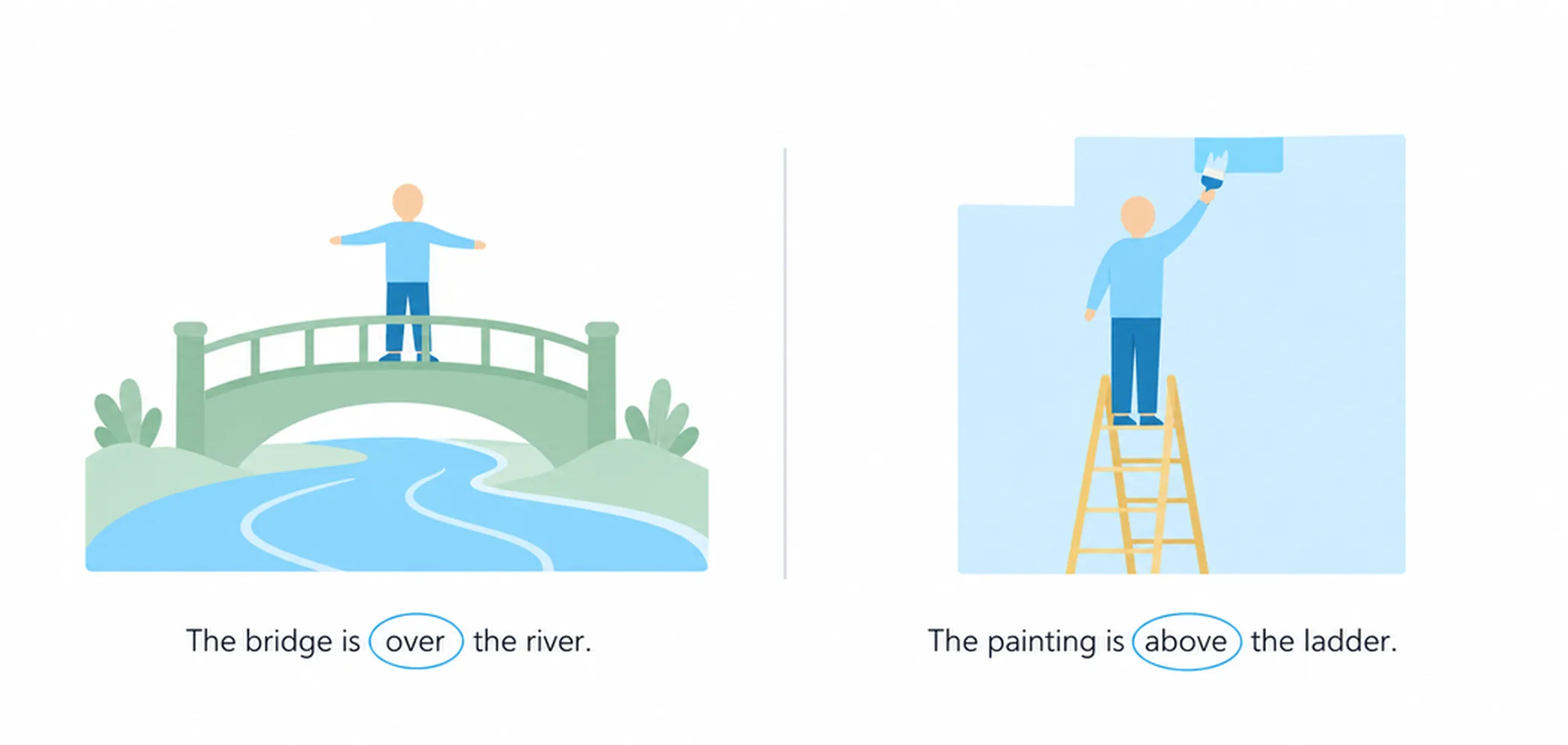
The Key Difference
Both 'over' and 'above' describe something that is higher or on top of something else. However, they have different uses. 'Above' means 'at a higher level than' and shows position only. 'Over' means 'above and across' and often includes the idea of movement or covering something. Think of it this way: 'above' is static (not moving), while 'over' can show action or movement.
Use 'Above' for Static Position
Use 'above' when you want to show that something is simply in a higher position. There is no movement or covering involved. 'Above' is often used with measurements or comparisons. For example, if you are standing in a room and the lamp is at a higher level than your head, the lamp is 'above' you.
Use 'Over' for Movement and Covering
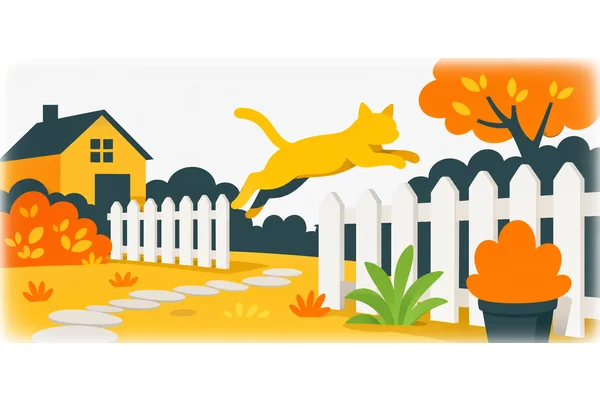
Use 'over' when something moves across or covers something else. 'Over' suggests action, movement, or contact. For example, if you jump across a river, you jump 'over' it. If a blanket covers your bed, it is 'over' the bed. 'Over' is more active and dynamic than 'above'.
Over vs Above: Side-by-Side Comparison
| Criteria | Over | Above |
|---|---|---|
| Basic Meaning | Directly on top of or covering something; also implies movement across or from one side to another. | Higher than something, but not necessarily directly on top or in contact with it; implies a static higher position. |
| Form / Type | Preposition / Adverb — often associated with contact, coverage, or movement. | Preposition / Adverb — typically associated with a higher level or rank without implying contact or movement. |
| When to Use | Use when something is directly above, covering, or moving across something else. Also used for quantities exceeding a number (e.g., "over 100 people"). | Use when something is at a higher level or position but not necessarily directly on top. Also used for rank, authority, or level (e.g., "above average"). |
| Movement | ✅ Strongly implies movement or transition across something. Example: "The bird flew over the lake." | ❌ Generally does not imply movement. It describes a static higher position. Example: "The sign is above the door." |
| Covering / Contact | ✅ Can imply covering or resting on top of something. Example: "She placed a blanket over the child." | ❌ Does not imply covering or physical contact. Example: "The lamp hangs above the table" (not touching it). |
| Rank / Authority | ⚠️ Sometimes used in authority contexts but less common. Example: "He has control over the department." | ✅ Commonly used for rank and hierarchy. Example: "She is above him in seniority." / "He is above the law." |
| Quantities & Numbers | ✅ Frequently used with numbers to indicate exceeding a quantity. Example: "There were over 500 attendees." | ✅ Also used with quantities but in a more formal or measured context. Example: "Temperatures above 30°C are expected." |
| Positive Example | "The plane flew over the mountains." / "She wore a coat over her dress." | "The stars glittered above us." / "Her score was above average." |
| Negative Example | ❌ "The temperature was over freezing" sounds unnatural — use above for measurements on a scale. | ❌ "She put a cloth above the table" is incorrect when covering is implied — use over instead. |
| Typical Context | Physical movement, covering objects, crossing spaces, exceeding counts, supervision, control. | Static elevated position, rank or hierarchy, measurements on a scale, figurative superiority. |
| Key Signal Words | Across, covering, spanning, crossing, jumping over, flying over, more than (informal) | Higher than, exceeding (on a scale), superior to, in a higher position, beyond a level |
| 🔑 Key Difference: Over suggests direct verticality, physical coverage, or movement across something, and is preferred when something is directly on top of or crossing over another object (e.g., "a bridge over the river"). Above indicates a higher position or level without implying direct contact, coverage, or movement, and is preferred for rank, scale measurements, and elevated but non-touching positions (e.g., "the moon above the clouds"). In many casual contexts they are interchangeable, but the distinction matters in precise or formal writing. | ||
Examples





What to Remember
- Use 'above' to show position only—something is higher, with no movement involved.
- Use 'over' when something is above and across, often showing movement or action.
- 'Above' is static and describes location; 'over' can describe covering or crossing something.
- Remember: 'above' = position only; 'over' = position plus movement or covering.
- Don't use 'over' when you only mean higher position without movement or covering.