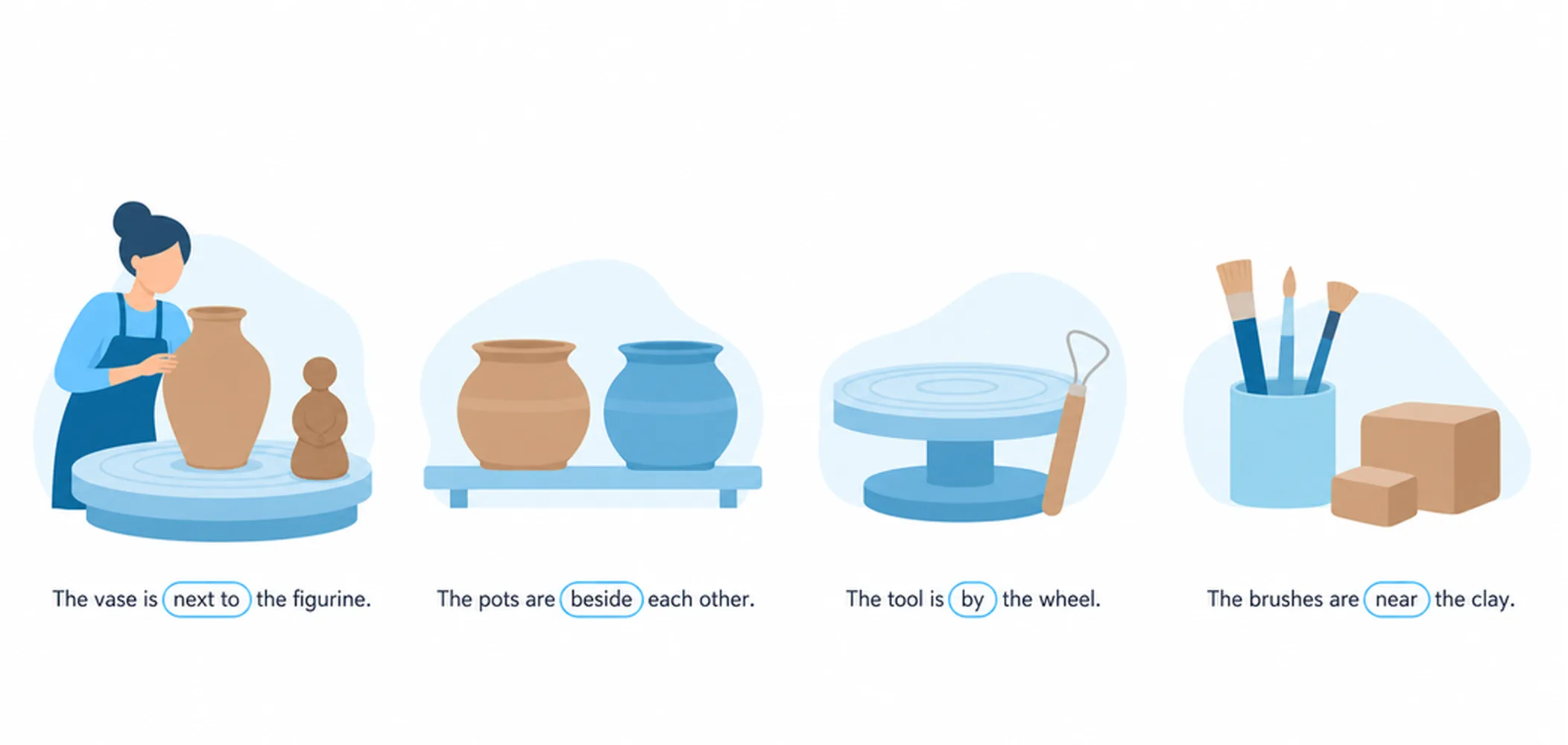
What Do These Prepositions Mean?
Next to, beside, by, and near are all prepositions of place. They tell us where something is in relation to something else. They are very similar, but they have small differences. Understanding these differences will help you describe locations more accurately in English.
Next To vs. Beside vs. By
Next to, beside, and by have almost the same meaning. They all mean very close to something, usually touching or almost touching it. Next to is the most common and easiest to use. Beside is more formal and common in written English. By is informal and very common in spoken English. You can use all three in most situations, but they feel different depending on the context.
Near vs. Next To/Beside/By
Near means close to something, but not as close as next to, beside, or by. If you use near, the distance is bigger. For example, if you sit next to your friend, you are touching chairs or very close. If you sit near your friend, there might be an empty seat between you. Near is useful when something is in the same area but not directly beside something.
Next To, Beside, By, and Near: Side-by-Side Comparison
| Dimension | Next to | Beside | By | Near |
|---|---|---|---|---|
| Form | Two-word preposition phrase | Single-word preposition | Single-word preposition (also used as adverb, noun, verb) | Single-word preposition or adjective/adverb |
| Proximity | Very close; immediately adjacent, touching or almost touching | Very close; immediately at the side of something | Very close; at the side of or right next to | Close but not necessarily immediately adjacent; within a short distance |
| Formality | Neutral; common in both spoken and written English | Slightly more formal or literary; common in writing | Neutral to informal; very frequent in everyday speech | Neutral; common in everyday speech and writing |
| When to use | When two things are directly side by side with no gap; emphasises direct adjacency | When focusing on the position at someone's or something's side; often used for people sitting or standing | When something is very close to or right alongside something else; also used for time deadlines and means | When something is within a general area or short distance, but exact adjacency is not required |
| Positive example | She sat next to me on the bus. | He stood beside the window and stared outside. | The cat was sleeping by the fire. | There is a supermarket near my house. |
| Negative example | The hotel is not next to the beach; it is several streets away. | Please do not stand beside the machinery when it is running. | The bench is not by the lake; they moved it further up the hill. | There is no pharmacy near the village; you must drive to the town. |
| Question example | Who is sitting next to you? | Who was standing beside her at the ceremony? | Is there a bus stop by the school? | Is there a hotel near the airport? |
| Typical contexts | Seating arrangements, sequential lists ("next to nothing"), comparing things of equal position | Literary descriptions, people standing or sitting at someone's side, expressing comparison ("beside the point") | Natural features (river, sea, road), deadlines ("by Friday"), means of transport ("by car"), passive voice agents | Directions, recommendations ("a café near here"), approximate locations, describing neighbourhoods |
| Interchangeability | Often interchangeable with beside and by in spatial contexts, but not with near | Often interchangeable with next to and by, but carries a slightly more formal tone | Often interchangeable with next to and beside spatially, but has many non-spatial uses that the others do not share | Generally not interchangeable with the others when exact adjacency is implied; refers to a broader area |
| Key signal words / phrases | next to nothing, next to impossible, right next to | beside the point, beside oneself, right beside | by the river, by Friday, by car, close by, nearby, by chance | near here, near the centre, near enough, draw near, in the near future |
| 🔑 Key Difference: Next to, beside, and by all describe immediate, direct adjacency and are often interchangeable in spatial contexts — though beside sounds slightly more formal or literary and by also carries many non-spatial meanings (time, means, agent). Near is the odd one out: it describes a general closeness within a broader area without requiring direct side-by-side contact. If you can slip a person between two objects, use near; if the two things are touching or right alongside each other, use next to, beside, or by. | ||||
Examples






What to Remember
- Next to, beside, and by mean very close to something, usually touching or almost touching it.
- Next to is the most common and easiest preposition of place to use in English.
- Beside is more formal and commonly used in written English compared to next to.
- Near means close to something but not necessarily touching or almost touching like the others.
- Use these prepositions to describe where something is located in relation to something else.