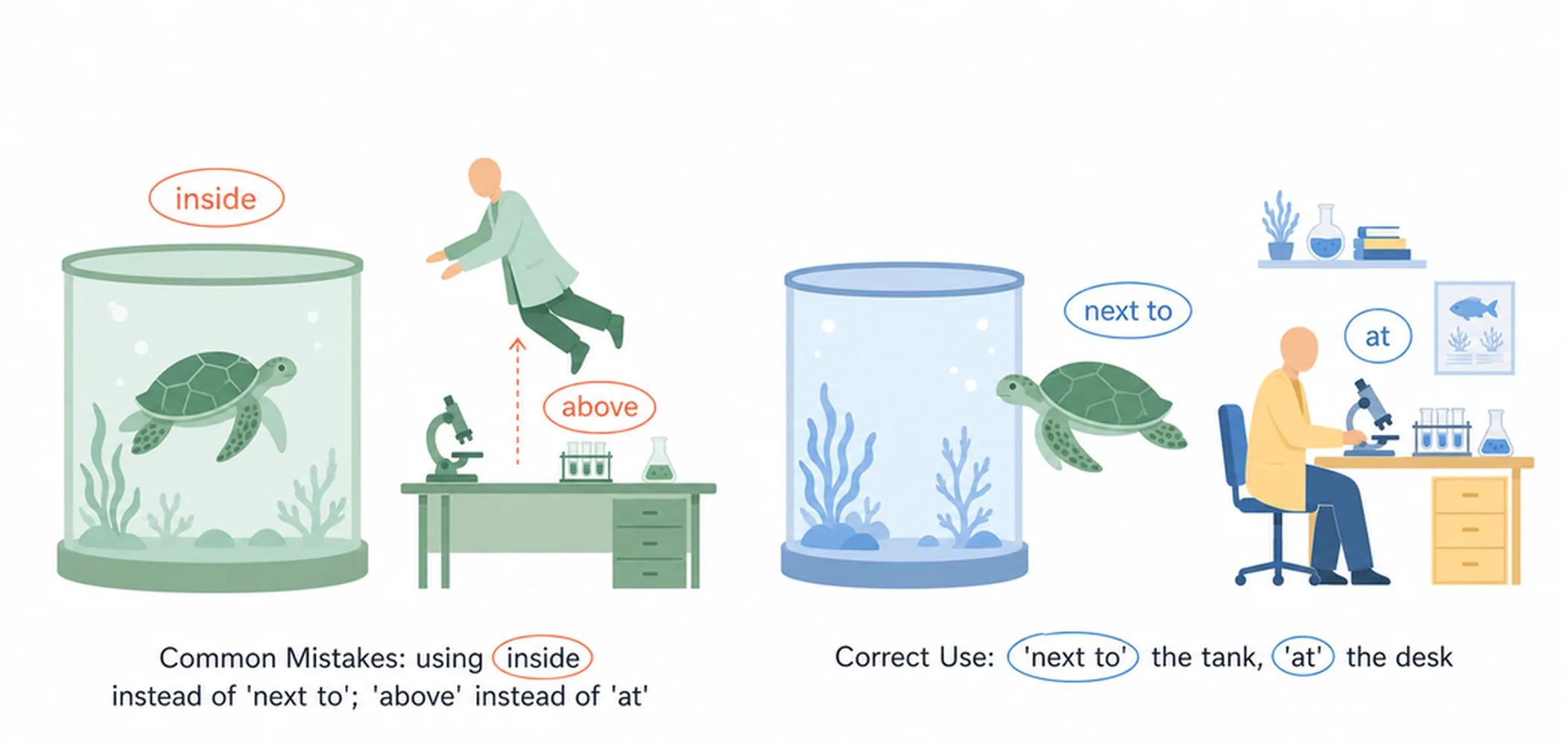
Why learners get prepositions of place wrong
Prepositions of place can be confusing because different languages use different rules. In English, we use IN for areas or containers, ON for surfaces, and AT for specific points. Many learners translate directly from their own language, which causes mistakes. Learning the English system will help you speak and write correctly.
IN vs ON vs AT — Side-by-Side Comparison
| Category | IN | ON | AT |
|---|---|---|---|
| Typical Use | Used for enclosed spaces, areas with boundaries, or locations where something is surrounded or contained. | Used for surfaces, lines, or positions where something is resting or attached to a flat or defined surface. | Used for specific, precise points, exact locations, or particular places regarded as a single spot. |
| Location Type | Three-dimensional enclosed or defined spaces: rooms, buildings, cities, countries, boxes, bodies of water. | Two-dimensional surfaces, floors, roads, walls, screens, public transport vehicles, and named streets. | Exact addresses, specific venues, institutions, events, or places seen as a single point (e.g. a corner, a stop). |
| Illustrative Phrase | "She is in the kitchen." / "We live in Paris." / "The letter is in the envelope." | "The book is on the table." / "There is a painting on the wall." / "He is on the bus." | "Meet me at the corner." / "She works at the hospital." / "We arrived at the station." |
| When to Use | When the subject is inside or surrounded by a space, including abstract spaces like "in the world" or "in a queue." | When the subject is touching or positioned on top of a surface, or attached to something (e.g. a floor, a road, a page). | When referring to a specific, well-known place or point in space, often where an activity takes place. |
| Positive Example | "The children are playing in the garden." | "Her keys are on the counter." | "I'll see you at the entrance." |
| Negative Example | ✗ "She is in the bus." (wrong — use on for vehicles) | ✗ "He works on the hospital." (wrong — use at for institutions) | ✗ "They live at France." (wrong — use in for countries) |
| Question Example | "Is she still in the office?" | "Are the glasses on the shelf?" | "Are you at the airport yet?" |
| Key Signal Words | Room, building, city, country, box, pocket, garden, water, queue, world, area, region. | Table, floor, wall, ceiling, page, screen, road, street, roof, shelf, bus, train, ship. | Address, door, corner, desk, top, bottom, event, station, airport, school, work, home. |
| Key Difference: Think of the three prepositions as a scale of specificity and dimension. IN implies being inside a three-dimensional space (enclosed, surrounded). ON implies contact with a surface (flat, two-dimensional). AT implies a precise point — a single, exact location with no real sense of dimension. A common trick: you are in a city, on a street in that city, and at a specific number on that street. | |||
Examples

I work in an office in the city.
Indoor spaces and large areas

There is a lamp on the desk.
Things resting on surfaces

We meet at the train station at 8 a.m.
Specific locations and points

The children are playing in the garden.
Outdoor spaces and enclosed areas
When to use it
Home locations
Use IN for rooms and areas inside a building. Use ON for surfaces.
"The phone is on the kitchen table." / "My bag is in the bedroom."
Travel and transport
Use AT for stops and stations. Use IN for cities and countries.
"I will see you at the station." / "She lives in France."
Meeting places
Use AT for specific meeting points. Use IN for general areas.
"Let's meet at the café." / "We played in the park."
Signal words
in
on
at
under
above
between
next to
behind
inside
outside
Common Mistakes
✕
Wrong
I live in the city centre.
✓
Correct
I live in the city center.
Both are correct! 'In' is right for cities. The British spelling uses 'centre' and American uses 'center'.
✕
Wrong
The book is in the table.
✓
Correct
The book is on the table.
Use ON for things resting on a surface. IN is for inside containers or areas.
✕
Wrong
She waits at the bus stop in 5 minutes.
✓
Correct
She waits at the bus stop for 5 minutes.
Use AT for specific locations. For duration, use FOR, not IN.
✕
Wrong
The picture is in the wall.
✓
Correct
The picture is on the wall.
Pictures hang ON walls (surfaces), not IN walls.
✕
Wrong
I meet him at the park tomorrow.
✓
Correct
I will meet him at the park tomorrow. / I'm meeting him at the park tomorrow.
Use future tense with AT for planned meetings. Present simple doesn't work here.
✕
Wrong
My keys are in my pocket on my trousers.
✓
Correct
My keys are in my pocket.
Pocket is inside the trousers. Don't use ON with a location that's inside something else.
✕
Wrong
The cat sleeps on the bed in the blanket.
✓
Correct
The cat sleeps on the bed under the blanket. / The cat sleeps in the blanket on the bed.
Use UNDER for something covering an object. The order depends on which is the main location.
KEY TAKEAWAYS
What to Remember
- Use IN for areas, rooms, containers, and enclosed spaces.
- Use ON for surfaces, like tables, floors, walls, and roofs.
- Use AT for specific points, addresses, and exact locations.
- Don't translate prepositions directly from your native language to English.
- Remember: IN a city, ON a street, AT a house number.