Understanding During, For, and While
These three words help us talk about time, but they work in different ways. 'During' and 'for' are prepositions—words that show time relationships. 'While' is a conjunction—a word that connects two ideas. Learning the difference helps you speak and write about time more clearly.
When to Use DURING
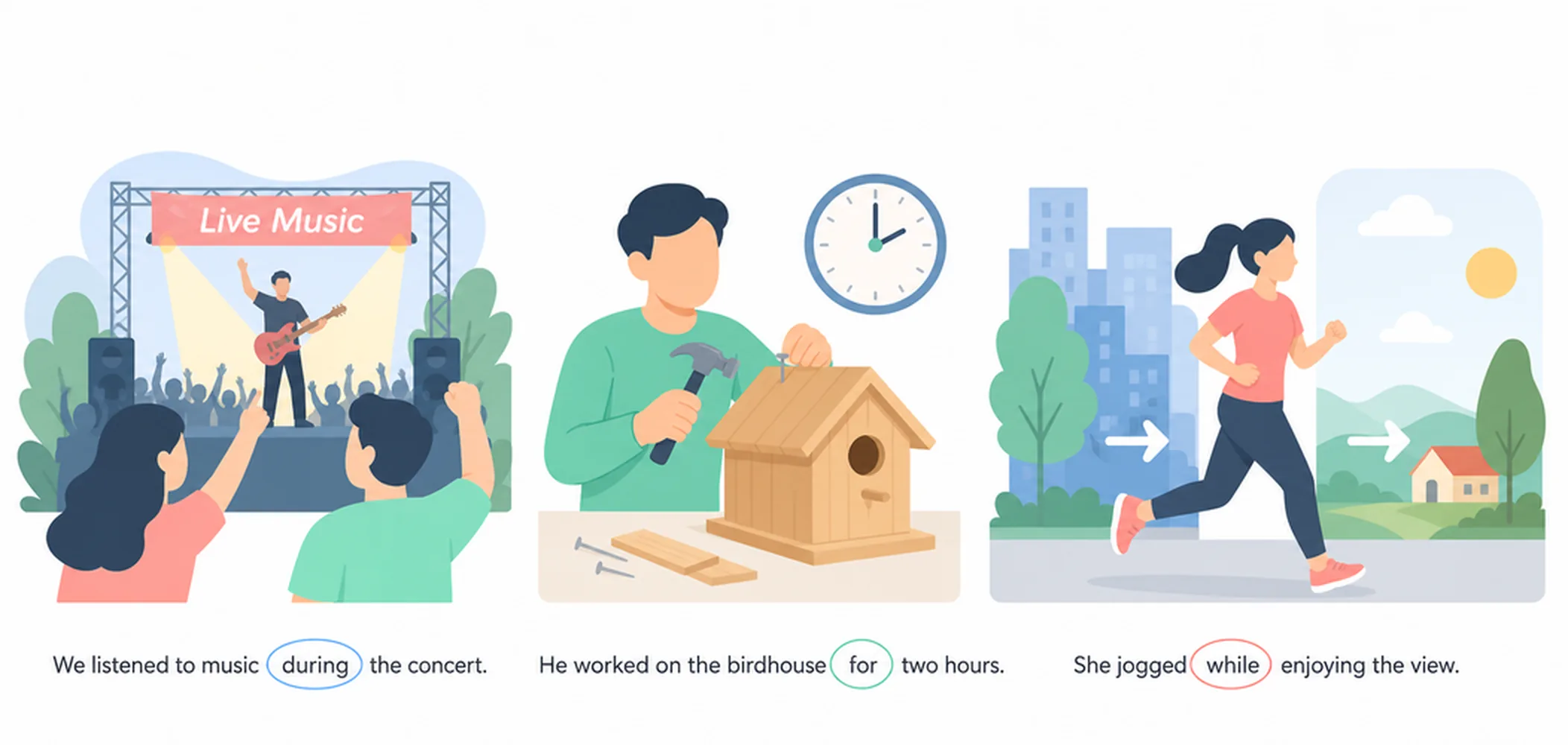
Use 'during' when something happens inside a period of time. It shows that one action happened within another time period. 'During' is followed by a noun (a thing or period), like 'during the movie' or 'during winter'. We don't usually say how long the action takes—just that it happened in that time.
When to Use FOR
Use 'for' when you want to say how long something takes. 'For' shows the length or duration of time. We use 'for' with numbers and time words, like 'for 2 hours' or 'for 3 weeks'. It answers the question 'How long?'
When to Use WHILE
Use 'while' to show that two actions happen at the same time. 'While' connects two sentences or clauses together. It shows that one thing was happening when another thing happened. The action with 'while' usually takes time, not just a moment.
Quick Comparison Table
DURING: shows time period (preposition) | FOR: shows how long (preposition) | WHILE: shows two actions at same time (conjunction)
Sentence Formulas
During
Used with a noun — refers to a period or event when something happens.
| Structure | Example | Notes |
|---|---|---|
| Subject + Verb + during + Noun (event/period) | She fell asleep during the movie. | Affirmative: action occurs within a specific period |
| Subject + Verb + not + during + Noun | He did not speak during the meeting. | Negative: action does not occur during that time |
| Aux. Verb + Subject + Verb + during + Noun? | Did you eat during the class? | Question: ask if action occurred during that period |
Note: Use during only with nouns (events or periods), not with clauses or time lengths. Incorrect: during I was sleeping or during three hours.
For
Used with a duration of time — shows how long something lasts.
| Structure | Example | Notes |
|---|---|---|
| Subject + Verb + for + Time Length (e.g. 2 hours, 3 days) | I have lived here for five years. | Affirmative: expresses duration of an action |
| Subject + Verb + not + for + Time Length | She has not called for two weeks. | Negative: action has not occurred for a specified duration |
| Aux. Verb + Subject + Verb + for + Time Length? | Have you studied for three hours? | Question: ask about the duration of an action |
Note: Use for with specific time measurements (minutes, hours, days, weeks, years, etc.), not with specific events or dates.
While
Used with a clause — indicates that two actions happen at the same time, or one action interrupts another.
| Structure | Example | Notes |
|---|---|---|
| Subject + Verb + while + Subject + Verb | I watched TV while she read a book. | Affirmative: two simultaneous actions |
| Subject + Verb + while + Subject + Verb + not | They talked while he did not listen. | Negative: one action occurs while another does not |
| Aux. Verb + Subject + Verb + while + Subject + Verb? | Were you sleeping while I was working? | Question: ask about simultaneous or interrupted actions |
Note: Use while only with clauses (Subject + Verb), not with nouns or time lengths. Incorrect: while the movie or while three hours.
Examples








What to Remember
- Use 'during' to show an action happening within a time period; always follow it with a noun.
- Use 'for' to say how long something lasts; it shows duration and is followed by a time length.
- Use 'while' as a conjunction to connect two actions happening at the same time; it introduces a clause.
- 'During' and 'for' are prepositions taking nouns; 'while' is a conjunction that connects complete ideas or clauses.
- Don't confuse 'during' (within a period) with 'for' (length of time); they show different time relationships.