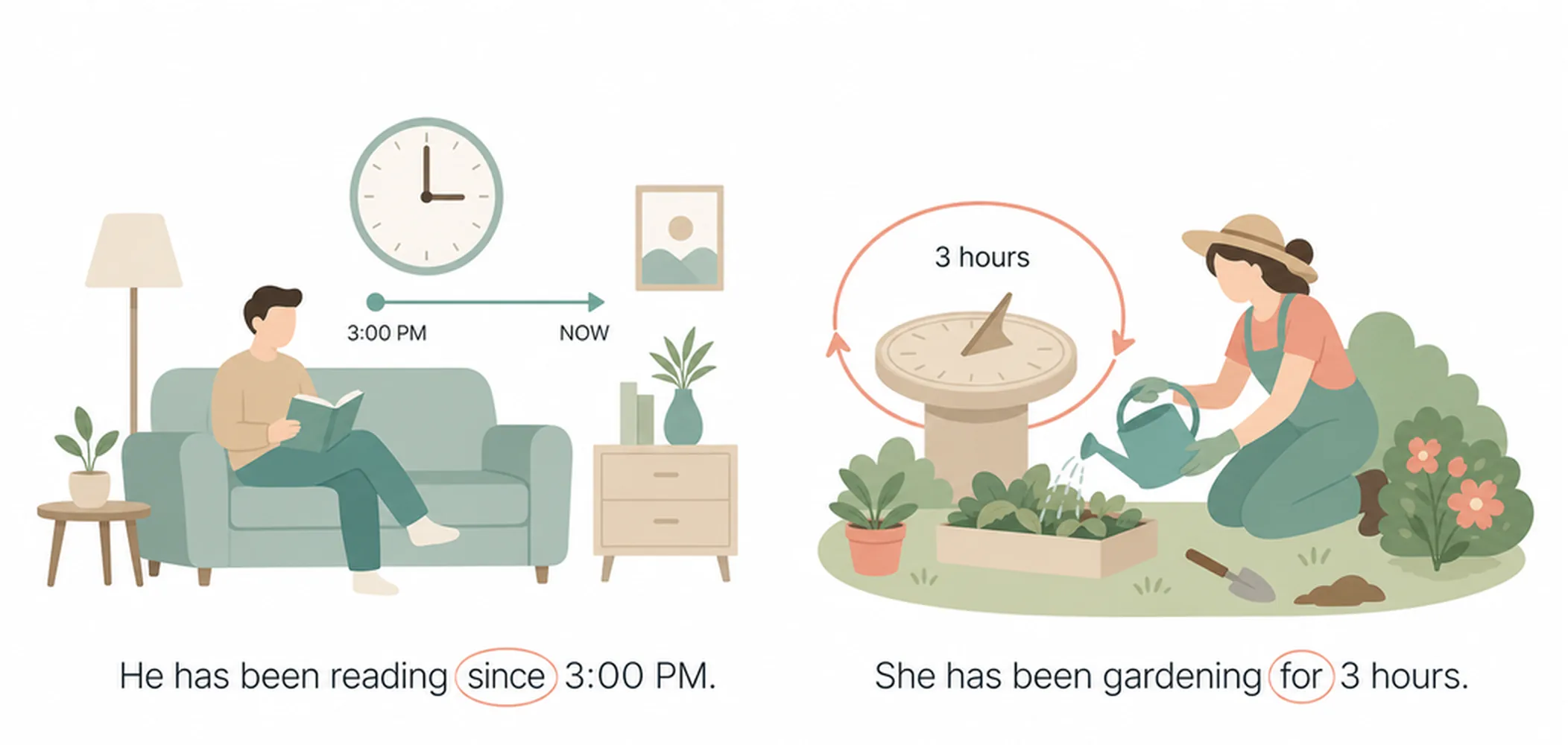
Since vs For: The Key Difference
Both 'since' and 'for' talk about time, but they work differently. Use 'since' to say WHEN something started—the starting point in time. Use 'for' to say HOW LONG something lasted—the duration or length of time. For example: 'I have lived here since 2015' (starting point) but 'I have lived here for 8 years' (duration).
Side-by-Side Comparison
SINCE answers 'when did it start?' and is followed by a specific time (a year, date, or time expression). FOR answers 'how long?' and is followed by a time period (hours, days, months, years). Both are commonly used with the present perfect tense ('have/has + past participle') to connect the past to now.
Since vs For: At a Glance
| Dimension | Since | For |
|---|---|---|
| Form | since + point in time (a specific moment, date, or event) | for + period of time (a duration or length of time) |
| Question answered | Since when? — marks the starting point of an action or state that continues to the present | How long? — expresses the total amount of time an action or state has lasted |
| What follows | A specific point: a year (since 2010), a date (since Monday), an event (since the meeting), or a clause (since I was a child) | A measured span: for two hours, for a week, for several months, for ages |
| Positive example | "She has lived in Paris since 2018." "I have known him since we were teenagers." |
"She has lived in Paris for six years." "I have known him for a long time." |
| Negative example | "I haven't eaten since breakfast." "He hasn't called since last Tuesday." |
"I haven't eaten for eight hours." "He hasn't called for a week." |
| Question example | "Since when have you been learning Spanish?" "How long has it been since you last slept?" |
"How long have you been learning Spanish for?" "Have you been waiting for a long time?" |
| Typical tenses used with | Primarily present perfect and present perfect continuous; also past perfect when referring to an earlier period | Present perfect, present perfect continuous, past simple, past continuous, and future tenses — used across a wider range of tenses |
| Key signal words / time expressions | since yesterday, since noon, since 1999, since January, since last summer, since the beginning, since then, since I was born | for two days, for an hour, for three weeks, for a month, for years, for a long time, for ages, for centuries |
| Common learner errors | ❌ "I have lived here since ten years." ✅ "I have lived here since 2014." — do not use since with a duration |
❌ "I have lived here for last year." ✅ "I have lived here for a year." — do not use for with a specific point in time |
| 💡 Key Difference: Use since to pinpoint the starting moment of an ongoing situation (e.g., a date, event, or named time). Use for to describe the total length of that situation (e.g., a number of hours, days, or years). A simple test: if you can answer the question "Since when?", use since; if you can answer "How long?" with a measured span, use for. | ||
Examples

I have worked here since 2018.
Starting point · Present perfect

She has been a teacher since January.
Specific time · Present perfect

We have known each other since we were children.
Past event as starting point · Present perfect

I have worked here for 5 years.
Duration · Present perfect

She has been a teacher for ten months.
Time period · Present perfect

We have known each other for a long time.
Unspecific duration · Present perfect
When to use it
Talking About Your Job
Tell people when you started working somewhere or how long you've been there.
"I have worked at this company since 2019" or "I have worked here for 4 years."
Describing Relationships
Explain when you met someone or how long you have known them.
"We have been friends since school" or "We have been friends for many years."
Where You Live
Say when you moved somewhere or how long you have lived there.
"I have lived in London since 2015" or "I have lived here for 8 years."
Signal words
since: 2020, Monday, last week, I was born, we met
for: 3 years, two weeks, a long time, several months, 6 hours
Common Mistakes
✕
Wrong
I live here for 3 years.
✓
Correct
I have lived here for 3 years.
Use present perfect with 'for' duration, not simple present.
✕
Wrong
She works here for 2010.
✓
Correct
She has worked here since 2010.
'For' needs a duration (2 years), not a year. Use 'since' for a starting point.
✕
Wrong
They have been friends since five years.
✓
Correct
They have been friends for five years.
Use 'for' with a time period (five years), not 'since'.
KEY TAKEAWAYS
What to Remember
- Use 'since' to show when something started—the specific point in time.
- Use 'for' to show how long something lasted—the duration or length.
- 'Since' needs a specific time: since 2015, since Monday, since yesterday.
- 'For' needs a length of time: for 8 years, for two hours.
- Both 'since' and 'for' commonly follow present perfect verbs like 'have lived.'