Before vs After: The Key Difference
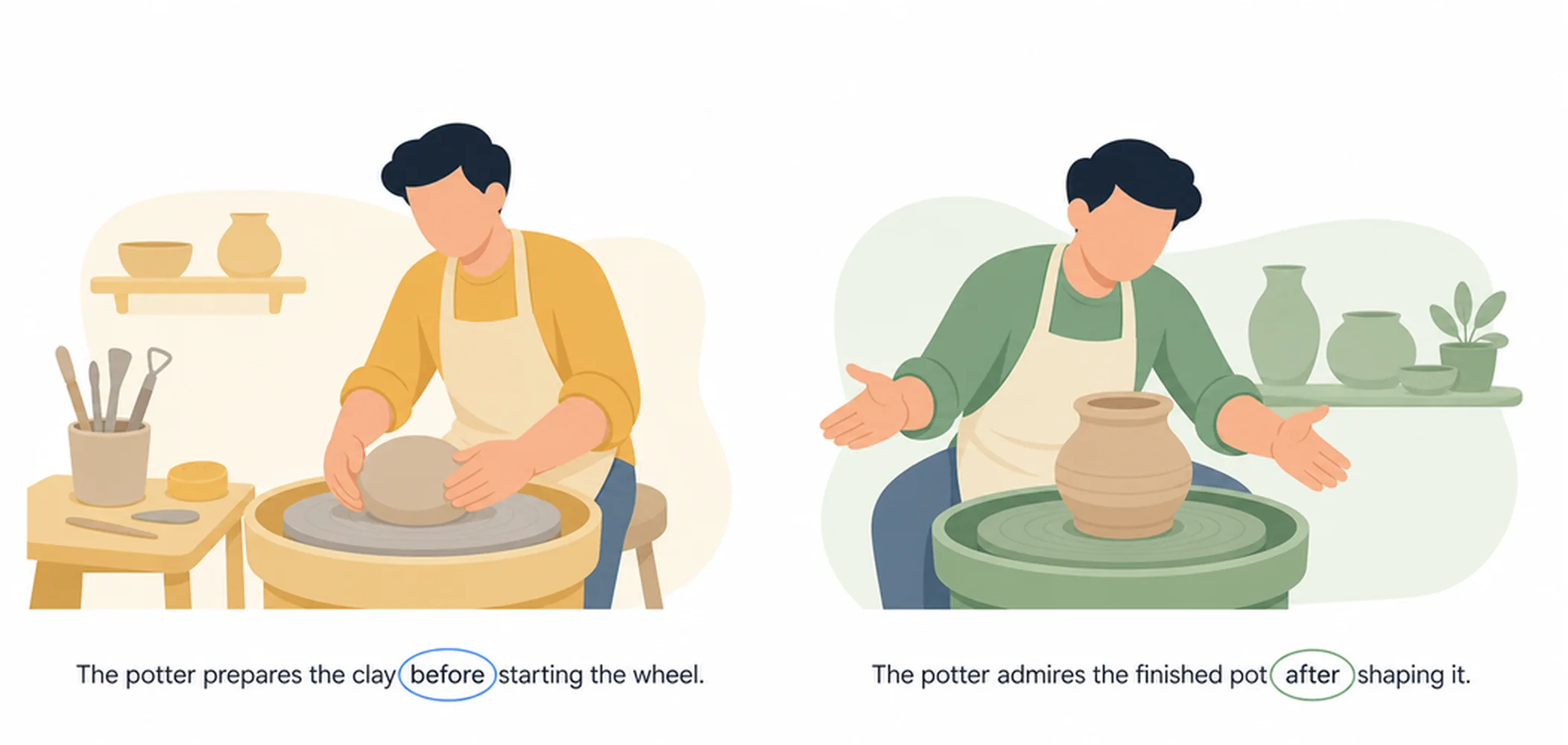
Before and after are prepositions of time. They show the order of events. Use before when something happens first, and the other thing comes later. Use after when something happens first, and you are talking about what comes next. Both words connect two actions or times.
Side-by-Side Comparison
Before means earlier in time. The event after 'before' is the second event. After means later in time. The event after 'after' is the second event. Example: 'I eat before I go to work' (eating happens first). 'I go to work after I eat' (work happens second). Both sentences mean the same thing, but the order is different.
Remember the Order
A simple way to remember: Before looks back (to the past event), and after looks forward (to the next event). If you say 'I sleep before midnight', midnight is later. If you say 'I sleep after 10 p.m.', 10 p.m. is earlier.
Before vs After: Side-by-Side Comparison Table
| Category | Before | After |
|---|---|---|
| Form | Preposition, conjunction, or adverb used to place an event earlier in time than a reference point. Preposition: before + noun/noun phrase Conjunction: before + subject + verb |
Preposition, conjunction, or adverb used to place an event later in time than a reference point. Preposition: after + noun/noun phrase Conjunction: after + subject + verb |
| Meaning | Indicates that one event happens earlier than or in advance of another event or time. | Indicates that one event happens later than or following another event or time. |
| Position in Sentence | Can appear at the beginning or middle of a sentence. When used as a conjunction at the start, a comma separates the two clauses. Before dinner, wash your hands. She left before he arrived. |
Can appear at the beginning or middle of a sentence. When used as a conjunction at the start, a comma separates the two clauses. After dinner, we watched a film. He relaxed after he finished work. |
| What Event It Refers To | Refers to the event that serves as the future boundary or deadline — the main action happens first, and the reference event comes second. | Refers to the event that has already occurred — it acts as the starting point or trigger for the main action that follows. |
| Positive Example | "Please submit your report before Friday." The report is due; Friday is the deadline that comes second. |
"She called me after the meeting." The meeting happened first; the call followed. |
| Negative Example | "Do not eat anything before the surgery." Eating is prohibited in the period leading up to the surgery. |
"He did not feel well after the long flight." The discomfort began once the flight had ended. |
| Question Example | "Did you speak to him before the interview?" Asking whether a conversation took place prior to the interview. |
"How do you feel after the interview?" Asking about a state or action that follows the interview. |
| Key Signal Words / Phrases | prior to, previously, in advance of, earlier than, up until, ahead of, by the time | following, subsequently, later, once, as soon as, in the aftermath of, thereafter |
| Tense Compatibility | Works with all tenses. In clauses introduced by before, the present simple is often used instead of the future simple: "Call me before you leave" (not "before you will leave"). | Works with all tenses. In clauses introduced by after, the present simple or present perfect is used instead of the future: "I'll call you after I arrive / after I have arrived." |
Examples




What to Remember
- Use before when an action happens first and another action comes later.
- Use after when an action happens first and you describe what comes next.
- Before and after are prepositions that show the order of two events.
- Both words connect two actions or times to show sequence clearly.
- After refers to something that happens following another event, not before it.