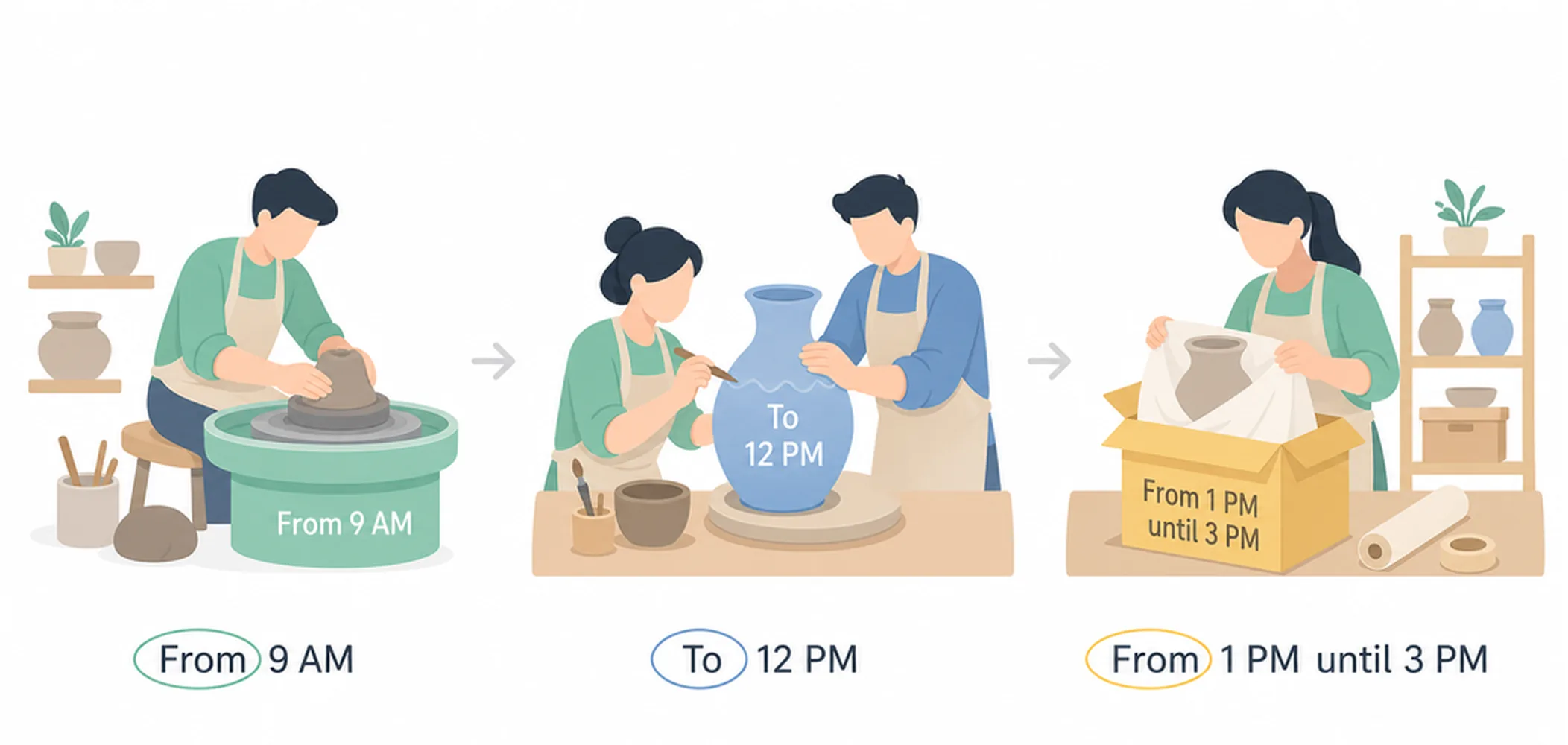
What are 'from...to' and 'from...until'?
Both 'from...to' and 'from...until' show a time period with a beginning and an end. They tell us when something starts and when it finishes. 'From' marks the start time, and 'to' or 'until' marks the end time. These prepositions are very common in daily life when we talk about work, school, activities, or events.
When do we use 'from...to'?
Use 'from...to' for specific time periods with clear start and end times. It works with hours, days, dates, and years. 'From...to' is the most common choice and sounds neutral and clear. You can use it for any situation: work schedules, classes, events, or how long something lasts.
When do we use 'from...until'?
'From...until' also shows a time period, but it emphasizes the end point—the moment when something stops. Use it when you want to focus on how long something continues up to a specific moment. 'Until' often sounds slightly more formal than 'to', but they are very similar in meaning. You can use either one in most situations, but 'to' is more common in everyday English.
From...to vs From...until: What's the Difference?
| Dimension | From…To | From…Until / Till |
|---|---|---|
| Form | from + starting point + to + ending point Example pattern: from [time/place] to [time/place] |
from + starting point + until/till + ending point or event Example pattern: from [time] until/till [time/event] |
| Primary Meaning & Emphasis | Indicates a span or range — both a clear start point and a clear end point. Neutral emphasis; focuses on the distance or extent between two points (time, place, or quantity). | Indicates duration up to a boundary — stresses that something continues and then stops at the end point. Emphasises the endpoint as a limit or condition. |
| Formality Level | Neutral — suitable for both formal and informal contexts. Commonly used in written and spoken English alike. | Until is slightly more formal; till is informal/conversational. Both are widely acceptable; until is preferred in formal writing. |
| Typical Contexts |
• Time ranges: working hours, historical periods • Place ranges: distances, travel routes • Numerical ranges: age, price, scores • Describing transformation or change |
• Ongoing actions or states that cease at a point • Waiting or anticipation scenarios • Conditions or events as endpoints • Emphasising continuity before a cutoff |
| Use with Places | Yes — very common with places and distances. "We drove from Paris to Rome." |
Rare / Unnatural — until/till is not normally used with physical locations. ❌ "We drove from Paris until Rome." (incorrect) |
| Use with Numbers & Quantities | Yes — naturally used with numerical ranges. "Tickets cost from £10 to £50." |
Limited — not typically used with numerical or quantity ranges. ❌ "Tickets cost from £10 until £50." (unnatural) |
| Positive Example | ✅ "The museum is open from 9 a.m. to 5 p.m." ✅ "She worked from Monday to Friday." |
✅ "He waited from noon until she arrived." ✅ "They stayed from Tuesday till the end of the week." |
| Negative Example | ✅ "The store was not open from Sunday to Tuesday." (Indicates closed across that range.) |
✅ "She did not stop working from morning until midnight." (Stresses the continuity of the action.) |
| Question Example | ✅ "How long does the flight take from London to New York?" | ✅ "Did you really study from 6 a.m. until midnight?" |
| Use with Events as Endpoint | Possible but less natural with event-based endpoints. "We talked from dinner to bedtime." — acceptable but feels like fixed reference points. |
Very natural with events or conditions as endpoints. ✅ "I'll wait from now until you call me." ✅ "He ran from start until he collapsed." |
| Interchangeability | Interchangeable with from…until only when the endpoint is a specific time and the context involves a continuing action or state. ✅ "I worked from 9 to 5." = "I worked from 9 until 5." |
Interchangeable with from…to when a fixed time endpoint is used. ✅ "I worked from 9 until 5." = "I worked from 9 to 5." ❌ NOT interchangeable for places, distances, or numerical ranges. |
| Key Signal Words / Cues |
• Distances and directions (London to Paris) • Price / age / score ranges (10 to 20) • Named days/dates used as fixed markers • Transformation verbs (change, go, grow) |
• Waiting, continuing, lasting, staying • Event-based endpoints (until she arrives) • Conditional or uncertain end time • Emphasis on duration or persistence |
| 🔑 Key Difference: Both from…to and from…until/till can describe time periods and are often interchangeable when a specific clock time is the endpoint (e.g., "from 9 to 5" = "from 9 until 5"). However, from…to is broader and more versatile — it works with time, place, distance, and numbers, and simply marks two boundary points. From…until/till is more restricted to time and events only, and it specifically stresses continuous duration up to a stopping point, making the endpoint feel like a decisive limit or condition. When in doubt: use to for ranges involving place or quantity; use until/till to highlight that something kept going right up to the moment it stopped. | ||
Examples






What to Remember
- Use 'from...to' for specific time periods with clear start and end points.
- 'From' marks when something starts, and 'to' or 'until' marks when it ends.
- 'From...to' works with hours, days, dates, and years for any time period.
- Use 'from...until' less commonly; 'from...to' is the preferred and most neutral choice.
- Both structures describe complete time periods in daily life activities and events.