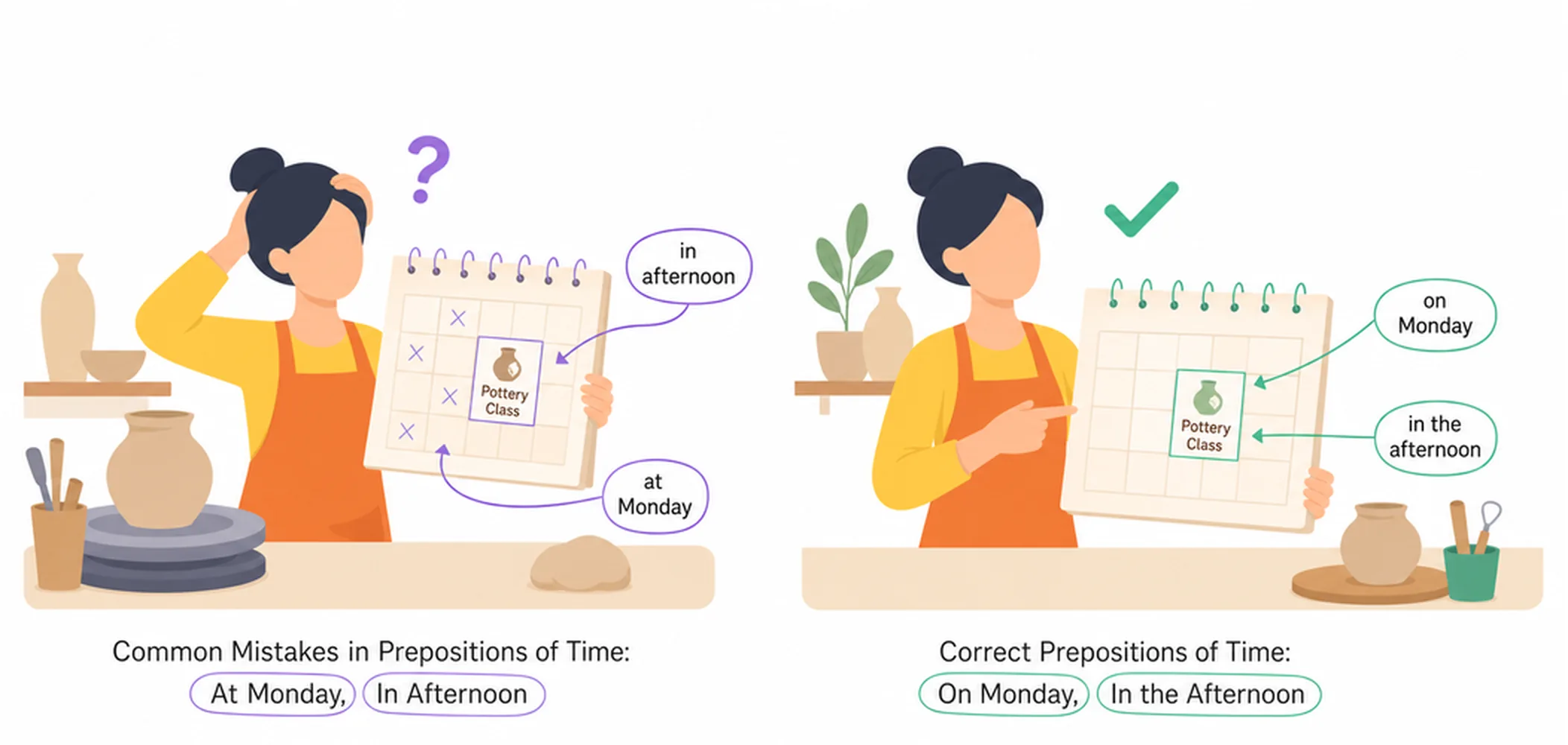
Why Learners Struggle with Prepositions of Time
Prepositions of time are confusing because the rules are not always logical. In many languages, one preposition works for all time expressions. But in English, we use different prepositions (at, in, on) depending on the type of time. Even small mistakes can make your writing unclear. Learning the correct patterns now will help you communicate more accurately.
At, In, On — Quick Reference Table
| Preposition | Time Category | Correct Examples | Common Mistake |
|---|---|---|---|
| AT | Exact / precise times; fixed periods |
at 6 o'clock at noon / at midnight at sunrise / at sunset at the weekend (BrE) at Christmas / at Easter at night |
❌ in night ❌ on midnight ❌ in the weekend |
| IN | Longer / broader periods |
in the morning / afternoon / evening in January / in March in summer / in winter in 2024 / in the 1990s in the 21st century in two hours (future) |
❌ at the morning ❌ on summer ❌ on January |
| ON | Specific days & dates |
on Monday / on Fridays on 5 July / on July 5th on my birthday on Christmas Day on the weekend (AmE) on a cold winter morning |
❌ in Monday ❌ at my birthday ❌ in Christmas Day |
| ⚠️ No preposition | With this, last, next, every, tomorrow, yesterday |
this morning last night next Monday every year tomorrow afternoon |
❌ on last Monday ❌ in every year ❌ on next Friday |
Examples

I have a meeting on Tuesday at 10 AM.
Specific day + exact time · Prepositions of time

She was born in March 1999.
Month and year · Prepositions of time

We usually eat dinner in the evening.
Part of the day · Prepositions of time

The store is closed on Sundays.
Day of the week · Prepositions of time
When to use it
Exact Times
Use 'at' for specific times. This is the most common and reliable rule in English.
"The class starts at 9:30 AM."
Days and Dates
Use 'on' for days of the week and specific dates. This is one of the clearest rules.
"I was born on March 15th. Let's meet on Friday."
Months and Seasons
Use 'in' for months, seasons, years, and centuries. These are all longer time periods.
"We took a trip in July. I love swimming in summer."
Parts of the Day
Use 'in' for morning, afternoon, evening, and night (without a specific time).
"I prefer working in the morning. The party is in the evening."
Signal words
Monday, Tuesday, Wednesday (days)
January, February, March (months)
1995, 2024 (years)
summer, autumn, winter, spring (seasons)
3 PM, 9:30 AM (exact times)
morning, afternoon, evening, night (parts of day)
the weekend (British English with 'at')
Common Mistakes
✕
Wrong
I will see you in Monday.
✓
Correct
I will see you on Monday.
Days of the week use 'on', not 'in'. Use 'on' for specific days: on Monday, on Friday.
✕
Wrong
The meeting is at 3 o'clock in the afternoon.
✓
Correct
The meeting is at 3 o'clock in the afternoon. (CORRECT) OR The meeting is at 3 in the afternoon.
'At' is correct for exact times. 'In the afternoon' is also correct, but together they are both acceptable. The original is actually correct English.
✕
Wrong
She was born on 1995.
✓
Correct
She was born in 1995.
Years use 'in', not 'on'. Use 'in' for months, years, seasons, and centuries: in 1995, in March, in summer.
✕
Wrong
We have a test in Friday morning.
✓
Correct
We have a test on Friday morning.
Specific days with times of day use 'on': on Friday morning, on Monday evening, on Saturday afternoon.
✕
Wrong
I go to the gym at the weekend.
✓
Correct
I go to the gym at the weekend. (British English) OR I go to the gym on the weekend. (American English)
British English uses 'at the weekend', but American English uses 'on the weekend'. Both are correct depending on your variety of English.
✕
Wrong
The office opens at 9 AM in weekdays.
✓
Correct
The office opens at 9 AM on weekdays.
Use 'on' with specific days or days of the week, not 'in'.
KEY TAKEAWAYS
What to Remember
- Use "at" for specific times like o'clock, midnight, and noon.
- Use "in" for months, years, seasons, and longer time periods.
- Use "on" for specific days and dates, including days of the week.
- Remember "in the morning/afternoon/evening" but "at night" is the exception.
- Avoid using one preposition for all time expressions; English requires different prepositions.