Understanding IN, ON, AT for Time
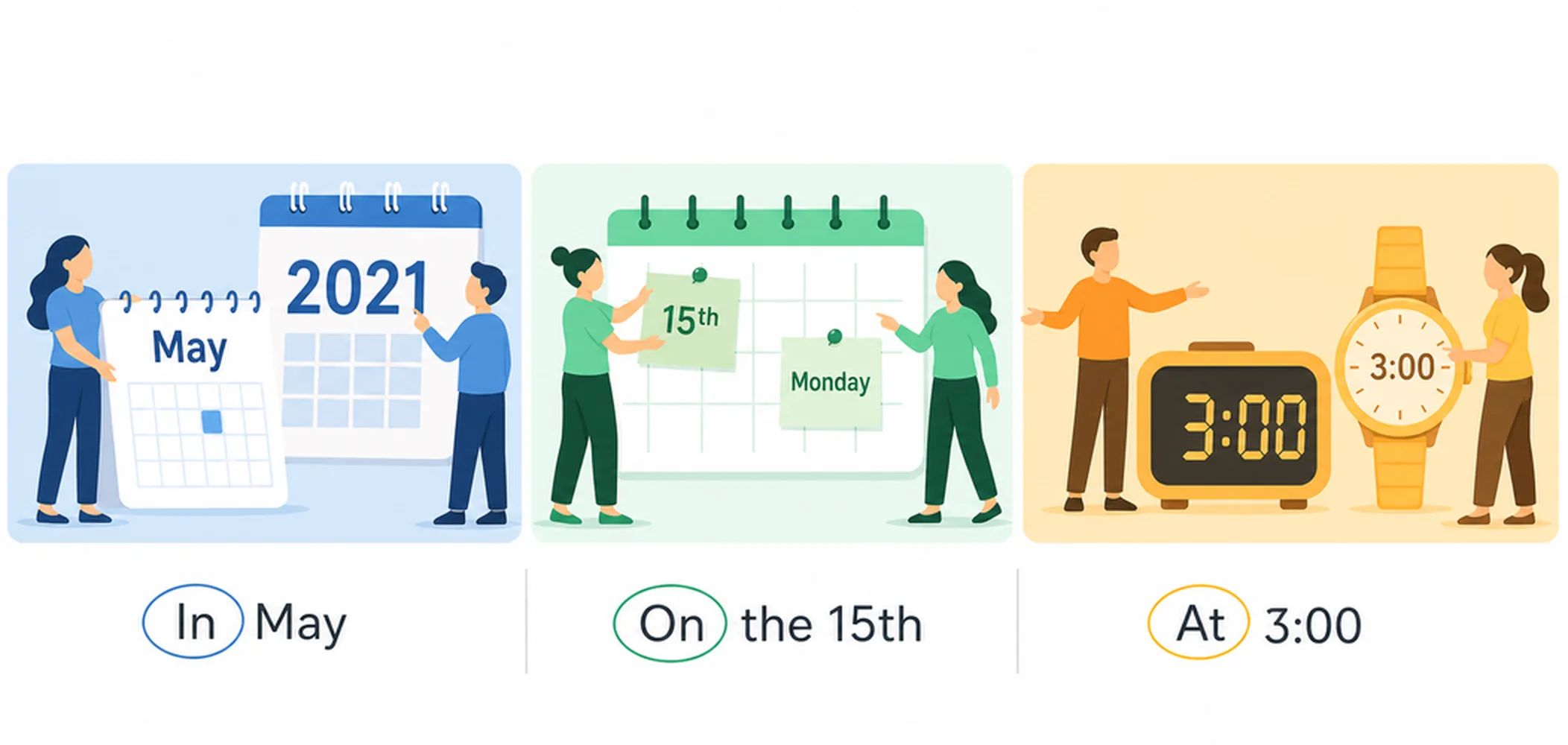
We use three prepositions to talk about when something happens: IN, ON, and AT. Each one is used for different time periods. Learning which to use will help you speak and write about time correctly and naturally.
IN for Months, Seasons, Years, and Long Periods
Use IN for months, seasons, years, and longer time periods. For example, we say "in January," "in summer," and "in 2024." We also use IN for parts of the day like "in the morning" or "in the afternoon." This preposition is for larger blocks of time.
ON for Days and Dates
Use ON for specific days and dates. We say "on Monday," "on Friday," and "on December 25th." If you mention a day with a specific event, use ON: "on my birthday," "on Christmas Day." Use ON when you are talking about a single day.
AT for Specific Times and Clock Times
Use AT for exact times and specific moments. We say "at 3 o'clock," "at midnight," and "at noon." We also use AT for special times in the day: "at breakfast," "at night." AT is the most precise preposition for time.
IN, ON, AT for Time — Quick Comparison
| Category | IN | ON | AT |
|---|---|---|---|
| Time Categories | Longer, broader periods: months, years, seasons, centuries, parts of the day | Specific days and dates: days of the week, calendar dates, special days | Precise, exact points in time: clock times, specific moments, short fixed periods |
| When to Use | Use in when the time reference is a large container of time — something that spans multiple days, weeks, or an extended period | Use on when the time reference is a single, named day or a specific date on the calendar | Use at when the time reference is a pinpoint moment — an exact hour, a fixed event time, or a very short period |
| Positive Example | She was born in July. We moved here in 2010. Flowers bloom in spring. I study in the morning. |
The meeting is on Monday. My birthday is on 5 March. We celebrate on Christmas Day. School starts on the first day of term. |
The train leaves at 9:00. We met at noon. I always eat at midnight. Call me at lunchtime. |
| Negative Example | She was not born in August. We did not move in 2005. It does not snow in summer here. |
The meeting is not on Friday. His birthday is not on 10 April. We do not work on Sundays. |
The train does not leave at 8:00. We did not meet at midnight. I do not eat at noon on weekdays. |
| Question Example | Which month were you born in? What did you do in the afternoon? Which year did you graduate? |
Which day is the class on? What date is the exam on? Do you work on weekends? |
What time does the film start — is it at 7 or 8? Did you arrive at noon? Will you call me at lunchtime? |
| Key Signal Words | January, February … December; 2000, 2024 …; spring, summer, autumn, winter; the morning, the afternoon, the evening; the 20th century | Monday, Tuesday … Sunday; 5 March, 12 July …; Christmas Day, New Year's Day, my birthday, a public holiday; the weekend (British English) | 1:00, 9:30, midnight, noon, midday, night, sunrise, sunset, lunchtime, the weekend (American English), the moment, the same time |
| Form / Structure | in + month / year / season / part of day in July · in 2024 · in winter · in the morning |
on + day / date / named day on Monday · on 5 March · on Christmas Day |
at + clock time / fixed moment at 9:00 · at noon · at midnight · at lunchtime |
| 💡 Key Difference — Think of it as a zoom lens: IN is the widest shot (big blocks of time: years, months, seasons, parts of the day). ON zooms in to a single day or date. AT zooms in all the way to an exact clock time or pinpoint moment. The broader the time period → use in; a named day or date → use on; a precise moment → use at. | |||
Examples






What to Remember
- Use IN for months, seasons, years, and parts of the day like morning or afternoon.
- Use ON for specific days of the week and exact dates.
- Use AT for exact times like "at 3 o'clock" or "at midnight."
- Remember: IN is for larger time blocks, ON for specific days, AT for exact moments.
- Don't use ON with months or seasons; use IN instead.