What is 'In' for Time?
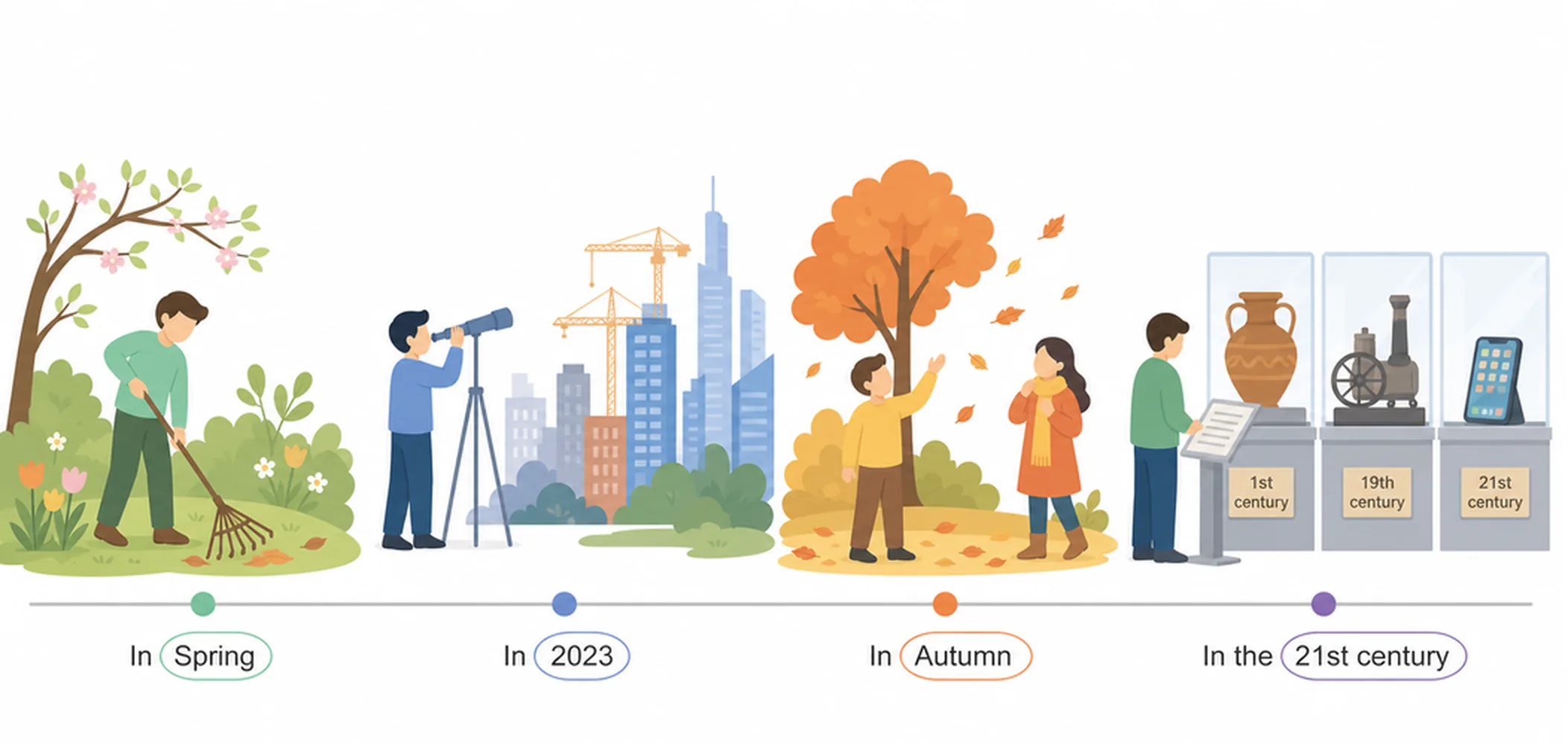
The preposition 'in' is used to talk about when something happens. We use 'in' with longer periods of time like months, years, seasons, and centuries. 'In' tells us a general time, not an exact day or time. For example, we say 'in May' or 'in 2024', not 'in Monday' or 'in 3 o'clock'.
Using 'In' with Different Time Periods
| Time Period Category | Usage Pattern & Example |
|---|---|
| Month | Use 'in' + month name: I have a meeting in January. |
| Year | Use 'in' + year: She was born in 1995. |
| Season | Use 'in' + season name: We go skiing in winter. |
| Century | Use 'in' + century: Shakespeare lived in the 16th century. |
All of these examples show general time periods, not exact dates. The event happens sometime during that period, which is why 'in' is the correct preposition to use.
Important Rules
Remember: do NOT use 'in' with days of the week (say 'on Monday', not 'in Monday') or with specific times (say 'at 5 o'clock', not 'in 5 o'clock'). Only use 'in' for months, years, seasons, and centuries. These are longer time periods where we do not know the exact day.
In vs. On vs. At — Time Prepositions Compared
| IN | ON | AT | |
|---|---|---|---|
| Form | in + long time period | on + specific day or date | at + precise point in time |
| When to use | Use with months, years, seasons, decades, centuries, and longer periods of time where the event occurs within a broad span | Use with days of the week, specific calendar dates, and named special days or holidays | Use with clock times, exact moments, meal times, and short fixed points such as midnight, noon, dawn, or night |
| Positive example |
She was born in March. They moved here in 2019. Flowers bloom in spring. It happened in the 20th century. |
The meeting is on Monday. He arrived on 14 July. We celebrate on Christmas Day. The report is due on Friday morning. |
The train leaves at 7:45. Call me at noon. She woke up at midnight. We eat at breakfast. |
| Negative example |
❌ She was born ❌ They moved here ❌ Flowers bloom ❌ It happened |
❌ The meeting is ❌ He arrived ❌ We celebrate ❌ The report is due |
❌ The train leaves ❌ Call me ❌ She woke up ❌ We eat |
| Question example |
When were you born? — In what year did this happen? Does it snow in winter there? Were they married in the nineties? |
Is the concert on Saturday or Sunday? Did they meet on Valentine's Day? Is the deadline on the 30th? |
Does the film start at 8:00 or 9:00? Do you usually eat lunch at noon? Did it happen at midnight? |
| Key signal words |
January, February … December; 2000, 1995, the 1800s; spring, summer, autumn/fall, winter; the 21st century, the Middle Ages; the morning, the afternoon, the evening |
Monday, Tuesday … Sunday; 1st, 2nd, 3rd … (calendar dates); Christmas Day, New Year's Day, my birthday, a weekday, Friday afternoon, Sunday evening |
7:00, 12:30, half past three; midnight, noon, midday; dawn, dusk, sunrise, sunset; breakfast, lunch, dinner; night, the weekend (BrE) |
| Key Difference: The choice between in, on, and at depends on how specific or broad the time reference is. Think of it as a funnel: IN covers the widest spans of time (centuries → years → months → seasons → parts of the day), ON narrows down to a single identifiable day or date, and AT pinpoints the most precise, clock-level or fixed-moment references. A helpful memory rule: "In a big period, on a day, at an exact time." Note that morning / afternoon / evening use in alone (e.g. in the morning), but when combined with a day they switch to on (e.g. on Friday morning), and night pairs with at (e.g. at night). | |||
Formula
✔ Positive
Subject
+
verb
+
in
+
[month/year/season/century]
They moved to London in 2020.
Examples
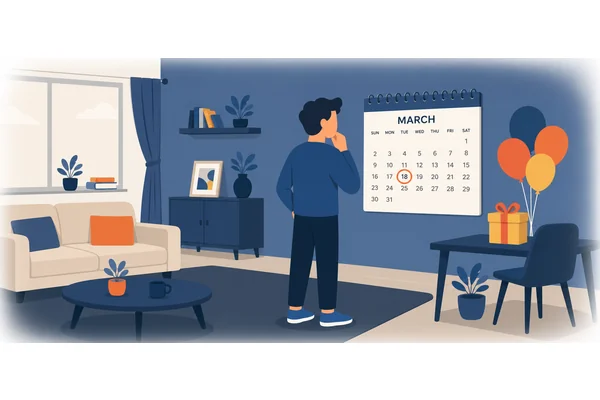
My birthday is in March.
Months · A2 daily use

I started this job in 2022.
Years · Personal information

The weather is hot in summer.
Seasons · General facts
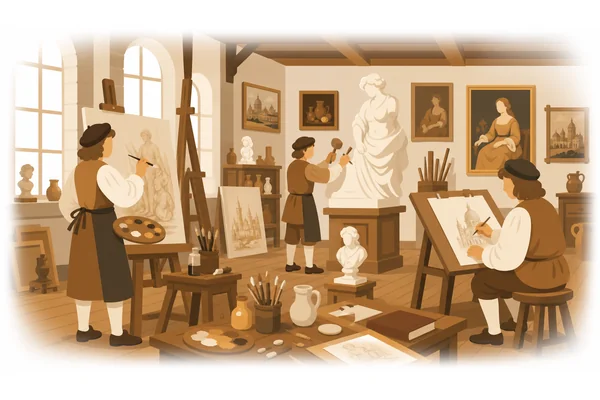
Many great artists lived in the 17th century.
Centuries · Historical context

I will see you in April.
Future plans · Months

Children go back to school in autumn.
Seasons · Routine events
When to use it
Talking About Birthdays
Tell people when you were born using months and years.
"I was born in December 1999."
History and Facts
Describe historical events using centuries and years.
"The Industrial Revolution happened in the 18th century."
Seasonal Activities
Explain what you do in different seasons.
"I like to swim in summer."
Plans and Schedules
Talk about future events using months and years.
"The conference is in June 2025."
Signal words
January, February, March, April, May, June, July, August, September, October, November, December
spring, summer, autumn, fall, winter
2024, 1999, 2050
century, centuries
Common Mistakes
✕
Wrong
I have class in Monday.
✓
Correct
I have class on Monday.
Use 'on' for days of the week, not 'in'.
✕
Wrong
We meet in 3 o'clock.
✓
Correct
We meet at 3 o'clock.
Use 'at' for specific times, not 'in'.
✕
Wrong
She was born in the 1990s in April in Tuesday at morning.
✓
Correct
She was born in April on Tuesday morning.
'In' only works with months, years, seasons, centuries. Use 'on' for day and 'at/in' for time of day.
KEY TAKEAWAYS
What to Remember
- Use 'in' with months, years, seasons, and centuries for general time periods.
- Don't use 'in' with specific days of the week or exact times of day.
- 'In' shows approximate time, not exact moments, so we say 'in May' not 'in Monday'.
- Examples: in January, in 2024, in summer, in the 21st century are all correct.
- Remember 'in' works for longer time periods; use other prepositions for shorter, specific times.