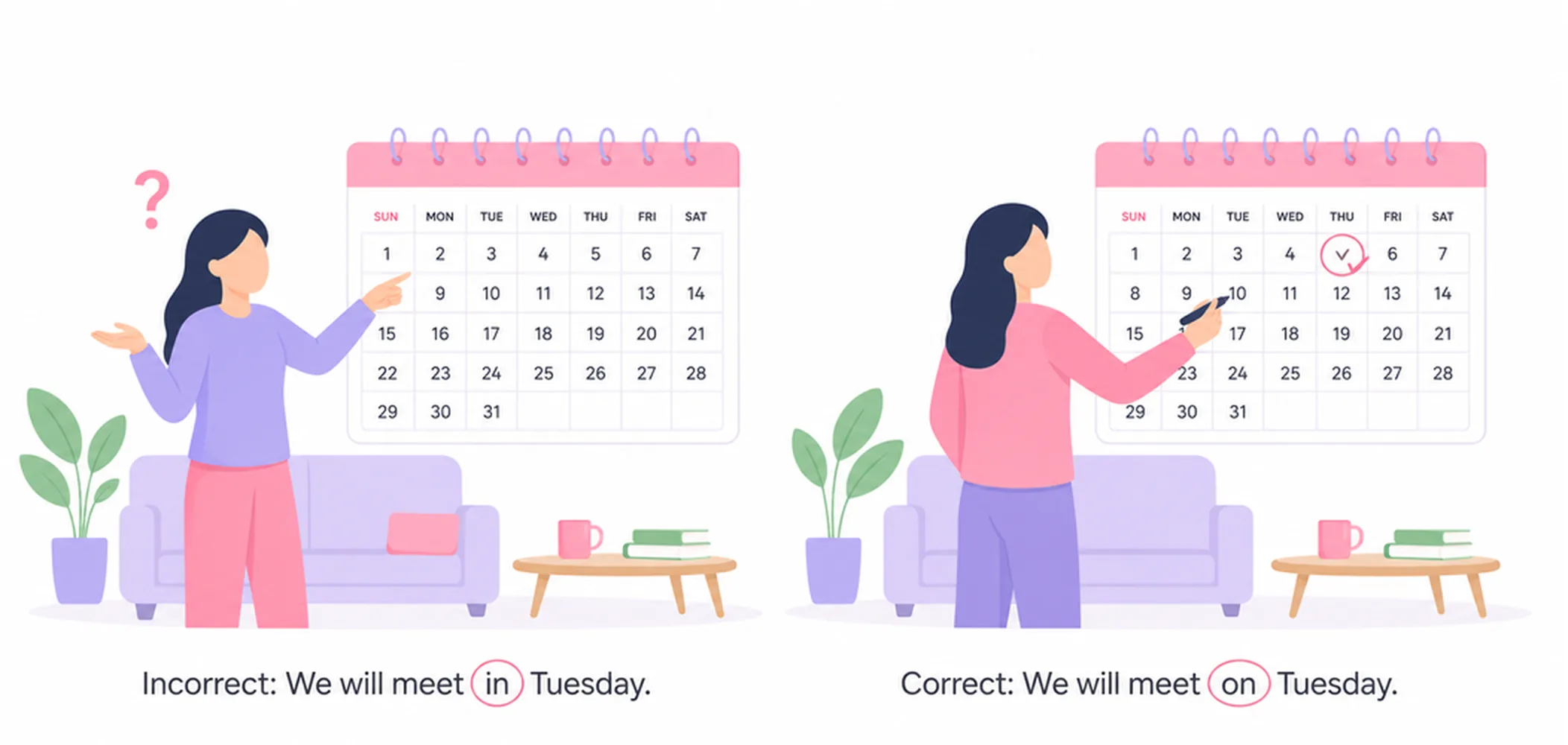
When to use 'on' with days and dates
We use the preposition 'on' before specific days and dates. 'On' tells us exactly when something happens. It is the most common preposition for talking about days of the week and particular dates. Without 'on', the sentence is usually incorrect.
Days of the week
Use 'on' before days of the week: Monday, Tuesday, Wednesday, Thursday, Friday, Saturday, Sunday. You can also say 'on Friday morning' or 'on Saturday afternoon' to be more specific. If you repeat a day (like every Friday), you can say 'on Fridays' (plural).
Specific dates
Use 'on' before specific dates like 'on 15 March', 'on December 25th', or 'on 3 June 2024'. You can say the date in different ways in English, but 'on' always comes before it. Never use 'on' with months alone (say 'in March', not 'on March').
On vs In vs At — Days and Dates
| Category | ON | IN | AT |
|---|---|---|---|
| Form | on + day / date | in + month / year / season / longer period | at + specific clock time / holiday period |
| When to Use | Use with days of the week (Monday, Tuesday…) and specific calendar dates (3rd July, Christmas Day) | Use with months (January), years (2024), seasons (summer), decades, and centuries | Use with exact times (8 o'clock), midnight/noon, and short holiday periods (at Christmas, at Easter) |
| Positive Example | The meeting is on Monday. Her birthday is on 5th March. |
She was born in April. The war ended in 1945. |
The train leaves at 9:00. We visit family at Christmas. |
| Negative Example | We don't work on Sundays. There is no class on 25th December. |
It doesn't rain much in summer. Nobody was born in 1800 who is still alive. |
The shop doesn't open at midnight. She isn't available at noon. |
| Question Example | Is the concert on Friday? Did it happen on 14th February? |
Were you born in July? Did that happen in 2010? |
Does the film start at 7 pm? Will you be home at Easter? |
| Key Signal Words / Phrases | Monday–Sunday; on weekdays; on weekends (US); specific ordinal dates (1st, 2nd…); named days (Christmas Day, New Year's Day) | January–December; spring, summer, autumn/fall, winter; 1990s; the 21st century; in the morning / afternoon / evening | o'clock; am/pm; noon; midnight; at night; at the weekend (UK); at Christmas; at Easter; at the moment |
| Special Notes | "On the weekend" is common in American English; British English typically uses "at the weekend" | "In the morning/afternoon/evening" uses in, but "at night" uses at — a common exception to learn | No preposition is used before this, last, next, every: say "next Monday" NOT "on next Monday" |
| 🔑 Key Difference: Think of the three prepositions as representing three sizes of time. AT is the smallest and most precise — a single point in time (a clock time or brief period). ON is medium — a specific day or date (a 24-hour period). IN is the largest — a broad stretch of time such as a month, year, season, or century. A simple memory rule: AT a time → ON a day → IN a longer period. | |||
Formula
✔ Positive
Subject
+
verb
+
on
+
day/date
I have class on Monday.
? Question
When/What day
+
verb
+
subject
+
?
When do you work? On Wednesdays.
Examples

I have a meeting on Monday.
Days of the week · Preposition of time

My birthday is on 12 August.
Specific date · Preposition of time

We go to the gym on Tuesdays and Fridays.
Repeated days · Preposition of time

The office is closed on New Year's Day.
Special dates · Preposition of time

Can we meet on Friday afternoon?
Day + time of day · Preposition of time

The conference starts on 5 November 2024.
Complete date with year · Preposition of time
When to use it
Making plans
Tell people when you want to meet or do something. Use 'on' before the specific day.
Can we have lunch on Thursday?
Birthdays and celebrations
Say when special days happen. Use 'on' before the date.
My birthday is on 30 June.
Schedules and timetables
Describe when classes, appointments, or work happen. Use 'on' for each day.
English lessons are on Mondays and Wednesdays.
Booking events
Tell when something is scheduled or planned. Use 'on' for the exact date.
The concert is on 12 September 2024.
Signal words
on Monday
on Tuesday
on Wednesday
on Thursday
on Friday
on Saturday
on Sunday
on Mondays
on the 1st
on 15 March
on New Year's Day
on Christmas Day
Common Mistakes
✕
Wrong
I have a dentist appointment in Monday.
✓
Correct
I have a dentist appointment on Monday.
Use 'on' for days of the week, not 'in'. 'In' is for months and seasons.
✕
Wrong
My exam is on March.
✓
Correct
My exam is in March.
Use 'in' for months alone. Use 'on' only with specific dates like 'on 15 March'.
✕
Wrong
We meet on Friday evening at 6 PM on the office.
✓
Correct
We meet on Friday evening at 6 PM in the office.
'On' is for time. Use 'in' for places.
✕
Wrong
The party is on 5 November on the evening.
✓
Correct
The party is on 5 November in the evening.
Use 'in' with parts of the day (morning, afternoon, evening). Use 'on' with the date.
KEY TAKEAWAYS
What to Remember
- Use 'on' before specific days of the week: on Monday, on Tuesday, on Wednesday, etc.
- Use 'on' with particular dates to say exactly when something happens.
- Add a time of day after the day for more specific information: on Friday morning.
- Use the plural form 'on Fridays' when referring to repeated or habitual days.
- Omitting 'on' before days and dates usually makes the sentence incorrect.