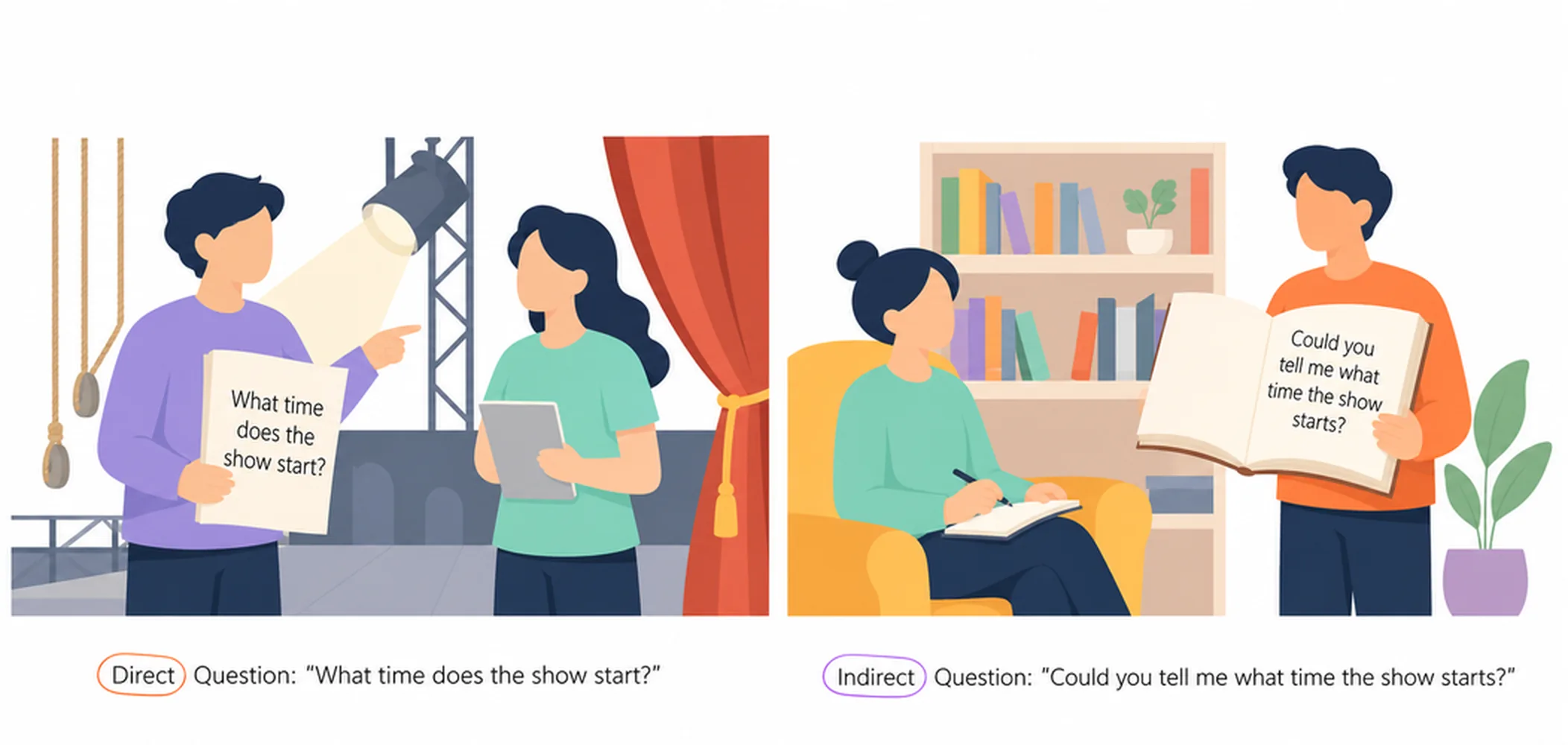
Direct vs Indirect Questions
Direct questions ask for information using question word order. We use them when we ask someone directly. Indirect questions are polite ways to ask for the same information using statement word order. They often start with phrases like 'Could you tell me...', 'Do you know...', or 'I want to know...'. Indirect questions are more polite and formal.
The Key Difference
In direct questions, the auxiliary verb comes before the subject: 'Do you like coffee?' In indirect questions, the subject comes before the verb: 'Could you tell me if you like coffee?' This word order change is the most important difference between the two forms.
Direct vs Indirect Questions: Side-by-Side Comparison
| Feature | Direct Questions | Indirect Questions |
|---|---|---|
| Form | Auxiliary verb or question word + subject + main verb (inverted word order) | Introductory phrase + question word (or if/whether) + subject + verb (normal/statement word order — no inversion) |
| Word Order | Inverted: auxiliary/modal comes before the subject e.g. Does she know…? |
Normal (statement) order: subject comes before the verb e.g. …if she knows… |
| Punctuation | Ends with a question mark (?) | Usually ends with a question mark only if the introductory phrase is a question; otherwise ends with a full stop (.) |
| Formality Level | Can be informal or neutral; often used in everyday conversation, interviews, and casual exchanges | More formal and polite; commonly used in professional, academic, or diplomatic contexts |
| When to Use | When asking someone directly; when a straightforward answer is expected; in casual or neutral situations | When being polite or tactful; when softening a request; in formal writing, customer service, or when speaking to strangers or superiors |
| Yes/No Question Example | "Is the manager available?" | "Could you tell me if the manager is available?" |
| Wh- Question Example | "Where does the meeting start?" | "Do you know where the meeting starts?" |
| Negative Example | "Didn't she call you?" | "I was wondering whether she had called you." |
| Common Introductory Phrases | None — the question stands alone | Could you tell me…, Do you know…, I was wondering…, Would you mind telling me…, I'd like to know… |
| Use of if / whether | Not used to introduce the question | Used to replace a yes/no question structure within an indirect question e.g. …if/whether he is coming |
| Auxiliary Verbs (do/does/did) | Required to form questions e.g. "Do you speak French?" |
Dropped in the embedded clause e.g. "…whether you speak French." |
| Key Signal Words / Markers | Who, What, Where, When, Why, How, Does, Did, Is, Are, Can, Will (placed at the start, before the subject) | if, whether, who, what, where, when, why, how (placed after the introductory phrase, before the subject) |
| 🔑 Key Difference | ||
| The fundamental distinction lies in word order and tone. Direct questions use inverted word order (auxiliary/modal before the subject) and are spoken or written as standalone questions, making them more immediate and straightforward. Indirect questions embed the question inside a longer statement or polite phrase, using normal statement word order (subject before verb) with no inversion. This makes indirect questions considerably more formal, polite, and less abrupt — the speaker "softens" the request rather than demanding an answer outright. Mastering the switch between the two allows speakers and writers to match their language to the social context appropriately. | ||
Formula
? Question
Question word (optional)
+
Auxiliary/Main verb
+
Subject
+
Rest of sentence
Where do you live?
Formula
Question phrase
+
Subject
+
Verb
+
Rest of sentence
Could you tell me where you live?
Examples

Where is the train station?
Direct question · Auxiliary before subject

What time does the shop close?
Direct question · Question word first

Can you help me?
Direct question · Asking permission

Could you tell me where the train station is?
Indirect question · Statement word order

Do you know what time the shop closes?
Indirect question · More polite

I want to know if you can help me.
Indirect question · Formal request
When to use it
Formal situations
Use indirect questions when you need to be polite and professional, such as in a shop or office.
"Could you tell me when the meeting starts?"
Talking about others
Use indirect questions when you ask one person about what another person thinks or does.
"Do you know if Sarah likes her job?"
Casual conversation
Use direct questions when you ask someone something directly and informally.
"What's your favourite food?"
Signal words
Could you tell me
Do you know
Can you tell me
I want to know
I'm wondering
Would you mind telling me
if
whether
Common Mistakes
✕
Wrong
Could you tell me where do you live?
✓
Correct
Could you tell me where you live?
Indirect questions use statement word order. Don't use auxiliary before subject in the second part.
✕
Wrong
I want to know if you like pizza or you don't like pizza?
✓
Correct
I want to know if you like pizza.
Indirect questions end with a period, not a question mark. Use statement word order.
✕
Wrong
Do you know what is your name?
✓
Correct
Do you know what your name is?
In the indirect part, keep statement word order: subject + verb, not verb + subject.
KEY TAKEAWAYS
What to Remember
- Indirect questions use statement word order, not question word order, even though they ask for information.
- Start indirect questions with polite phrases like "Could you tell me," "Do you know," or "I want to know."
- Do not use a question mark at the end of an indirect question; use a period instead.
- Indirect questions are more polite and formal than direct questions when asking for the same information.
- Remember that the auxiliary verb comes after the subject in indirect questions, unlike in direct questions.