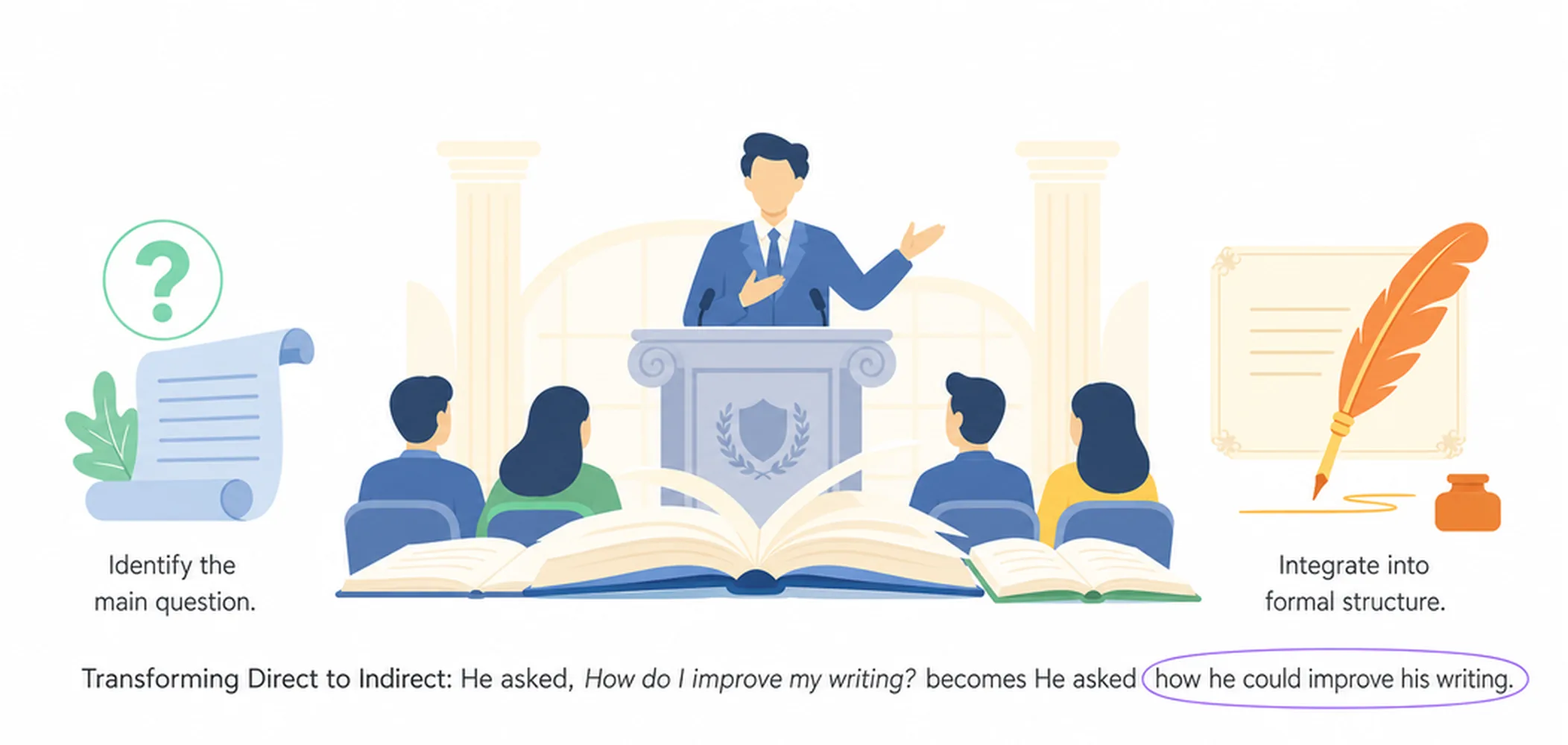
What are indirect questions?
An indirect question is a polite way to ask someone something. Instead of asking directly, you report the question as part of a statement. In formal writing, indirect questions are more polite and professional. They are common in emails, letters, and official communication. For example, instead of saying "Where is the office?", you can say "Could you tell me where the office is?"
How to form indirect questions
To form an indirect question, you need an introductory phrase like "Could you tell me...", "I would like to know...", or "Could you help me find out...". Then you add the question information, but you use statement word order (not question word order). This means the subject comes before the verb. The indirect question does not use a question mark at the end unless the whole sentence is a question.
Indirect questions vs. direct questions
In a direct question, the verb often comes before the subject: "Where is the meeting?" But in an indirect question, the subject comes before the verb: "Could you tell me where the meeting is?" Remember: indirect questions sound more formal and polite. They are better for business writing, formal emails, and professional requests.
Indirect Questions in Formal vs. Informal Writing
| Aspect | Direct (Informal) Question | Indirect (Formal) Question |
|---|---|---|
| Form | Auxiliary verb or question word placed at the beginning; subject–verb inversion; ends with a question mark. | Introduced by a polite phrase or clause; no subject–verb inversion in the embedded question; declarative word order is maintained. |
| When to use | Casual conversations, messages between friends or close colleagues, quick verbal exchanges where formality is unnecessary. | Formal emails, official correspondence, business letters, academic writing, requests to superiors, clients, or strangers. |
| Positive example | "When does the meeting start?" | "Could you please tell me when the meeting starts?" |
| Negative example | "Why hasn't the report been submitted?" | "I would be grateful if you could explain why the report has not been submitted." |
| Yes/No question example | "Is the deadline flexible?" | "I was wondering whether the deadline is flexible." / "Could you advise me as to whether the deadline is flexible?" |
| Wh- question example | "Where do I send the invoice?" | "I would like to know where I should send the invoice." |
| Key signal words / phrases | Who, what, where, when, why, how, do, does, did, is, are, can, will — placed at the front of the sentence. | "Could you tell me…", "I was wondering…", "I would like to know…", "Would you be able to confirm…", "I would be grateful if you could clarify…", "whether / if" (for yes/no), "I wonder if you might…" |
| Punctuation | Always ends with a question mark (?). | Often ends with a full stop (.) when the introductory clause is a statement; a question mark is used only when the introductory clause is itself a direct question (e.g., "Could you tell me…?"). |
| Word order inside the question | Inverted: auxiliary before subject — e.g., "does he know", "is the office open". | Normal declarative order: subject before verb — e.g., "whether he knows", "where the office is". |
| Tone & register | Direct, efficient, and potentially abrupt; appropriate among equals in informal settings but may seem rude or demanding in professional contexts. | Polite, respectful, and deferential; signals professionalism and consideration for the reader; reduces the perceived imposition of the request. |
| Key Difference: The core distinction between direct and indirect questions lies in both structure and tone. Direct questions use subject–verb inversion and stand alone, making them efficient but potentially blunt. Indirect questions embed the question inside a polite introductory phrase, restore normal declarative word order, and soften the request — making them the preferred choice in formal writing contexts such as business emails, official letters, and academic correspondence. Mastering this shift is essential for any writer who needs to convey professionalism and courtesy while still requesting information clearly. | ||
Examples






What to Remember
- Use an introductory phrase like "Could you tell me..." or "I would like to know..." to start indirect questions.
- Indirect questions use statement word order, not question word order, so the verb comes after the subject.
- Add "if" or "whether" when asking yes/no questions indirectly: "I wonder if you could help me."
- Indirect questions end with a period, not a question mark, because they are statements, not direct questions.
- Indirect questions are more polite and professional than direct questions in formal writing like emails and letters.