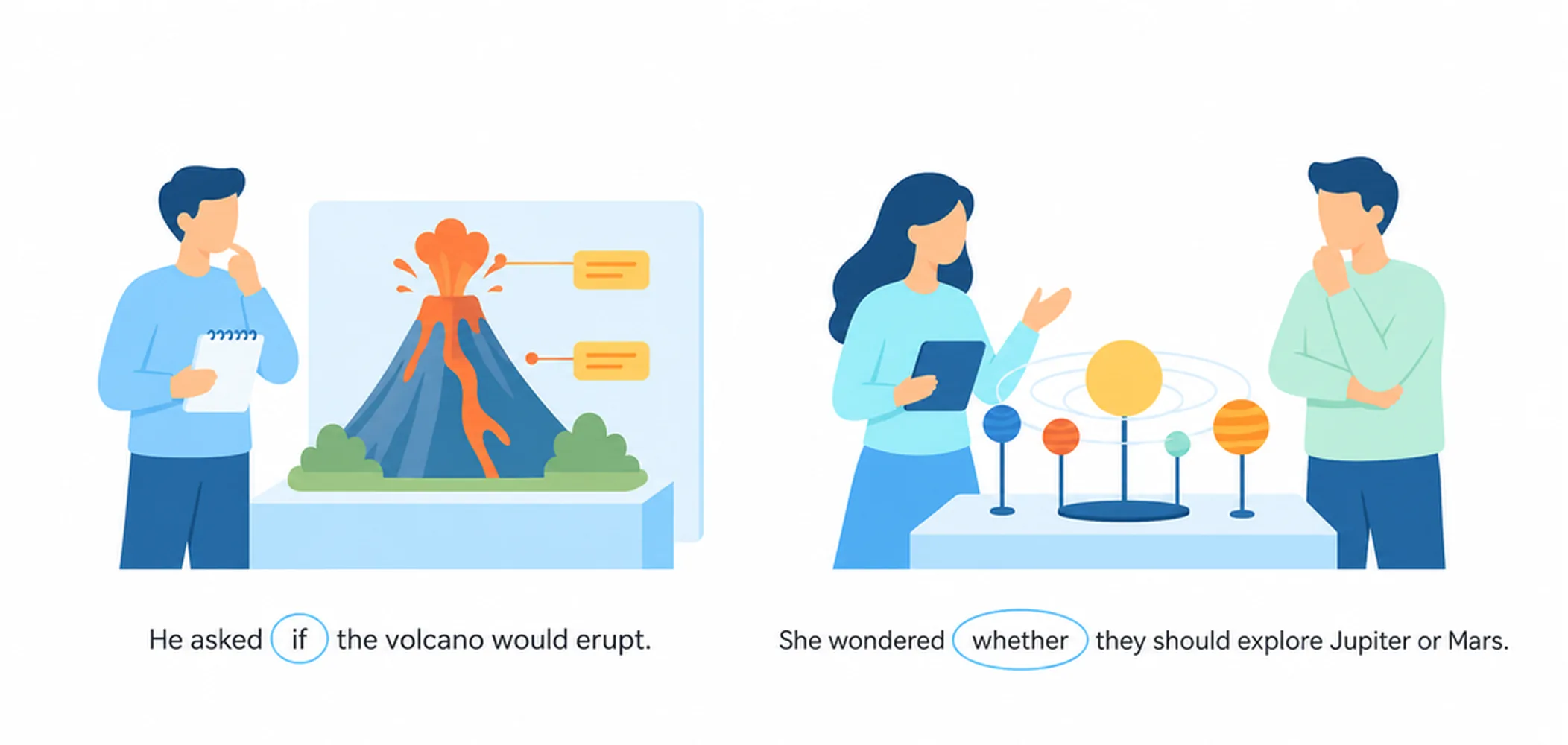
What are indirect questions?
An indirect question is a polite way to ask for information. Instead of asking directly, you report the question inside another sentence. For example, instead of asking "Do you like coffee?", you can say "I want to know if you like coffee." Indirect questions are more polite and natural in conversation.
How to use 'if' and 'whether'
Use 'if' or 'whether' to introduce an indirect question about yes/no questions. Both words have the same meaning. The word order in the indirect question is important: it must be normal word order (subject + verb), not question word order. For example: "Do you speak English?" becomes "I want to know if you speak English." Notice the subject 'you' comes before the verb 'speak'.
The difference between 'if' and 'whether'
In A2 level English, 'if' and 'whether' are usually the same in meaning and both are correct. However, 'whether' is slightly more formal. You can use either one in most situations. Remember: the word order stays the same, and you do NOT use a question mark at the end of an indirect question—use a period instead.
If vs Whether: Side-by-Side Comparison
| Dimension | IF | WHETHER |
|---|---|---|
| Form | Conjunction used to introduce an indirect yes/no question. Typically followed by a subject + verb. | Conjunction used to introduce an indirect yes/no question, often in more formal or written contexts. Can be followed by a subject + verb or by an infinitive phrase. |
| Formality Level | Informal to neutral. More common in everyday spoken English. | Neutral to formal. More common in written, academic, and professional contexts. |
| When to Use |
• After verbs like ask, wonder, know, find out, tell • In informal speech and writing • When the sentence does not begin with the indirect question |
• After verbs like ask, wonder, know, decide, discuss, consider • As the subject of a sentence • After prepositions • Before infinitives (to + verb) • In formal writing and academic contexts |
| Followed by "or not" |
✅ Can be used with "or not" but only at the end of the clause. ❌ Cannot be used as "if or not" directly after if. Example: I don't know if she's coming or not. |
✅ Can be used with "or not" both immediately after whether and at the end of the clause. Example: I don't know whether or not she's coming. Example: I don't know whether she's coming or not. |
| Positive Example | She asked if I wanted some coffee. | She asked whether I wanted some coffee. |
| Negative Example | I don't know if he isn't telling the truth. | I don't know whether he isn't telling the truth. |
| Question Example |
❌ Cannot begin a sentence as a subject. ❌ If she will attend is unknown. (incorrect) |
✅ Can begin a sentence as a subject. ✅ Whether she will attend is still unknown. (correct) |
| After a Preposition |
❌ Cannot follow a preposition. ❌ There is doubt about if it works. (incorrect) |
✅ Can follow a preposition. ✅ There is doubt about whether it works. (correct) |
| Before an Infinitive |
❌ Cannot precede an infinitive (to + verb). ❌ I didn't know if to call him. (incorrect) |
✅ Can precede an infinitive (to + verb). ✅ I didn't know whether to call him. (correct) |
| Key Signal Words / Verbs | ask, wonder, know, check, find out, tell, see — used mainly in informal registers. | ask, wonder, know, decide, consider, discuss, determine, doubt, debate — used in both formal and informal registers. |
| 🔑 Key Difference: Both if and whether can introduce indirect yes/no questions and are often interchangeable after reporting verbs (e.g., ask, know, wonder). However, whether is the only correct choice when it: (1) begins a sentence as the subject, (2) follows a preposition, or (3) precedes an infinitive (whether to do). Additionally, only whether can be immediately followed by or not (whether or not), while if … or not requires or not at the end of the clause. In formal writing, whether is generally preferred over if in all indirect question contexts. | ||
Examples






What to Remember
- Indirect questions are polite ways to ask for information by reporting the question inside another sentence.
- Use 'if' or 'whether' to introduce an indirect question about yes/no questions; both words mean the same.
- Always use normal word order in indirect questions, not inverted question word order.
- An indirect question ends with a period, not a question mark.
- Example: "Do you like coffee?" becomes "I want to know if you like coffee."