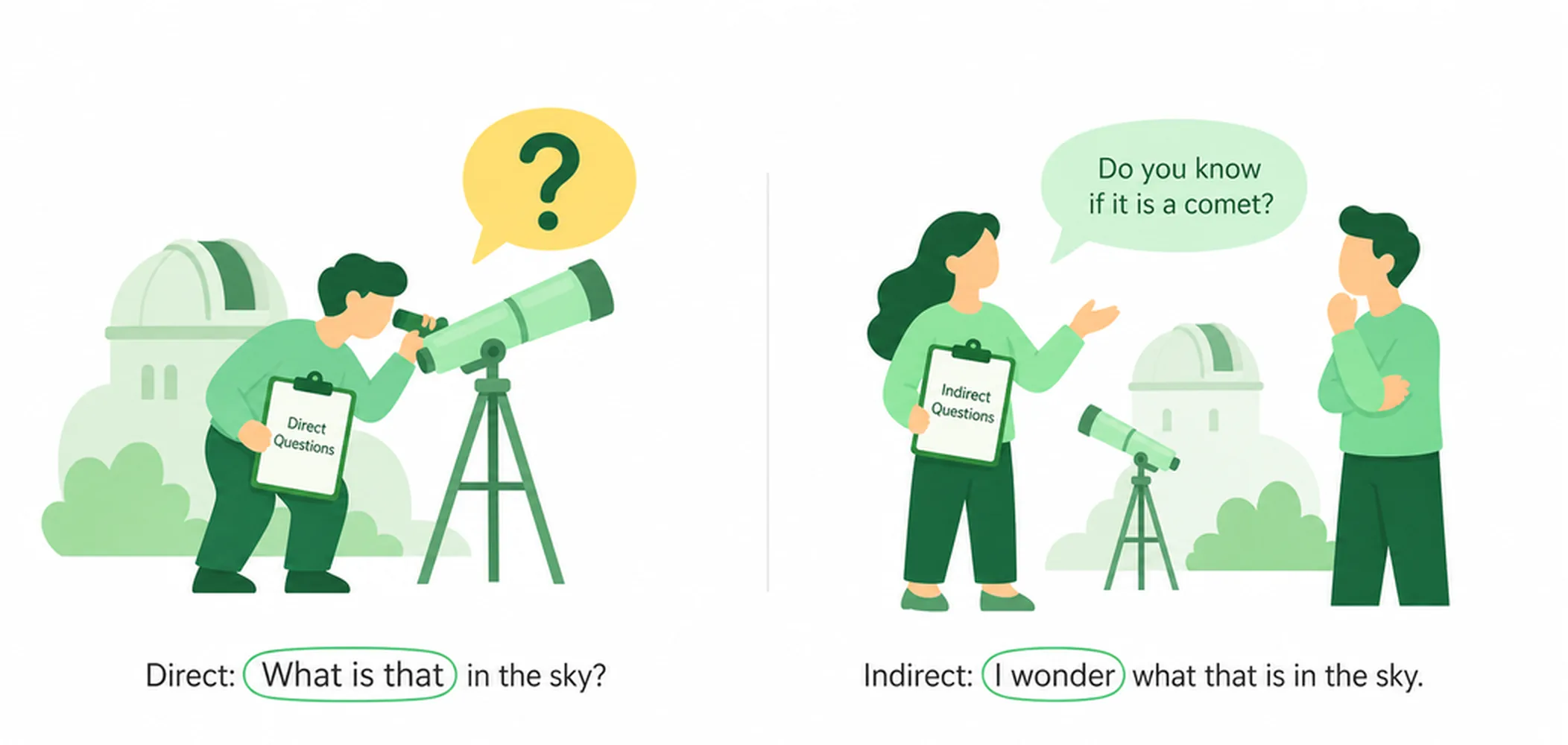
What are indirect questions?
Indirect questions are polite ways to ask for information. Instead of asking directly, you embed the question inside a statement. The word order changes: you use statement word order (subject + verb) instead of question word order (verb + subject). This is common in polite conversations and formal situations.
How to Form an Indirect Question: Step-by-Step
An indirect question (also called reported question) is a question embedded within a statement or larger sentence. Unlike direct questions, which use question word order, indirect questions follow statement word order and are typically introduced by verbs like ask, wonder, want to know, or inquire.
Direct question: "Where is the station?"
Indirect question: "Could you tell me where the station is?"
Start by choosing your reporting verb (ask, wonder, want to know, inquire, etc.) and decide when the question is being asked relative to the main clause. This determines whether you shift the verb tense in the embedded question.
If the reporting verb is in the past tense, shift the verb tense in the indirect question one step back (present becomes past, past becomes past perfect, etc.). If the reporting verb is in the present tense, keep the original tense.
Change the word order from inverted question form to normal statement order. Remove the question mark and use appropriate punctuation.
"Do you live in London?"
"She asked if I lived in London."
Use the correct connector to introduce the embedded question. Yes/no questions use "if" or "whether," while questions with question words (where, what, who, when, why, how) keep those words.
| Question Type | Connector | Example |
|---|---|---|
| Yes/No questions | if / whether | "He asked whether she would come." / "I wonder if they know." |
| Questions with question words | Keep the question word | "Can you tell me where the library is?" / "She wants to know how you did it." |
If your reporting verb is in the past tense, adjust the verb tense in the indirect question. Present tenses shift to past, past tenses shift to past perfect. Present perfect, past perfect, and conditionals often remain unchanged.
| Original Tense | Reporting Verb in Past | Example |
|---|---|---|
| Present Simple | Past Simple | Direct: "Where do you work?" / Indirect: "He asked where I worked." |
| Present Continuous | Past Continuous | Direct: "What are you doing?" / Indirect: "She wondered what I was doing." |
| Present Perfect | Past Perfect | Direct: "Have you finished?" / Indirect: "They asked if I had finished." |
| Past Simple | Past Perfect | Direct: "When did you arrive?" / Indirect: "He inquired when I had arrived." |
| Future (will) | Would | Direct: "Will you help?" / Indirect: "She wanted to know if I would help." |
Review your indirect question to ensure it preserves the original meaning and maintains grammatical consistency. Verify that pronouns are adjusted if necessary (I becomes he/she, you becomes they, etc.) and that the overall sentence flows naturally.
Direct: "Where are you going?"
Direct: "Did the train arrive on time?"
Examples





What to Remember
- Indirect questions embed a question inside a statement to be more polite.
- Change word order from question form (verb + subject) to statement form (subject + verb).
- Use a question word (what, where, why, how) or "if/whether" to introduce the indirect question.
- End indirect questions with a period, not a question mark.
- Remember: the embedded question uses statement word order even though it asks for information.