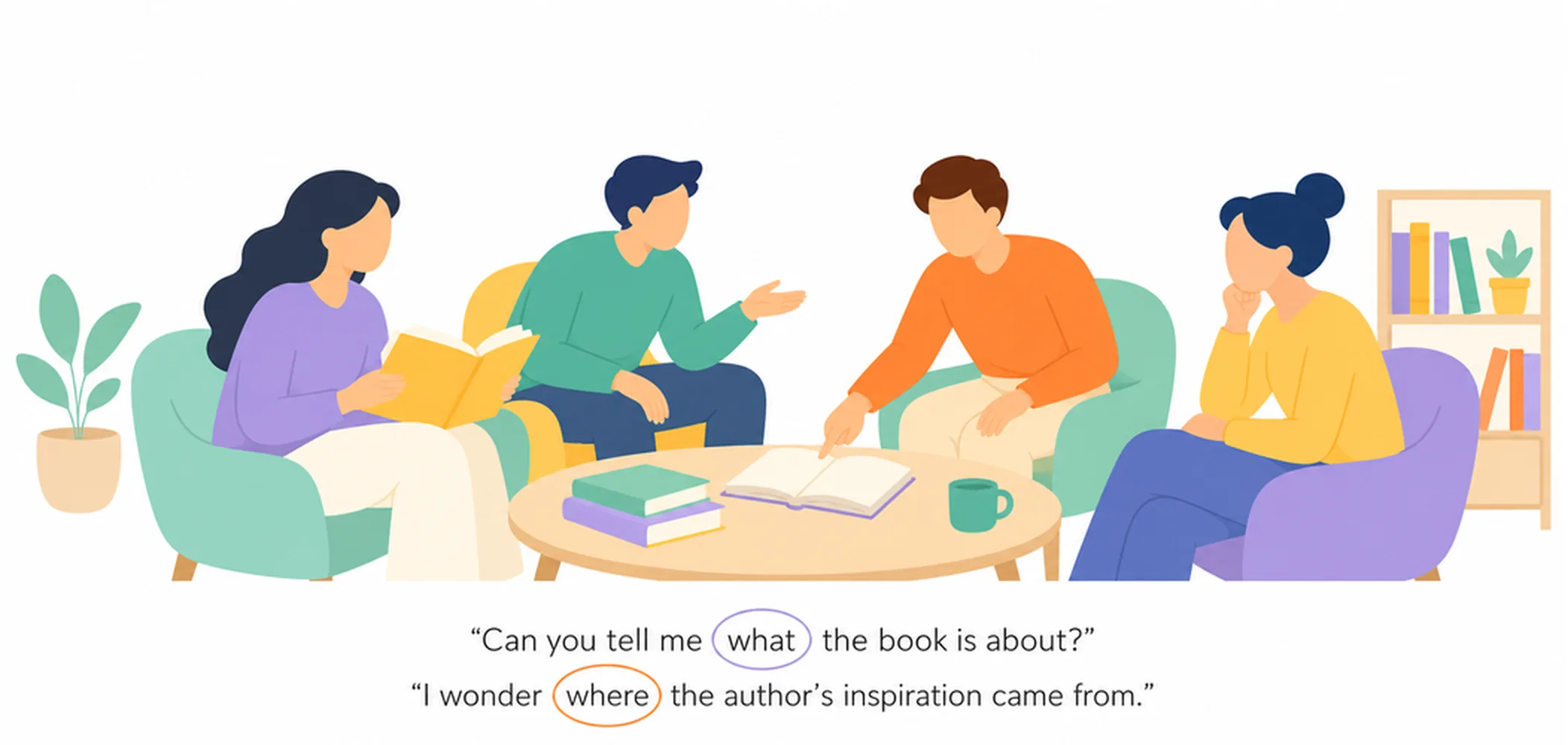
What are indirect questions?
An indirect question is a polite way to ask for information. Instead of using question word order, we embed the question inside a statement. Indirect questions are softer and more polite than direct questions. We often use them in formal situations or with people we don't know well.
Direct vs. Indirect Questions
A direct question uses question word order: "Where is the bathroom?" An indirect question uses statement word order: "Could you tell me where the bathroom is?" Notice that in indirect questions, the subject comes before the verb, just like in normal sentences. This word order change makes the question sound more polite and less demanding.
How to form indirect questions
To make an indirect question, start with an introductory phrase like "Could you tell me...?" or "Do you know...?" Then add the question (using statement word order, not question word order). Use a question mark at the end. Common introductory phrases are: "Could you tell me...", "Do you know...", "Can you help me...", "I'd like to know...", and "Could you please tell me..."
Direct vs. Indirect Questions: Side-by-Side Comparison
| Feature | Direct Questions | Indirect Questions |
|---|---|---|
| Form | Auxiliary/modal verb + subject + main verb (inverted word order) |
Introductory phrase + question word / if / whether + subject + verb (normal statement word order) |
| When to Use | Casual conversations, close friends, straightforward requests where directness is appropriate | Formal situations, polite requests, speaking to strangers, authority figures, or in professional/written contexts |
| Yes/No Question Example | "Is the bank open on Saturdays?" | "Could you tell me if the bank is open on Saturdays?" |
| Wh- Question Example | "Where does she live?" | "Do you know where she lives?" |
| What / Which Example | "What time does the train leave?" | "I was wondering what time the train leaves." |
| How Question Example | "How much does this cost?" | "Could you tell me how much this costs?" |
| Word Order | Inverted: auxiliary verb comes before the subject "Did he arrive?" |
Normal (SVO): subject comes before the verb "Do you know if he arrived?" |
| Use of "Do / Does / Did" | Required as an auxiliary to form the question "Did they finish?" |
Dropped inside the indirect clause; verb conjugated normally "Do you know if they finished?" |
| Punctuation | Always ends with a question mark (?) | Ends with a question mark if the introductory phrase is a question; ends with a full stop (.) if it is a statement (e.g., "I was wondering…") |
| Introductory Phrases | None — the question stands alone | "Could you tell me…", "Do you know…", "I'd like to know…", "I was wondering…", "Would you mind telling me…", "Can you explain…" |
| Linking Words | None needed | if / whether (for yes/no questions); the original wh- word (for wh- questions) |
| Register / Tone | Neutral to informal; can sound blunt or impolite in formal contexts | Polite, formal, and softened; conveys respect and consideration for the listener |
| 🔑 Key Difference: The fundamental distinction between direct and indirect questions lies in word order and register. Direct questions use inverted word order (auxiliary + subject) and are grammatically straightforward but can sound abrupt. Indirect questions embed the question inside a polite introductory phrase, restore normal subject-verb order, drop auxiliary "do/does/did," and use if/whether or a wh- word as a connector — making them more appropriate for formal, professional, and polite interactions. | ||
Examples






What to Remember
- Use indirect questions to ask politely by embedding questions within statements.
- Change question word order to statement word order in indirect questions.
- Start indirect questions with polite phrases like "Could you tell me" or "Do you know."
- Place the subject before the verb in indirect questions, not after.
- Add a question mark at the end of indirect questions, not a question mark after the embedded question.